Planning a holiday in Sardinia but worried about the language barrier? The good news is that you can visit Sardinia without speaking fluent Italian, particularly if you stay in established tourist destinations. English is used in many hotels, organised tours and visitor-facing businesses. But once you leave the main resorts, it helps to know a little Italian—and to understand that Sardinia also has its own remarkable linguistic heritage.
Do people in Sardinia speak English?
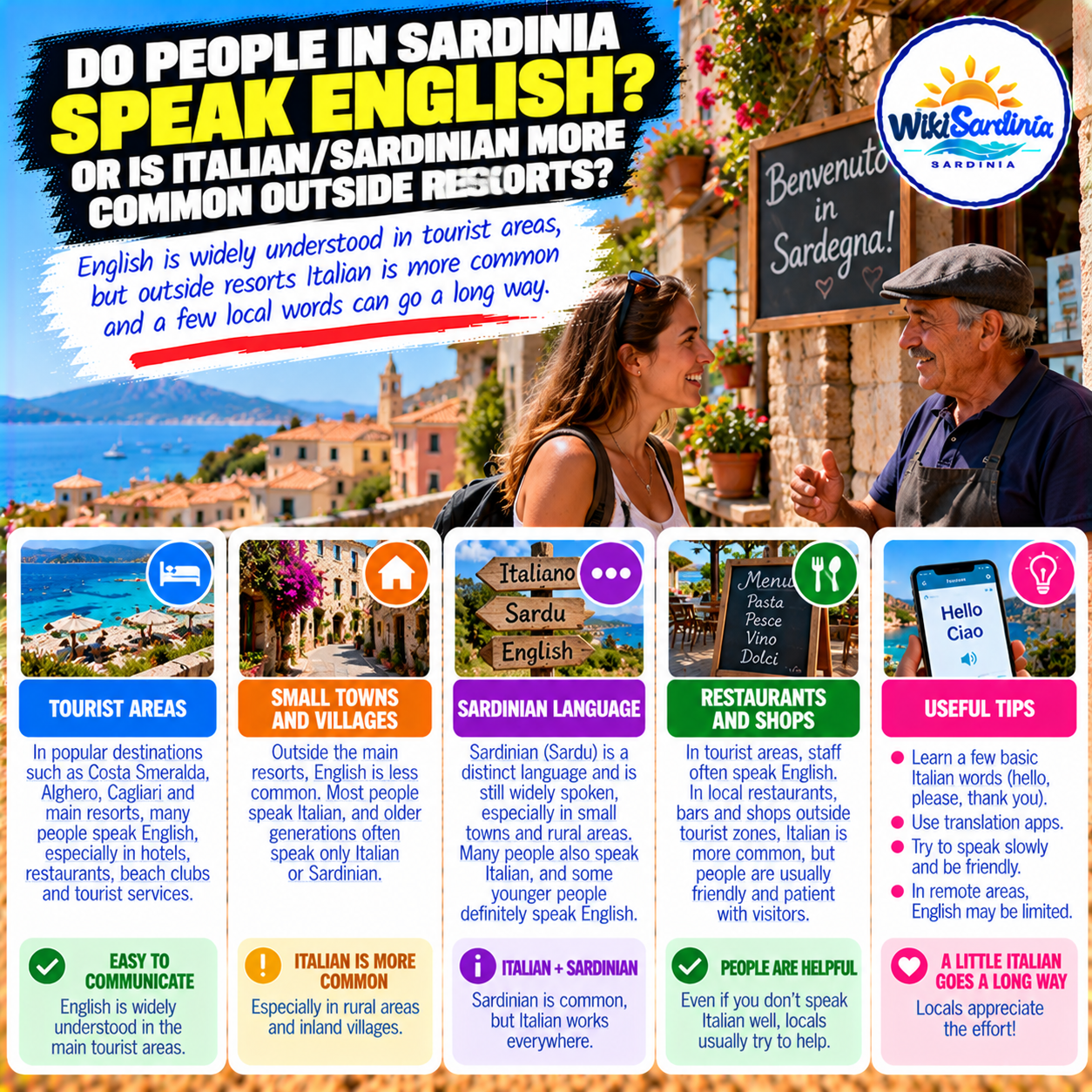
Some do, especially people who work with international visitors. In places such as Alghero, Cagliari, Olbia and the Costa Smeralda, travellers may find English-speaking reception staff, tour guides and restaurant workers. That does not mean everyone in those destinations speaks English, or that every business provides an English-language service.
Language ability varies from person to person, between generations and by workplace. It is better to expect that English may be available in tourist-facing settings than to assume it will be understood everywhere.
What language is spoken most in Sardinia?
Italian is the common language of public life across Sardinia. It is used in schools, most administration, road signs, national media and everyday interactions between people with different local language backgrounds. If you learn a few Italian expressions before your trip, they will be useful almost everywhere on the island.
Sardinia is also home to Sardinian, often called sardu, a Romance language with its own history and linguistic characteristics. It is not simply “bad Italian” or an Italian accent. Sardinian has regional varieties, and the island's linguistic landscape is more complex than a single Italian-versus-Sardinian distinction.
Is Sardinian still spoken?
Yes, Sardinian continues to be spoken in many communities and is an important part of the island's cultural identity. However, it would be inaccurate to claim that everyone in Sardinia speaks it, or that older residents speak only Sardinian. Many people use Italian, Sardinian or both in different situations, and language use varies by family, locality and generation.
There are also other historic languages and varieties on the island, including Catalan in Alghero, Gallurese in the northeast, Sassarese in the northwest and Tabarchino Ligurian in communities such as Carloforte. Their linguistic classification and relationship to Sardinian are distinct subjects in their own right.
Will I be able to communicate in Alghero?
Alghero is a popular international destination with a historic centre, beaches, restaurants and organised activities. English may be available in accommodation and tourism services, although it is not guaranteed at every small shop or café. Italian is a reliable language to use, and visitors may also encounter Algherese Catalan in local cultural contexts, signage and community life.
If you are staying in the old town, a friendly greeting and a few basic Italian words can make everyday interactions easier even when staff speak some English.
What about Cagliari, Olbia and Costa Smeralda?
In Cagliari and Olbia, you are likely to find English in some hotels, visitor attractions and businesses serving tourists. Costa Smeralda resorts also cater to international travellers, so multilingual service can be part of the hospitality experience. However, these are not English-speaking cities in the same sense as destinations where English is an official or dominant language.
Outside tourist services—at a pharmacy, a small neighbourhood shop, a local bus stop or a government office—Italian may be more useful.
Is English less common in small villages?
It can be. In rural and inland communities, there may be fewer businesses that regularly serve foreign visitors. Some residents may be comfortable in English; others may not. The difference is not a measure of friendliness or hospitality. It simply reflects everyday language needs and individual experience.
Approach conversations patiently. Speaking slowly in simple Italian, showing a written address or using a translation app can help. Avoid raising your voice or assuming that speaking louder in English will make you easier to understand.
Will restaurant menus be in English?
In popular tourist areas, bilingual or multilingual menus are common enough to be useful, but not universal. Smaller family-run restaurants may offer only Italian menus, handwritten specials or dishes described verbally. This is a good opportunity to learn a few food terms.
For example, pesce means fish, carne means meat, formaggio means cheese and senza means without. If you have a food allergy, do not rely on a rough translation alone. Carry a clearly written allergy explanation in Italian and confirm ingredients with the restaurant.
Useful Italian phrases for travelling in Sardinia
- Buongiorno — Good morning / good day.
- Buonasera — Good evening.
- Per favore — Please.
- Grazie — Thank you.
- Scusi — Excuse me.
- Parla inglese? — Do you speak English?
- Non parlo bene italiano — I don't speak Italian well.
- Quanto costa? — How much does it cost?
- Dov'è la fermata dell'autobus? — Where is the bus stop?
- Il conto, per favore — The bill, please.
These phrases are standard Italian and can be understood across Sardinia. You do not need to learn a particular Sardinian variety to have a successful holiday, although showing interest in local words and culture is always welcome.
Can translation apps help?
Yes. Translation apps can help with menus, accommodation messages, transport notices and simple conversations. Download offline language packs before visiting remote areas where mobile coverage may be weak. Be aware that automatic translation can struggle with local dialects, Sardinian varieties and culturally specific expressions.
For important matters—medical instructions, legal documents, allergies or emergency information—seek reliable professional assistance rather than depending solely on a machine translation.
Do road signs use Sardinian or Italian?
Official road information is generally presented in Italian, and visitors may also encounter local-language place names or bilingual signs. Sardinia's place-name traditions reflect its linguistic diversity, but navigation is usually straightforward using the names shown on road signs and mapping services.
Some locations have names that differ between Italian and a local language. If a destination appears under two names, check the municipality and exact location rather than assuming they are different places.
Is Sardinian the same as Italian?
No. Sardinian is a distinct Romance language, with features that developed differently from standard Italian. It is often discussed as one of the more distinctive Romance languages, although individual varieties and the island's multilingual history make simple labels incomplete. Italian and Sardinian can influence one another in everyday speech, but they should not be treated as interchangeable.
For visitors, the key point is that Italian is widely useful for communication, while Sardinian and other local languages are part of the island's living cultural heritage.
What if I speak only English?
You can still enjoy Sardinia. Choose accommodation with clear communication, book transport and activities through reliable channels, and keep essential information—such as hotel addresses and reservation details—available in writing. A little preparation goes a long way, especially if you plan to explore inland villages rather than stay exclusively in resort areas.
Most importantly, remember that an unfamiliar language is part of travelling somewhere with its own identity. A smile, patience and a sincere attempt at “buongiorno” can make an interaction more pleasant for everyone.
The verdict
English is useful in many tourist-facing businesses in Sardinia, but Italian is the safest everyday language across the island. Sardinian remains an important distinct language, alongside other local linguistic traditions, though usage varies greatly. You do not need fluent Italian for a holiday, but a few phrases and an offline translation app will make independent travel much easier—especially outside the main resorts.