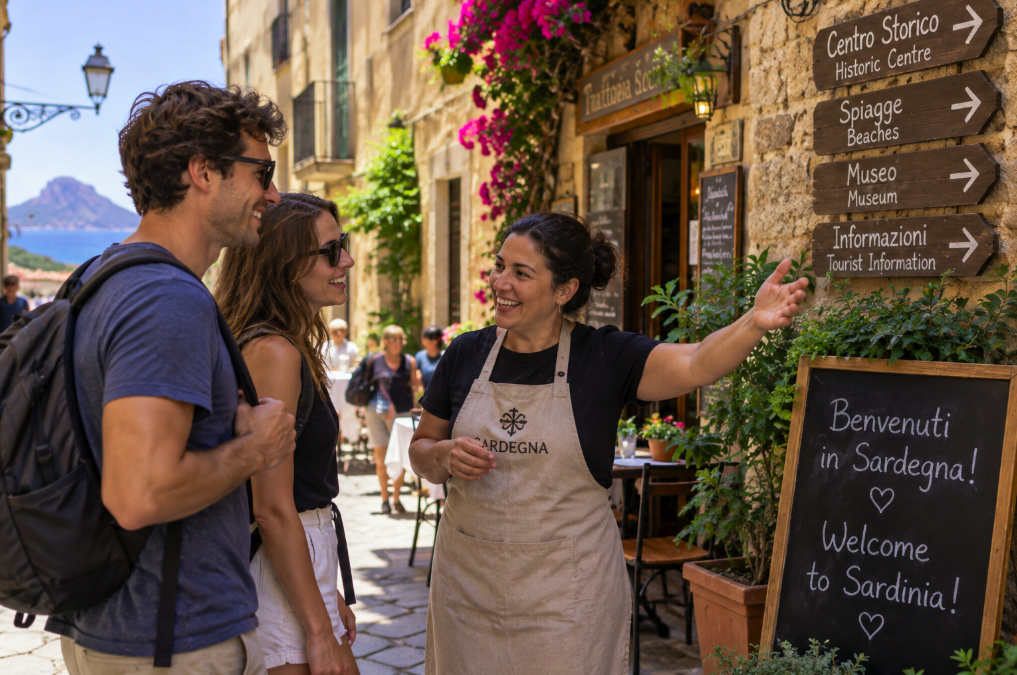
Yes, you can travel around Sardinia without speaking Italian. English is commonly encountered in the island’s tourism industry, especially at hotels, resorts, organized tours, rental-car desks and other services used regularly by international visitors. But Sardinia is not an English-speaking destination, and once you leave the main tourist areas you should not expect everyone you meet to be comfortable having a full conversation in English.
For American travelers wondering whether language should stop them from booking a Sardinian holiday, the practical answer is no. Sardinia receives a substantial international tourism flow: official regional statistics recorded more than 2.37 million foreign arrivals in 2024, accounting for more than half of all arrivals that year. Visitors from the United Kingdom alone generated more than 713,000 overnight stays. The island’s tourism infrastructure is therefore accustomed to welcoming people who do not speak Italian.
Where is English easiest to use?
English is most likely to be useful in places with a strong international tourism economy. That includes destinations such as Alghero, Olbia and the Costa Smeralda, as well as many hotels and tourism businesses around Cagliari, Villasimius and other established coastal resorts.
At accommodation properties used by international guests, it is reasonable to find staff able to handle basic check-in questions, bookings and practical requests in English, although this should not be interpreted as a guarantee for every individual property or employee. The same applies to professional tourism services. Regional rules for some tourism professions include formal foreign-language requirements; for example, current regional information for travel-agency technical directors refers to certification in two foreign languages, including English at B2 level or above.
Restaurant experiences vary more. In heavily visited areas, menus may be translated and staff may speak some English. In a small family trattoria or a bar in an inland village, communication may be mostly in Italian. This rarely makes ordering impossible: pointing at a menu, asking simple questions and using a translation app can cover a surprising amount of ground.
Italian, Sardinian and other local languages
Italian is the language an international visitor should treat as the everyday common language of Sardinia. At the same time, the island has a rich linguistic identity of its own. Sardinian is protected by Italian and regional legislation, and several other historical linguistic varieties are present in particular areas.
For travelers, Alghero is especially interesting because of its Catalan linguistic heritage. In other parts of the island you may hear Sardinian varieties in conversation, particularly among local residents. Gallura and Sassari also have their own distinctive linguistic traditions.
You do not need to learn these languages to travel around the island. A visitor trying to communicate should normally begin with Italian rather than assuming that a local language is appropriate everywhere. Learning that Sardinia is linguistically more complex than simply “Italy, therefore Italian,” however, adds useful cultural context to a trip.
When English becomes less reliable
The biggest difference is usually between tourism-facing situations and ordinary daily life. At an international hotel in Olbia, communicating in English may be routine. At a village bakery, pharmacy, petrol station or small agricultural business away from the main visitor routes, English ability can range from fluent to almost none.
This matters more if you plan to explore rural Sardinia, hike independently, stay in small agriturismi or visit villages in the interior. A few Italian words, offline maps and a translation app are sensible preparation. If you have an important dietary allergy or medical requirement, keep the relevant information written clearly in Italian rather than relying on spontaneous translation.
Driving also reduces the language problem considerably. Road signs follow standard Italian and European conventions, and navigation apps make getting around straightforward. What can be harder is an unexpected situation — asking about parking restrictions, explaining a problem with a rental car or finding out why a rural road is temporarily closed. Those are the moments when basic Italian or a translation tool becomes particularly useful.
A few Italian phrases make a difference
You do not need a phrasebook memorized before arriving, but several expressions are worth knowing. Buongiorno means good morning or good day; buonasera is good evening; per favore means please; grazie means thank you; and parla inglese? is the simple question “Do you speak English?”
For directions, dov’è…? means “where is…?” while il conto, per favore asks for the bill in a restaurant. Even when the conversation immediately switches to English, opening with a greeting in Italian is an easy and courteous habit.
Downloading Italian for offline use in a translation app is also worthwhile, particularly if your itinerary includes beaches with weak mobile reception, mountain areas or smaller villages. Save the address of your accommodation and any important booking information rather than depending entirely on a live connection.
Should language worries change your Sardinia plans?
For most visitors, no. An English-speaking traveler can realistically book accommodation, rent a car, eat out and visit Sardinia’s major destinations without becoming fluent in Italian first. The experience simply becomes easier — and often friendlier — if you accept that English will not work perfectly everywhere.
That is especially true outside the summer resort environment. Sardinia is a real island with towns, farms and villages where daily life is conducted primarily for residents rather than tourists. The occasional language gap is part of travelling independently, not a sign that the destination is inaccessible.
So if “Do people in Sardinia speak English?” is the final concern before clicking the booking button, it should not be a deal-breaker. Expect enough English to manage in most tourism settings, bring a translation app for the gaps, learn five or six Italian phrases and treat any Sardinian words you encounter as an invitation to understand a little more about the island itself.