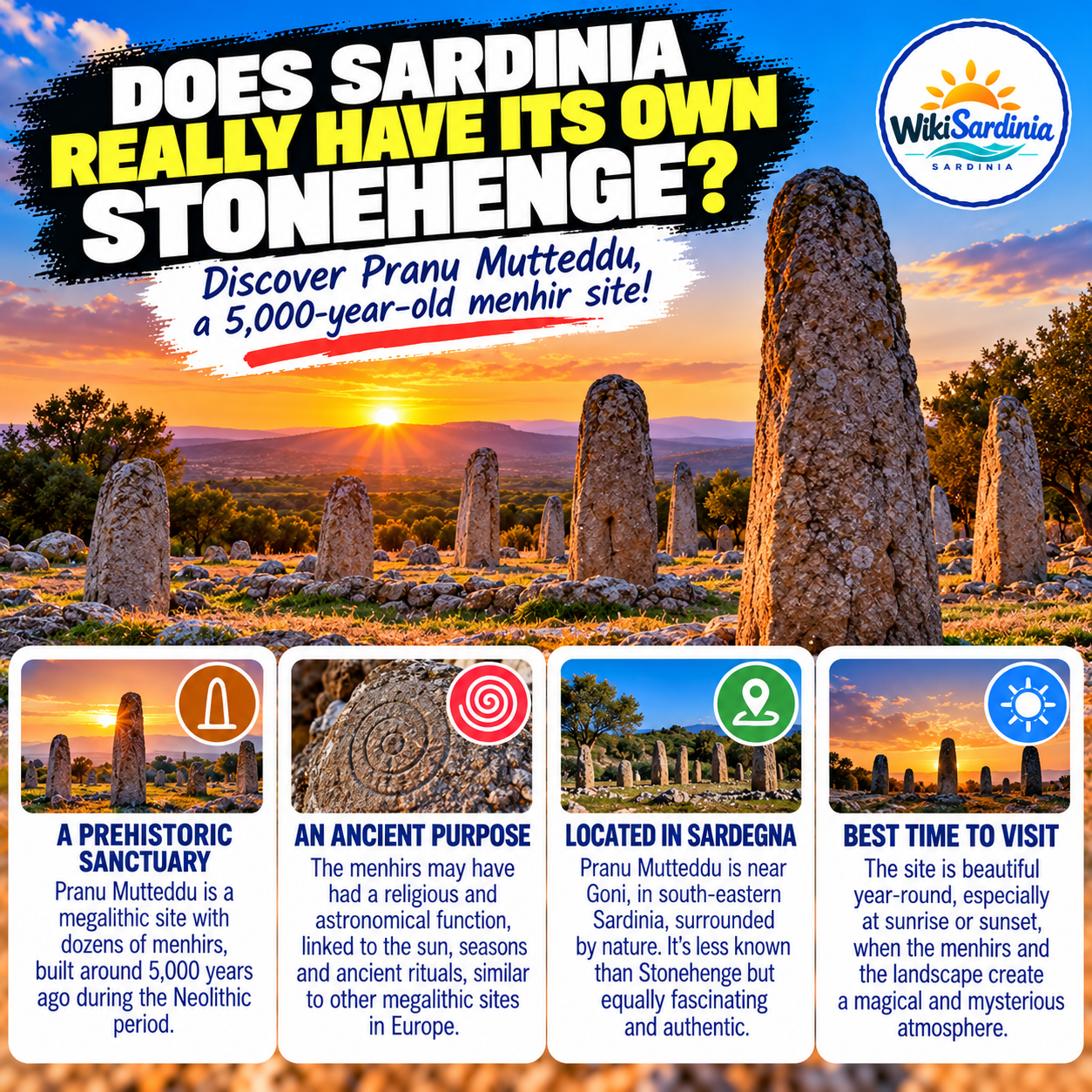
Does Sardinia really have its own Stonehenge? Yes—at least in the sense that the island has an extraordinary landscape of prehistoric standing stones. Near the village of Goni, in southern Sardinia, the archaeological park of Pranu Mutteddu is regularly nicknamed the “Sardinian Stonehenge.” But this comparison is an invitation to discover a distinctive Sardinian prehistoric site, not a claim that it is a replica of the famous English monument.
Where is Sardinia's Stonehenge?
Pranu Mutteddu lies in the Gerrei area, along provincial road SP23 near Goni. The archaeological park extends across approximately 200,000 square metres of countryside with oak trees and Mediterranean vegetation. Among its most striking features are around 60 menhirs: upright stone monuments standing singly, in pairs and in alignments. According to Italy's Ministry of Culture, this is the highest known concentration of menhirs on the island.
How old are the standing stones?
The site has a long and complex prehistoric history. Excavations directed by archaeologist Enrico Atzeni linked significant parts of the complex to Sardinia's Late Neolithic Ozieri culture, commonly dated to around 3200–2800 BC. The Ministry of Culture's heritage catalogue gives a wider archaeological chronology, from approximately 4100 to 2300 BC. Consequently, describing the entire group as being precisely “5,000 years old” is a useful approximation rather than a date established for every stone.
What were the menhirs used for?
The stones are part of a much larger ritual and funerary landscape, including monumental tombs, burial chambers and concentric stone structures made from local sandstone. Some menhirs stand near the graves, while others form distinctive lines. Their position alongside tomb architecture suggests symbolic, ceremonial and funerary functions, potentially connected with the remembrance of ancestors. Yet the beliefs and ceremonies of the people who erected them cannot be reconstructed with certainty.
Is it the same as Stonehenge in England?
No. Both places reveal the impressive monument-building traditions of prehistoric communities, but their architectural forms, cultural settings and histories differ. Stonehenge is known for its monumental circular arrangements and lintelled stones. Pranu Mutteddu is particularly remarkable for its many upright menhirs spread through a landscape that also contains prehistoric tombs. The nickname “Sardinian Stonehenge” captures the atmosphere, but the site's real importance lies in its own archaeology.
What can visitors see at Pranu Mutteddu?
Walking among the stone alignments, visitors can observe differently shaped menhirs, stone-built tombs and shaded clearings. The setting is quieter and more rural than Sardinia's famous beaches, making it a rewarding stop for travelers interested in archaeology, landscapes and the island's pre-Nuragic past. Plan time to explore the wider complex rather than simply photograph one row of stones, and treat the ancient structures with care.
How to visit
Look for Parco Archeologico di Pranu Mutteddu, Goni, on SP23 in southern Sardinia. Check current opening times, guided visits and ticket conditions directly with the site before leaving: these can change, and published institutional listings do not always reflect the day's availability. Comfortable walking shoes and water are sensible for exploring the outdoor setting.
The verdict: does Sardinia have its own Stonehenge?
Yes, as a memorable nickname—but Pranu Mutteddu is an important prehistoric monument in its own right. Its roughly 60 standing stones and remarkable burial architecture tell a story that reaches back thousands of years, long before the island's famous nuraghi. If you want to discover a less expected side of Sardinia, this is a fascinating place to start.