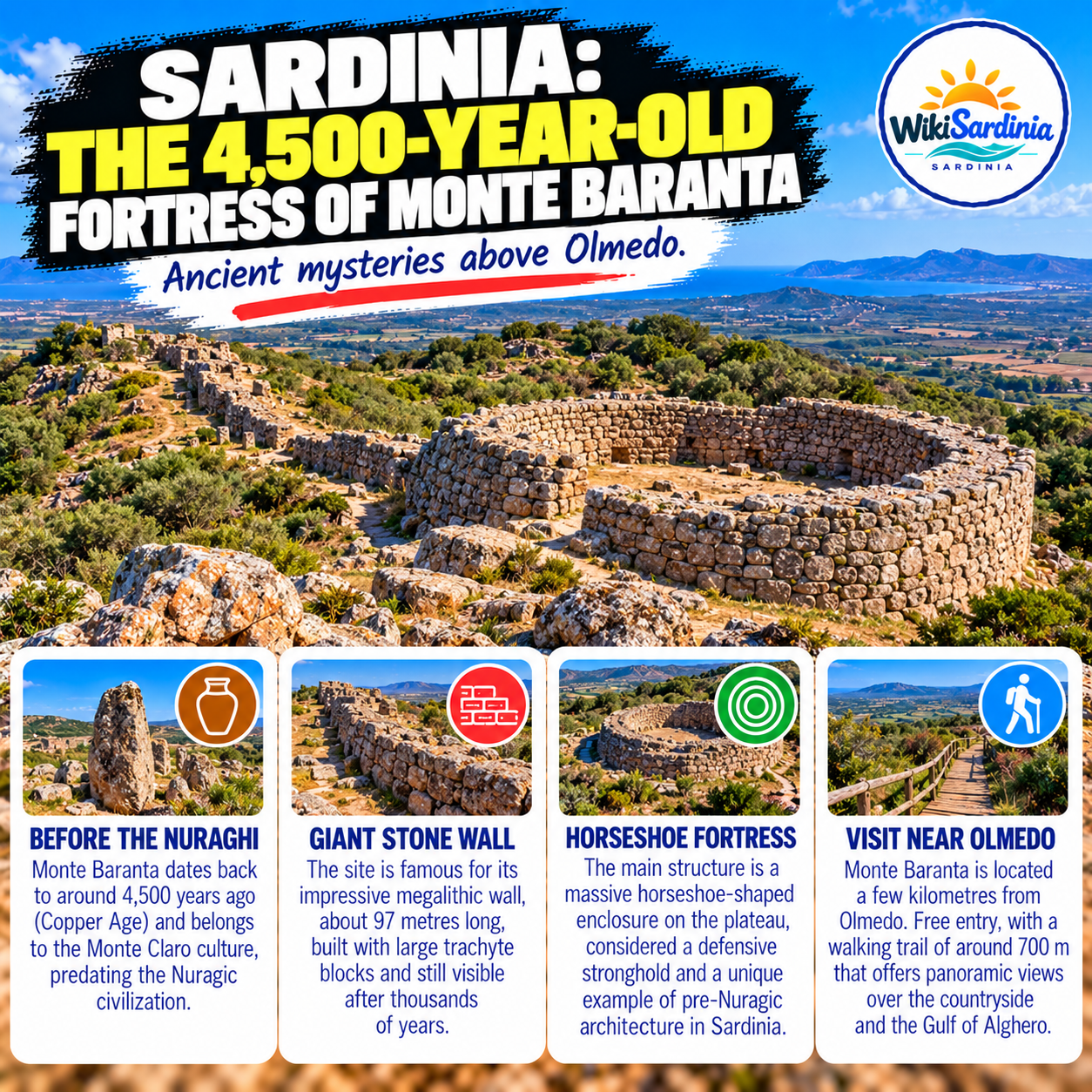
Just a few kilometres from Olmedo, near Alghero in northwestern Sardinia, the ruins of Monte Baranta preserve a remarkable story from long before the island's famous nuraghi. On a rocky plateau overlooking the Nurra countryside, a community of the Copper Age built a formidable stone enclosure, a defensive wall and a settlement that archaeologists associate with the Monte Claro culture.
A fortress around 4,500 years old
The main occupation is generally dated to the third millennium BC, with the Italian Ministry of Culture listing the complex around 2500–2200 BC. Other official heritage accounts use slightly different ranges, reflecting archaeological chronology rather than an exact founding year. Monte Baranta is therefore best understood as a roughly 4,500-year-old pre-Nuragic fortified settlement, not as a nuraghe.
The enormous horseshoe-shaped enclosure
Its most extraordinary feature is the recinto-torre, a horseshoe-shaped stone enclosure positioned at the edge of the plateau. Its walls rise to approximately 3.5 metres and can be as much as 6.5 metres thick. Two passages lead into an open court, while traces of a stairway suggest access to an elevated walkway. This is not a typical circular nuraghe: its form and construction belong to a different period and architectural tradition.
A 97-metre defensive wall
Higher on the plateau stands an imposing megalithic wall, roughly 97 metres long and about five metres thick, defending the more accessible side of the settlement. Archaeologists have identified the remains of rectangular huts behind it. The builders combined massive masonry with the natural protection offered by the steep plateau edges.
The mystery of the stones beyond the walls
Monte Baranta was not exclusively a defensive place. Outside the wall lies a megalithic circle formed by around 80 stone slabs, enclosing a space approximately ten metres across. Nearby is a large fallen menhir measuring about 3.95 metres. Evidence that the stone was unfinished suggests it may never have been erected. Archaeologists often interpret this sector as a possible ceremonial area, but its precise use remains uncertain.
Why was the settlement abandoned?
The relatively limited finds from its principal occupation have led scholars to propose that Monte Baranta may have been inhabited for only a comparatively short time. Some structures appear unfinished. Later use of parts of the site has also been documented, so the story is more complicated than a single sudden abandonment. The exact reasons why its original community left are unknown.
How to visit Monte Baranta from Alghero
The archaeological area is near Olmedo, a short journey inland from Alghero. According to the Ministry of Culture's IDESE site listing, visitors can follow directions from the SP19 road toward the parking area, then walk approximately 700 metres to the plateau. The listing describes free entry, parking and a trail of medium difficulty, with no accessible route for visitors with mobility impairments. Conditions can change, so check local information before departure.
Wear sturdy shoes, carry water and avoid climbing the ancient walls. The rocky terrain and exposed position deserve care, especially in hot weather or after rain. The reward is not only the archaeology: the plateau opens out toward the countryside of the Nurra and the Alghero area.
A hidden chapter of Sardinia's past
Monte Baranta challenges the idea that Sardinia's monumental stone architecture began with the nuraghi. Here, centuries earlier, builders already knew how to create massive defensive structures and organize a settlement around them. For curious travellers based in Alghero, it is an unforgettable encounter with the island's deeper prehistory.