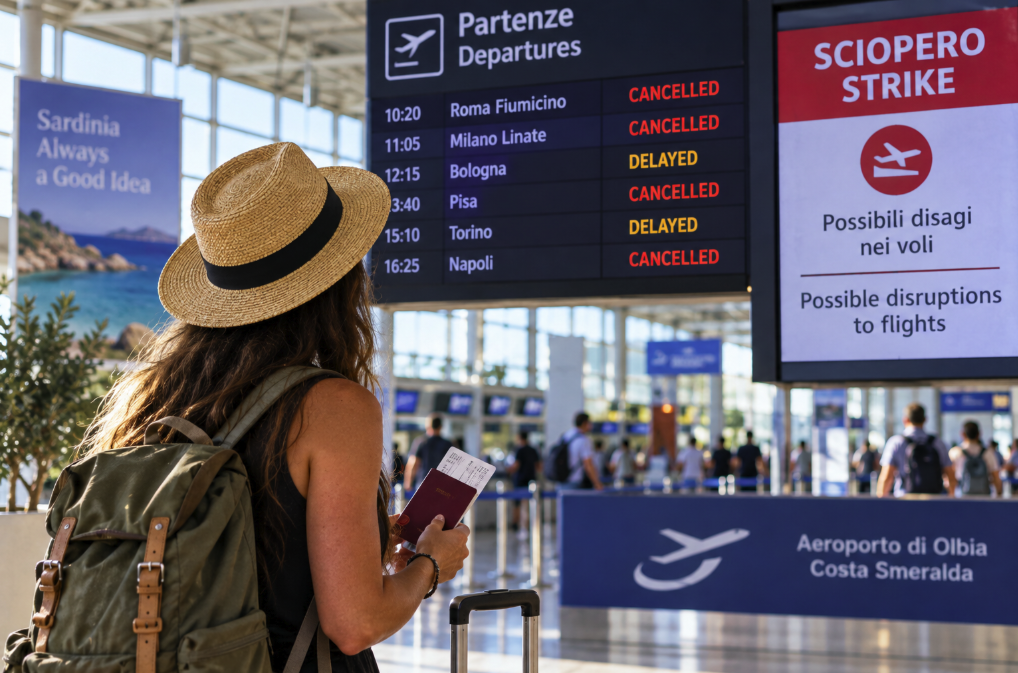
Travel insurance can cover some losses caused by strikes during a Sardinia trip, but buying a policy after a walkout has already been announced may be too late for that particular event. For U.S. travelers, the crucial questions are not simply whether a policy mentions “strikes,” but which benefits apply, when the policy became effective and when the labor action became a known or foreseeable event.
The distinction matters in September 2026, when transport strikes have again affected travel planning in Italy. A national rail strike ran from 9:18 p.m. on September 7 until 9 p.m. on September 8, with possible cancellations and delays before and after the official period. Sardinia’s regional rail network published its own list of guaranteed trains for strike periods. Travelers therefore have a very practical reason to understand what insurance does — and does not — pay for when transport stops.
Strike coverage is not automatic
Some U.S. travel insurance policies treat a labor strike affecting a travel supplier as a covered reason for trip cancellation, trip interruption or travel delay. The exact language varies by plan, and a policy may impose a minimum delay before benefits begin or restrict the types of expenses that qualify.
Travel Guard, for example, currently states that its coverage can apply to trip cancellation or interruption caused by a sanctioned union labor strike affecting an airline or another travel supplier, provided the insurance became effective before the strike was foreseeable. The company considers a strike foreseeable when union members vote to approve it.
Allianz similarly explains that strike-related cancellation, interruption or delay benefits can apply when included in the policy, but the insurance must have been purchased before the strike was threatened or announced. Once the event is known, losses related to it may be excluded.
This is one of the most important lessons for anyone booking Sardinia: travel insurance is generally designed for unforeseen events, not for buying protection after a disruption is already on the calendar.
What expenses might be covered?
Depending on the policy and circumstances, strike-related benefits can potentially include non-refundable prepaid trip costs if a covered strike forces cancellation, unused portions of a trip if it is interrupted, or reasonable additional expenses during a covered delay.
For a Sardinia traveler, that could mean a hotel night after a canceled onward flight, meals during a qualifying delay or the loss of prepaid accommodation if the policy's cancellation or interruption terms are satisfied. But these are examples, not guarantees. Deductibles, benefit limits, minimum delay periods and documentation requirements differ between insurers and plans.
A missed connection can also be more complicated than it first appears. If a rail strike prevents you from reaching an airport and you miss a separately booked flight, coverage depends on the exact policy language and whether that form of transport disruption qualifies. Never assume that “strike coverage” automatically protects every independently booked component of an itinerary.
What if the strike was already announced when you bought the policy?
This is where many travelers are disappointed. Once a strike is considered known or foreseeable under the insurer's rules, a newly purchased policy will generally not cover losses arising from that event.
Travel Guard maintains a public strike list with cutoff dates for certain labor actions. Its current examples demonstrate the principle clearly: coverage bought after the insurer's specified foreseeable date does not provide cancellation or interruption protection for losses caused by that listed strike.
The practical rule is simple: if insurance matters to you, buy it soon after making the first non-refundable trip payment rather than waiting until an airline, airport or union announces disruption.
That still does not mean every future strike will be covered. Read the certificate or policy, because the covered reasons and exclusions control the claim, not a general marketing page.
The September 7 strike was rail, not a Sardinia-specific Groundforce stoppage
Travelers should also verify exactly which strike they are reacting to. Authoritative Italian sources confirm that the major action beginning on September 7, 2026 was a national rail strike involving FS Group personnel and other rail-sector workers. It affected services into September 8, with essential regional services guaranteed in specified time bands.
For Sardinia, RFI published a detailed list of guaranteed trains on routes including Cagliari–Elmas, Cagliari–Oristano, Sassari, Olbia and Golfo Aranci. That is relevant to travelers reaching Cagliari Airport by train or moving between Sardinian cities.
Public strike calendars also show a separate September labor action involving Sogaer Group personnel at Cagliari Elmas Airport, beginning September 6 and involving overtime and supplementary work. That is different from describing the September 7 disruption as a Groundforce strike.
Groundforce has appeared in recent European strike alerts — including labor actions at Spanish and Portuguese airports — but travelers should not assume that every September Italian disruption involved the same ground-handling company. The operator, country, union and dates matter both for travel planning and insurance claims.
Airline rights and travel insurance are different
Insurance should not be the first or only source of reimbursement after a canceled flight. When an airline cancels or significantly disrupts travel, passengers may have rights directly against the carrier under applicable European passenger-rights rules. Those rights are separate from a private insurance policy.
Whether additional monetary compensation is due can depend on the cause of the cancellation and whether it is considered an extraordinary circumstance. A strike by the airline's own staff and a strike involving external airport or air-traffic-control workers can raise different legal questions.
The practical order is to ask the airline or travel supplier what rebooking, refund, hotel or meal assistance it provides first. Then submit eligible remaining losses to the insurer with evidence of what the supplier did or did not reimburse. Insurance companies generally will not pay twice for the same expense.
Five questions to ask before buying a policy
- Are strikes a covered reason? Look specifically under trip cancellation, trip interruption and travel delay, not only in a general summary.
- When does a strike become foreseeable? The definition can determine whether your purchase date qualifies.
- How long must the delay last? Some travel-delay benefits begin only after a specified number of hours.
- Does the policy cover the transport you are actually using? A flight, ferry, train and separately booked airport transfer may not be treated identically.
- What documentation is required? Keep cancellation notices, receipts, booking confirmations and written statements from the carrier whenever possible.
Build some protection into the itinerary too
Insurance works best alongside sensible scheduling. Avoid booking a non-refundable international flight only a few hours after a ferry or train connection if missing that flight would be financially painful. For an important return flight from Olbia, Cagliari or Alghero, an extra night near the departure airport can sometimes be cheaper than insuring an unnecessarily tight chain of connections.
Check Italy's official strike information before departure and again during the trip. For rail travel, Trenitalia and RFI publish guaranteed services when applicable. Airlines and airports should be checked directly for aviation disruptions.
Travelers should also save insurer contact details and the full policy certificate offline. If a strike happens while you are already in Sardinia, contact the insurer before making an expensive alternative booking when practical; some plans have assistance services that can explain which expenses may qualify.
What U.S. travelers should take away
A policy that covers strikes can be valuable for a Sardinia trip, particularly when flights, trains and ferries are combined. But the timing of the purchase is critical. Insurance bought after a specific strike becomes known is unlikely to turn that already-announced disruption into a covered event.
Do not shop only for the phrase “strike coverage.” Compare cancellation, interruption, delay and missed-connection terms, benefit limits and the insurer's definition of a foreseeable event. And if a disruption occurs, pursue airline or transport-provider remedies before claiming unreimbursed eligible costs.
The best insurance decision happens when the trip is booked, not when the departure board turns red. For Sardinia travelers worried by recent strike headlines, that is the difference between meaningful protection against an unexpected labor action and a policy that arrives after the risk is already known.