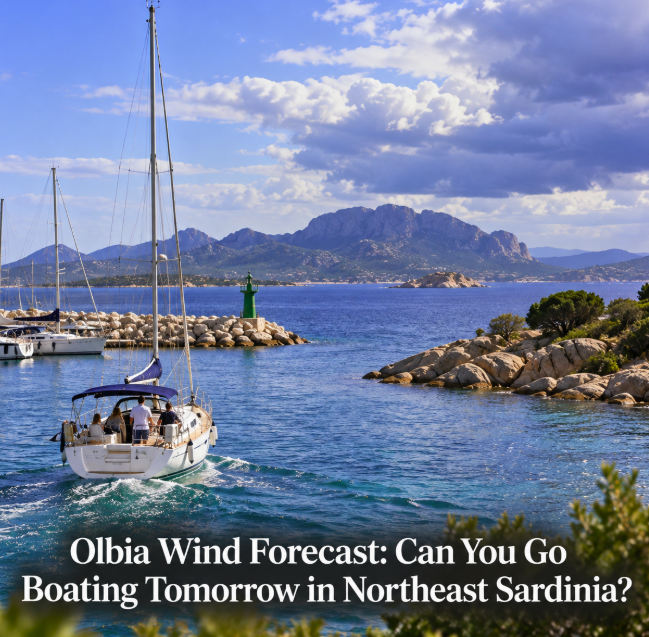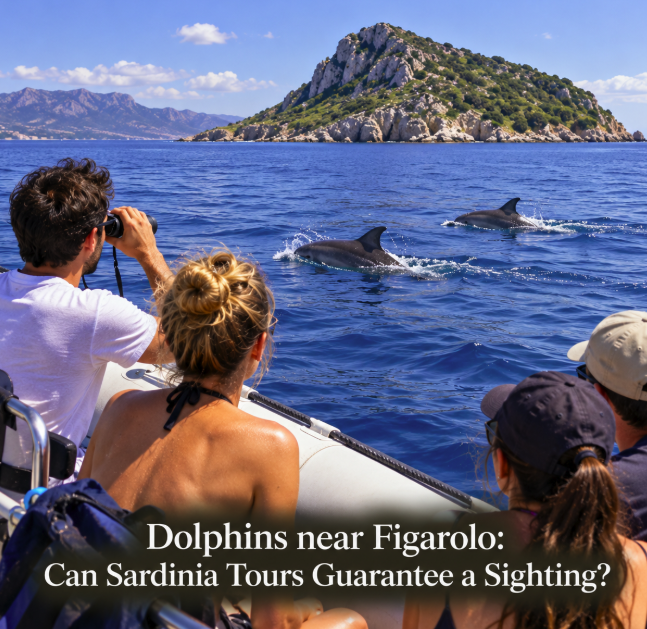
The waters around Figarolo and Golfo Aranci are one of northeastern Sardinia’s best-known areas for watching bottlenose dolphins, and some local operators report sighting rates above 90%. But travelers searching for a tour with a guaranteed dolphin encounter should understand the distinction: these are wild animals moving freely in the Mediterranean, so a responsible operator cannot promise that dolphins will appear on every departure. High probability is not the same thing as a guarantee.
There is another important detail hidden in the phrase “snorkeling with dolphins.” On responsible Figarolo excursions, the dolphin watching and snorkeling are separate parts of the trip. You observe dolphins from the boat and snorkel at designated coastal stops; you do not jump into the water to chase or swim alongside the animals.
Why dolphins are seen so often near Figarolo
Figarolo is a small island just outside Golfo Aranci, east of Olbia. The surrounding waters are regularly used by common bottlenose dolphins, and local tours concentrate their search around Capo Figari, Golfo Aranci and the waters close to the island.
A fish-farming facility near Figarolo raises sea bass and sea bream in offshore cages. The concentration of fish helps explain why dolphins repeatedly use this area to feed. Local operators have built dolphin-watching excursions around this predictable behavior, although the animals remain completely free to move elsewhere.
DST Sardegna, one of the established operators offering Figarolo dolphin watching and snorkeling, currently advertises a sighting probability of more than 95%. Its own tour description nevertheless says the itinerary varies according to where the dolphins are and the sea and weather conditions. That is the correct way to interpret the percentage: a record of very frequent encounters, not a contractual promise that wildlife will appear.
Can any Figarolo tour guarantee dolphins?
No credible wild-dolphin excursion can guarantee a sighting in the literal sense. Another current operator covering Golfo Aranci and Tavolara states explicitly that it cannot guarantee dolphins because they are wild animals. A Golfo Aranci kayak operator similarly publishes a roughly 90% success rate while saying that dolphins cannot be guaranteed.
For travelers, this is actually a useful test when choosing a tour. An operator that explains uncertainty, maintains distance and treats the dolphins as wildlife is preferable to one implying that the animals will perform on demand.
Weather can also affect the outing. Poor sea conditions may force a cancellation, and even when the boat sails, wind and waves can change the route or make spotting fins more difficult.
What a dolphin-and-snorkeling trip actually includes
Current Figarolo excursions generally combine a period searching for bottlenose dolphins with swimming and snorkeling stops. DST Sardegna’s longer tour is currently listed at about 3 hours 30 minutes, with departures from Olbia and Golfo Aranci, a maximum of 12 passengers per inflatable boat, and masks, fins and buoyancy equipment included.
The itinerary can include waters around Capo Figari and stops near places such as Cala Greca, Cala Moresca and Figarolo. The captain adapts the route according to marine conditions and dolphin locations rather than following an identical sequence every day.
As of September 2026, that operator lists the adult price at €70 and the child price at €60 for the longer dolphin-watching and snorkeling excursion. Prices, schedules and availability can change, so travelers should verify their exact date before booking.
You should not expect to snorkel beside the dolphins
DST Sardegna’s published code of conduct specifically says that its guides do not swim with the dolphins. The reason is to avoid interfering with their natural behavior and to reduce the risk of transmitting disease. The operator also says boats maintain safe distances, respect appropriate navigation speeds and do not feed the animals.
That makes the wording used on booking sites important. “Dolphin watching and snorkeling” means two activities during the same excursion, not a promise of underwater contact with dolphins.
If swimming directly with dolphins is the feature you are looking for, a responsible Figarolo wildlife tour is not designed to provide it. The more appropriate experience is watching them naturally from the boat, then enjoying snorkeling elsewhere along the coast.
How to improve your chances
Choose an operator that spends enough time in the dolphin area and uses guides familiar with local behavior. Small groups can make viewing easier because passengers have more room to move safely and listen to the guide.
Ask the operator about recent sightings when booking, but remember that yesterday’s encounter cannot guarantee tomorrow’s. Morning departures sometimes benefit from calmer sea conditions, although dolphins can also be encountered later in the day and weather patterns vary.
If dolphins are the main reason for your trip, leaving a second suitable day free in your itinerary is sensible. That gives you flexibility if wind or rough seas cause the excursion to be postponed.
What happens if no dolphins appear?
This depends on the operator. Do not assume that “95% sighting probability” means an automatic refund for the remaining 5%. Read the cancellation and wildlife-sighting conditions before paying.
For example, current Figarolo excursions commonly provide a reschedule or refund when the operator cancels because of bad weather or because minimum participation is not reached. That is different from a completed excursion on which the dolphins simply do not appear.
A good tour should therefore be enjoyable even without a sighting. The coastline around Golfo Aranci, Capo Figari and Figarolo offers clear water, rocky coves and snorkeling opportunities that give the trip value beyond the wildlife search.
Figarolo is a strong choice, not a dolphin show
For travelers staying in Olbia, Golfo Aranci or the Costa Smeralda area, Figarolo is one of the most practical places to look for dolphins without turning the day into a long offshore expedition. The combination of recurring bottlenose-dolphin activity, experienced local skippers and short access from the coast explains the area’s popularity.
The realistic promise is therefore better than a guarantee: your chances can be very high, but the dolphins decide whether they appear. Book a wildlife-watching tour that respects that fact, treat snorkeling as a separate coastal activity, and avoid any excursion that encourages chasing, feeding or entering the water with wild dolphins.
Seeing a bottlenose dolphin surface beside Figarolo is memorable precisely because it is not staged. In Sardinia, the best dolphin experience is an encounter with a wild animal on its own terms.