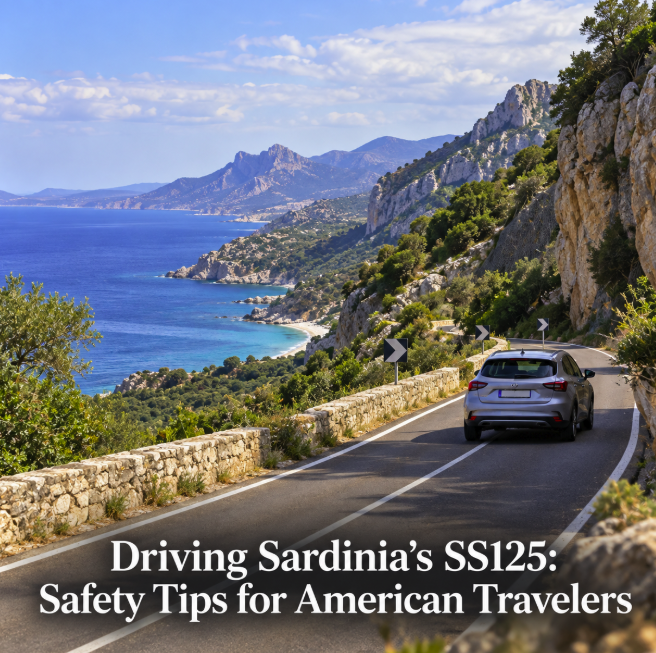
Sardinia’s SS125, the Orientale Sarda, is one of the island’s best-known roads, running along the eastern side of Sardinia and connecting very different landscapes. For American visitors, parts of the route can feel demanding at first: curves can be tighter than those on many U.S. highways, distances that look short on a map may take longer than expected, and local road signs and driving habits require attention. The answer is not to fear the SS125, but to approach it as a road where conditions and posted limits matter more than the estimated arrival time on a navigation app.
Do not treat the SS125 as one uniform road
The first thing to understand is that “SS125” does not describe a single driving experience. The route includes different types of road and has been modified over time, with modern sections as well as older, more winding stretches. Drivers should follow the signs and conditions they actually encounter rather than assuming that advice about one section applies to the entire road.
This is particularly important in eastern Sardinia, where mountainous terrain can produce bends, changes in elevation and limited sight lines. Italian road law requires drivers to adapt speed not only to the posted maximum but also to the vehicle, road, traffic, visibility and other conditions. The Highway Code specifically calls for reduced speed on curves, steep descents, narrow sections, at night and when visibility is limited.
Posted speed limits come first
Italy’s general maximum limits are 130 km/h on motorways, 110 km/h on main extra-urban roads, 90 km/h on secondary and local extra-urban roads and 50 km/h in built-up areas, unless signs establish a different limit. Road authorities can impose lower limits on individual sections, so the sign in front of you is more important than a generic national figure.
For Americans accustomed to miles per hour, it helps to remember a few rough conversions before setting off: 50 km/h is about 31 mph, 70 km/h about 43 mph and 90 km/h about 56 mph. Rental-car speedometers in Italy display kilometers per hour prominently, so there is no need to calculate continuously while driving.
On winding sections, the legal maximum is not necessarily an appropriate target. ACI’s guidance and the Italian Highway Code emphasize maintaining control and being able to stop safely within the visible distance ahead. If a curve feels too fast, slow down before entering it rather than braking abruptly halfway through.
Let faster local traffic pass safely
A common source of stress for visitors is having a faster driver appear behind them. Do not allow another vehicle to pressure you into driving beyond your comfort level or the safe speed for the road. Maintain a predictable pace and use a suitable safe place to let traffic pass when one becomes available.
Avoid stopping suddenly or pulling onto an unsafe shoulder simply to get out of someone’s way. On a mountain road, predictability is more useful than trying to match the pace of a driver who knows every bend.
The same principle applies when overtaking. Limited visibility on curves makes patience essential. Follow road markings and signs, and do not attempt a pass unless it is clearly legal and there is ample visibility and distance.
Choose a manageable rental car
For most visitors, a smaller car can make Sardinian driving easier. Compact dimensions help not only on winding roads but also when entering villages, parking and navigating older urban streets. An automatic transmission can reduce workload for American drivers who do not regularly use a manual gearbox.
Before leaving the rental lot, locate the headlights, hazard lights, windshield controls and parking brake, and adjust mirrors and navigation while stationary. If the car has driver-assistance systems, understand what they do before relying on them.
Navigation apps are useful, but they should not override road signs or common sense. If an app suggests a minor road that looks unsuitable for the vehicle, continue on a reasonable signed route and allow it to recalculate.
American drivers should check their documents before departure
U.S. visitors should not assume that a state driver’s license alone is all they need. Italian consular guidance for holders of U.S. licenses directs travelers to obtain an International Driving Permit in the United States before traveling to Italy, with AAA identified as the issuing route in the United States. Travelers should carry the underlying valid U.S. license as well and verify current requirements before departure.
Rental companies can also impose their own documentation and age requirements, so check the contract before arriving in Sardinia rather than dealing with a missing document at the rental desk.
Daylight makes a first drive easier
If the SS125 is unfamiliar, planning the first drive during daylight is sensible. Mountain curves and junctions are easier to read when visibility is good, and daylight reduces the extra workload of interpreting an unfamiliar road at night.
Allow more time than the map suggests, particularly if the route is part of a sightseeing day. Sardinia rewards stops, but they should be made in proper parking areas or safe pull-offs rather than at the edge of a bend for a photograph.
Weather matters too. Rain can reduce visibility and grip, while strong sun can create glare. Italian rules require drivers to adapt their speed to weather and visibility even when they remain below the posted maximum.
The SS125 should be driven, not rushed
The Orientale Sarda can feel very different from an American freeway, and that is part of the reason travelers remember it. The practical approach is simple: follow posted signs, enter curves at a comfortable speed, leave adequate space, avoid being pressured by faster traffic and build extra time into the day.
For American visitors, the biggest adjustment is often psychological rather than technical. A route can be perfectly manageable while still requiring more concentration than a broad interstate highway. Treat the SS125 as part of the journey rather than an obstacle between destinations, and the drive becomes considerably less intimidating.