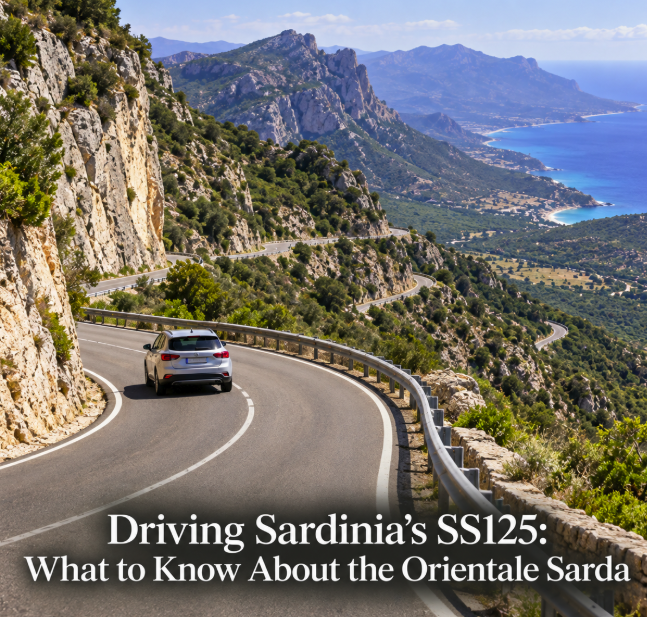
The SS125 Orientale Sarda is one of the classic roads of eastern Sardinia, but travelers should not imagine a single coastal highway with uninterrupted sea views. The route mixes modern, faster sections with older mountain stretches, and its most memorable part around Baunei, Genna Silana and Dorgali is famous precisely because it is slow and winding. For drivers accustomed to wide American highways, the main challenge is usually not poor pavement but curves, elevation changes, limited overtaking opportunities and the temptation to look at the scenery instead of the road.
The road remains an important state route managed by ANAS, while the historic alignment is intertwined with newer variants and bypasses. Before a long drive, current restrictions should always be checked with ANAS traffic information because temporary works, incidents and weather-related closures can change conditions after any travel guide is published.
The Baunei–Dorgali section is the famous one
The stretch most travelers have in mind when they talk about the Orientale Sarda runs through Ogliastra and the Supramonte. Sardinia’s official tourism portal describes the SS125 climb toward the Genna Silana pass as the route’s most demanding section. The pass rises above 1,000 metres, followed by roughly 25 kilometres of winding descent toward Dorgali.
This is magnificent driving country, with limestone mountains, forests and access roads leading toward some of the east coast’s best-known landscapes. It is also a road where average speed matters more than distance. A map can make Baunei and Dorgali look relatively close, but repeated bends and changes in elevation mean the journey should not be scheduled as though it were a straight motorway transfer.
There are stretches where confident local drivers may appear quickly behind you. Do not respond by driving faster than feels safe. Keep a predictable pace and use a safe pull-off when available to let faster traffic pass rather than braking suddenly or stopping on the roadway.
Is the SS125 dangerous?
It does not need to be treated as an extreme road, but some sections demand concentration. The mountain alignment has numerous curves, and drivers can encounter motorcycles, cyclists, tour buses, camper vans and local traffic. Visibility around bends is naturally limited.
Stay within posted speed limits, keep well inside your lane and never cut a blind corner. A small rental car can be more comfortable than a large SUV on winding roads and in village parking areas. Drivers unfamiliar with manual transmissions should consider booking an automatic well in advance rather than learning hill starts during the trip.
Night driving changes the experience considerably. The scenery disappears, wildlife can be harder to spot and a sequence of unfamiliar bends becomes more tiring. If the SS125 is part of the holiday rather than merely transportation, driving the mountain section in daylight is the better plan.
Road conditions can change
ANAS is responsible for the SS125 and publishes traffic and road information through its official channels. Construction, maintenance, accidents and weather can create temporary lane restrictions or diversions, so a statement that the entire road is “open” can become obsolete quickly.
For that reason, this guide does not claim that every kilometre is unrestricted on every day of 2026. Check the latest ANAS information shortly before departure, especially if a navigation app suggests an unexpected detour. Local signs and traffic instructions take priority over a saved itinerary.
Heavy rain deserves particular attention in mountainous terrain. After severe weather, allow extra time and avoid assuming that a smaller alternative road will be faster simply because an app proposes it.
The old and new Orientale Sarda are not the same experience
Over the years, faster variants have changed parts of eastern Sardinia’s north-south road network. The historic SS125 remains attractive because it goes through landscapes that newer infrastructure was designed to bypass.
This can create confusion in navigation. A route planner optimized for speed may send you through newer sections while a scenic itinerary sends you along the older road. If your goal is sightseeing, examine the route before leaving instead of blindly following the fastest option.
In the south, Sardinia’s tourism authority also distinguishes between scenic coastal roads and the older inland SS125 alignment through the Sarrabus. The name “Orientale Sarda” therefore covers a much broader journey than the famous Supramonte curves alone.
Where to stop without blocking the road
The SS125 provides access to several worthwhile detours, but stops should be made only where parking is permitted and the vehicle can leave the traffic lane completely.
Near Baunei, a side road from the SS125 leads toward Pedra Longa, the dramatic limestone pinnacle on the coast. Sardinia’s official tourism portal notes that Pedra Longa can be reached directly by car via a scenic road connecting it with the SS125, ending near a parking area.
Baunei also provides access toward the Golgo plateau, while the northern part of the route brings travelers toward Dorgali and connections for Cala Gonone. The latter involves its own dramatic road through a tunnel and switchbacks down toward the coast.
These detours are why an SS125 day should not be planned using driving time alone. A two-hour transfer can easily become most of a day once viewpoints, villages, lunch and short walks are included.
Motorcycles, bicycles and camper vans
The curves make the Orientale Sarda popular with motorcyclists and cyclists. Drivers should expect vulnerable road users even on sections that feel remote. Leave generous passing distance and wait for clear visibility rather than overtaking simply because traffic behind is impatient.
Camper vans can travel the route, but their size makes tight bends and parking more demanding. Anyone renting a large motorhome specifically for Sardinia should consider whether they are comfortable with mountain driving before building an itinerary around the old SS125.
For cyclists, the official Sardinia tourism portal itself presents the Orientale Sarda as part of a major mountain-and-sea cycling itinerary, including the challenging Genna Silana section. That is another reason motorists should expect bicycles on the road.
How much time should you allow?
Navigation estimates are useful for a direct journey, but they are poor guides to a scenic-road day. Add time for slow vehicles, viewpoints and stops, and avoid scheduling a ferry, flight or fixed excursion immediately after a long mountain drive.
If you are traveling between Baunei and Dorgali for pleasure, treat the road as part of the day rather than an obstacle between attractions. Start with fuel, water and enough daylight, and save the faster transfer mentality for the island’s main arterial roads.
Passengers prone to motion sickness may also want medication or another strategy before the most winding section. The repeated bends around the Supramonte are exactly what make the drive memorable, but they can be uncomfortable for someone reading a phone or map in the passenger seat.
A road trip worth slowing down for
The Orientale Sarda earns its reputation not because it is the fastest way across eastern Sardinia, but because the road reveals the island’s mountainous interior while remaining close to some of its most spectacular coastline. Around Baunei and Dorgali, the SS125 passes through terrain that feels very different from the flat resort roads many first-time visitors expect.
Drive it with realistic timing, use proper stopping areas, respect cyclists and motorcycles, and check ANAS for current conditions before setting out. The curves are part of the experience. On the SS125, arriving a little later is often the point.