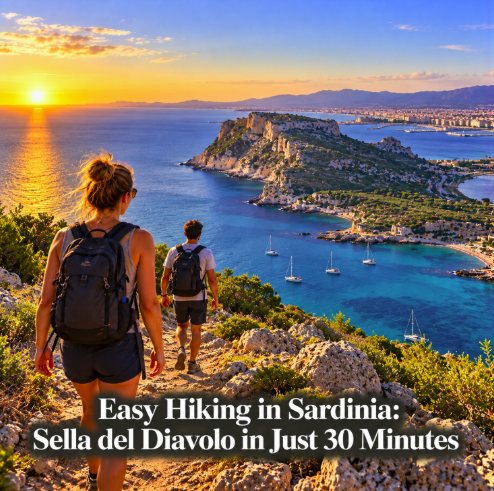
Sella del Diavolo is one of the easiest places to add a real coastal hike to a stay in Cagliari without committing an entire day. Rising beside Poetto and Marina Piccola, the headland gives walkers broad views over the Gulf of Cagliari, the long beach, Molentargius and the city. A short ascent can take around 30 minutes for a reasonably fit walker, but that figure should be treated as an approximate one-way walking time rather than a promise that the complete outing will be finished in half an hour.
The attraction is the ratio between effort and scenery. You leave the urban waterfront and, within a relatively short distance, find yourself among limestone, Mediterranean scrub and archaeological remains with the sea below. It feels surprisingly wild for a trail immediately beside Sardinia’s capital.
Where the Sella del Diavolo hike starts
The most commonly used approach begins around Marina Piccola, at the western end of Poetto beach. This makes the hike unusually convenient for visitors staying in Cagliari because you do not need to drive deep into the countryside to reach the trail area.
Marina Piccola is also served by Cagliari’s public transport network, so the walk can fit into a car-free city break. From the marina area, routes climb onto the Sella del Diavolo promontory and lead toward panoramic points above the gulf.
The exact path you choose matters. The headland contains multiple tracks rather than a single paved tourist walkway, so follow established paths and pay attention at junctions.
Can you really hike it in 30 minutes?
For some walkers, roughly 30 minutes is a realistic estimate for reaching a rewarding elevated viewpoint from the Marina Piccola side. It is not a reliable total time for everybody, and it should not be interpreted as a 30-minute round trip.
Allow at least an hour if you want to climb, stop for photographs and return without rushing. Ninety minutes gives you considerably more freedom to explore viewpoints and archaeological traces.
Your pace will depend on heat, footwear, route choice and how often you stop. A person accustomed to rocky Mediterranean trails may move quickly; someone wearing casual shoes or walking with children may need much longer.
How difficult is the trail?
Sella del Diavolo is generally considered an accessible hike rather than a demanding mountain trek, but “easy” needs context. The route is not a flat promenade. Expect rocky and uneven ground, short uphill sections and exposed Mediterranean terrain.
You do not need technical climbing equipment for the normal hiking routes, but shoes with good grip are much better than flip-flops. Loose stones can make the descent more awkward than the ascent.
Anyone with limited mobility or significant balance difficulties should not assume that the trail is accessible simply because it is short. Poetto’s promenade below is a much easier alternative for a level walk with views of the headland.
The view over Poetto
The classic reward is the view east over Poetto, the long strip of beach stretching away from Cagliari. From above, the geography of the city becomes much clearer: the urban coastline, saltwater areas around Molentargius and the broad arc of the gulf all fit into a single panorama.
Looking in other directions reveals the rocky coastline around the promontory and the open Mediterranean. The changing perspective is one reason it is worth continuing beyond the first viewpoint if you have enough time and the weather is comfortable.
The headland itself is the landmark Cagliari residents see from Poetto every day, so climbing it also gives visitors a different understanding of one of the city’s defining landscapes.
Why is it called the Devil’s Saddle?
The Italian name Sella del Diavolo means “Devil’s Saddle.” Local legend explains the saddle-like shape through a battle between angels and demons over the Gulf of Cagliari. In the best-known version, the devil falls and leaves his saddle on the promontory.
The story is folklore rather than geology, but it has become inseparable from the headland’s identity. Seen from Poetto, the distinctive profile makes the origin of the name easy to understand.
More than a viewpoint
The promontory has a much longer human history than its modern role as a recreational trail. Archaeological remains and traces of different periods survive around the headland, reflecting its strategic position above the gulf.
Walkers may encounter remains associated with ancient and later defensive use of the area. Treat these features as archaeological heritage rather than climbing structures or picnic furniture.
This combination of history and landscape is what distinguishes Sella del Diavolo from a simple urban lookout.
Best time of day
Outside summer, the hike can work well through much of the day when conditions are mild. In June, July and August, early morning and late afternoon are much more comfortable than midday.
There is little dependable shade on exposed sections. A short trail can feel much harder when limestone is reflecting summer heat and there is no shelter from the sun.
Carry water even if you expect to be walking for only an hour. A hat and sunscreen are sensible for most of the warmer season.
What about sunset?
Late-day light can be beautiful on the headland, but sunset introduces a practical problem: you still have to descend. If you plan to stay until the sun is low, carry a charged phone and a proper light rather than relying on the phone screen as a torch.
Leave enough daylight to negotiate rocky sections safely. The most dramatic photograph is not worth stumbling down an unfamiliar path in darkness.
For visitors who want a completely relaxed sunset, Marina Piccola or another waterfront viewpoint below may be the better choice.
Wind can change the experience
Cagliari is exposed to strong winds, and an otherwise easy walk can feel very different on a gusty day. Check the forecast before setting out, particularly if you are hiking with children or are uncomfortable on exposed terrain.
Stay back from cliff edges even in calm weather. Photographs can flatten perspective and make exposed positions look safer than they are.
Getting there without a car
One of the great advantages of Sella del Diavolo is its proximity to Cagliari. Marina Piccola and Poetto are connected to the city by public transport, making this one of Sardinia’s more practical hikes for travelers without a rental car.
Check CTM’s current route planner and timetable on the day of the walk because services and frequencies can change. A taxi is another straightforward option from central Cagliari.
If you do drive, remember that parking around Poetto and Marina Piccola becomes busier during beach season and on sunny weekends.
Combine the hike with Poetto
The simplest half-day plan is to climb Sella del Diavolo in the morning, descend to Marina Piccola and then continue along Poetto. That turns a short hike into a relaxed Cagliari coastal day without additional transport.
In warm weather, the beach provides an obvious place to stop afterward. Outside the swimming season, Poetto remains useful for a long promenade, lunch or an aperitivo overlooking the gulf.
Molentargius Regional Natural Park is also nearby, creating the possibility of combining coastal scenery with the wetland landscape associated with Cagliari’s flamingos.
What to bring
For the standard short outing, keep it simple: supportive shoes, water, sun protection and a phone with enough battery for navigation and emergencies. Trekking poles are optional rather than essential for most confident walkers, but they may help on loose ground.
Do not underestimate the value of footwear. The fact that the trail begins beside a beach tempts visitors to attempt it in sandals intended for sand rather than rock.
If rain has recently fallen, take extra care on stone surfaces and reconsider the route if conditions look slippery.
A short hike, not a race
The “30-minute hike” description is useful because it tells visitors that Sella del Diavolo does not require a major expedition. It should not become a target time.
Allow enough time to stop, look back over Poetto and enjoy the landscape. If you have only 30 minutes total before another appointment, walking part of the route and turning around early is more sensible than trying to rush to the top and back.
For travelers staying in Cagliari, that flexibility is exactly what makes Sella del Diavolo so appealing. It offers a taste of Sardinia’s rocky coastal hiking almost on the doorstep of the city: close enough for a spontaneous morning walk, but scenic enough to feel like you have left town behind.