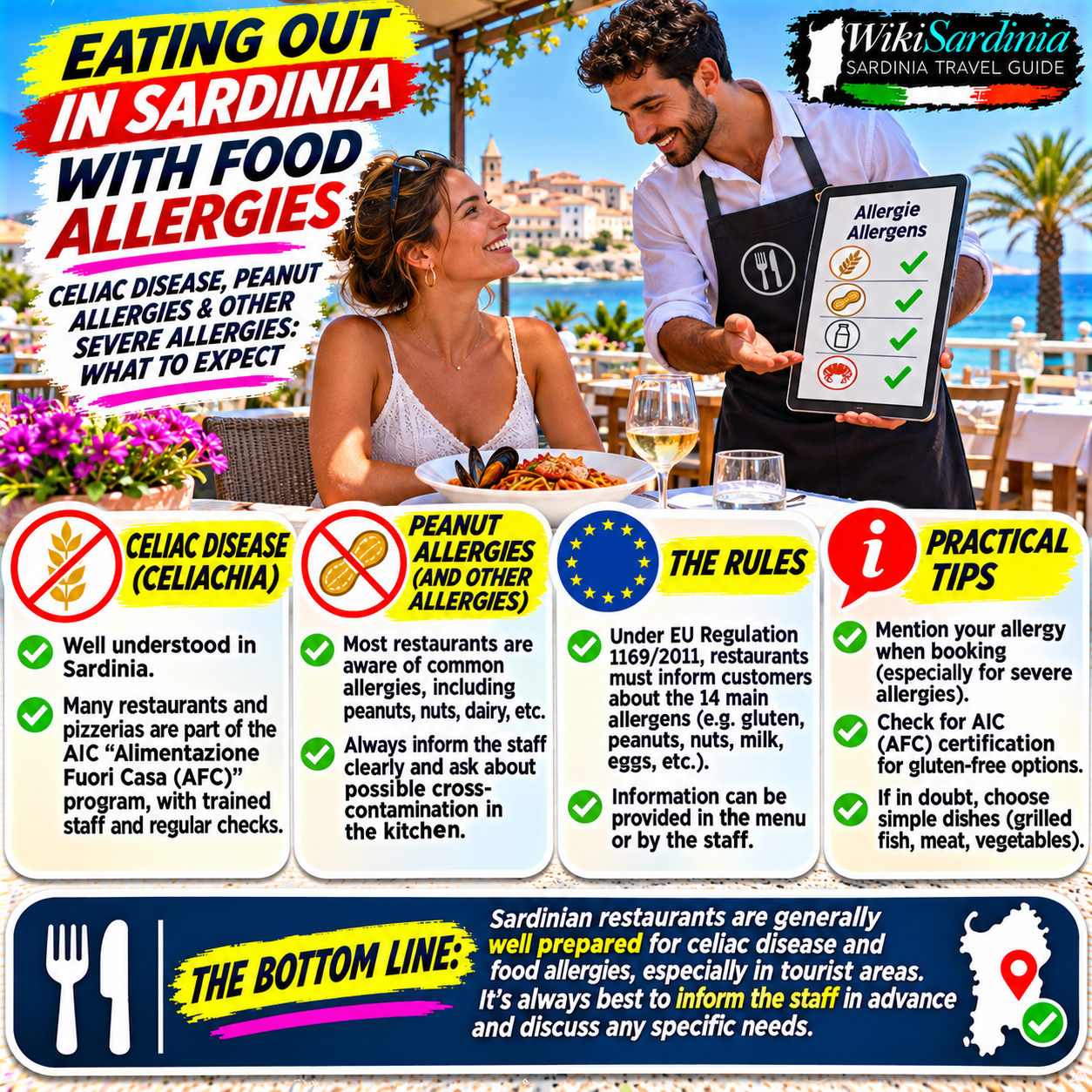
Visitors with celiac disease or severe food allergies can find suitable dining options in Sardinia, but restaurant knowledge and kitchen procedures vary. Italy has an established celiac-friendly restaurant program and EU allergen disclosure requirements. Neither guarantees that every restaurant can safely accommodate a severe allergy.
Celiac disease is not a food allergy
Celiac disease is an autoimmune condition triggered by gluten. Peanut allergy is an immune-mediated food allergy that can cause anaphylaxis. Both require careful ingredient checks and prevention of cross-contact, but the conditions are different. Explain your specific medical requirement rather than simply asking for a special diet.
Finding gluten-free restaurants in Sardinia
The Italian Celiac Association (AIC) operates its Alimentazione Fuori Casa (AFC) program, which includes participating restaurants and other food businesses receiving training and monitoring. Consult the current directory through AIC before your trip. Participation is useful evidence of preparation for celiac diners, not an absolute guarantee or evidence of peanut-allergy expertise. Confirm procedures with the individual restaurant.
What Italian restaurants must disclose
Under EU Regulation 1169/2011, allergen information is required for non-prepacked foods, including restaurant meals. The 14 categories are cereals containing gluten, crustaceans, eggs, fish, peanuts, soybeans, milk, specified tree nuts, celery, mustard, sesame, sulphur dioxide and sulphites above the specified threshold, lupin and molluscs. Ask to see the written allergen information and speak with the kitchen. The absence of an allergen from a listed recipe does not establish the absence of cross-contact.
Traditional Sardinian dishes: what to check
| Dish | Potential concerns |
|---|---|
| Pane carasau | Normally wheat-based. |
| Malloreddus and fregula | Typically wheat semolina. |
| Culurgiones | Usually wheat dough; fillings may contain milk products. |
| Seadas | Typically wheat and cheese; shared frying oil may matter. |
| Grilled fish or meat | Check marinades, flour, sauces, shared grills and utensils. |
| Gelato and pastries | Check nuts, peanuts, milk, eggs, cones and shared scoops. |
Recipes vary. No dish should be treated as automatically safe based on its name or traditional ingredients.
Managing a severe peanut allergy
Peanuts are called arachidi in Italian; tree nuts are a separate allergen category. Ask specifically about peanut oil (olio di arachidi), sauces, desserts, supplier ingredient labels and shared equipment. Do not assume that olive oil is the only cooking oil used in Sardinia. If the kitchen cannot confirm appropriate precautions, choose another restaurant.
Questions to ask before booking
- Can the chef accommodate my specific medical dietary requirement?
- Can staff check ingredient labels and supplier information?
- Are clean utensils, preparation surfaces and separate cooking equipment available?
- Is frying oil shared with foods containing my allergen or gluten?
- Can the kitchen maintain these precautions during busy service?
Contact restaurants ahead of time, particularly in smaller villages and during peak summer. No reliable island-wide survey establishes how well every Sardinian restaurant understands severe allergies. A confident answer from a waiter is not a substitute for clear kitchen procedures.
Useful Italian phrases and allergy cards
- Sono celiaco/a. Non posso mangiare glutine, nemmeno in piccole quantità. — I have celiac disease. I cannot eat gluten, even in small quantities.
- Ho una grave allergia alle arachidi. Anche piccole tracce possono causare una reazione grave. — I have a severe peanut allergy. Even small traces can cause a severe reaction.
- Usate olio di arachidi? — Do you use peanut oil?
- Potete evitare la contaminazione crociata? — Can you prevent cross-contact?
- Posso parlare con lo chef e consultare la lista degli allergeni? — Can I speak with the chef and consult the allergen list?
Carry a professionally translated allergy card tailored to your actual allergies. Show it before ordering and confirm that the kitchen understands it.
Preparing for emergencies
Carry your prescribed emergency medication, including adrenaline (epinephrine) auto-injectors if prescribed, and follow your clinician's emergency action plan. Keep medication accessible and stored according to its instructions. In suspected anaphylaxis, use prescribed adrenaline promptly according to your action plan and call 112 for emergency assistance. Do not rely on antihistamines as a replacement for adrenaline. Before traveling, discuss medication supplies and emergency planning with your clinician.
Frequently asked questions
Does senza glutine mean safe for celiac disease?
It means gluten-free, but ask about preparation and cross-contact, particularly for pizza, pasta and fried foods.
Does an AIC participating restaurant guarantee peanut-free food?
No. The program focuses on gluten-free dining for people with celiac disease. Discuss peanut allergies separately.
Are rural restaurants less safe?
Location alone does not establish safety. Evaluate the individual kitchen's procedures and willingness to accommodate your needs.
Can I eat at a buffet?
Shared serving utensils and food contact can make buffets difficult to assess. Ask whether a suitable meal can be prepared separately.
Can I buy gluten-free food in supermarkets?
Packaged gluten-free products are available in Italy, although selection varies. Check labels and your specific dietary requirements.
The bottom line
Sardinia can be a rewarding culinary destination for visitors with medical dietary requirements. Plan ahead, use the AIC directory where relevant, communicate precisely and confirm cross-contact precautions. If a restaurant cannot meet your needs, do not take the risk.