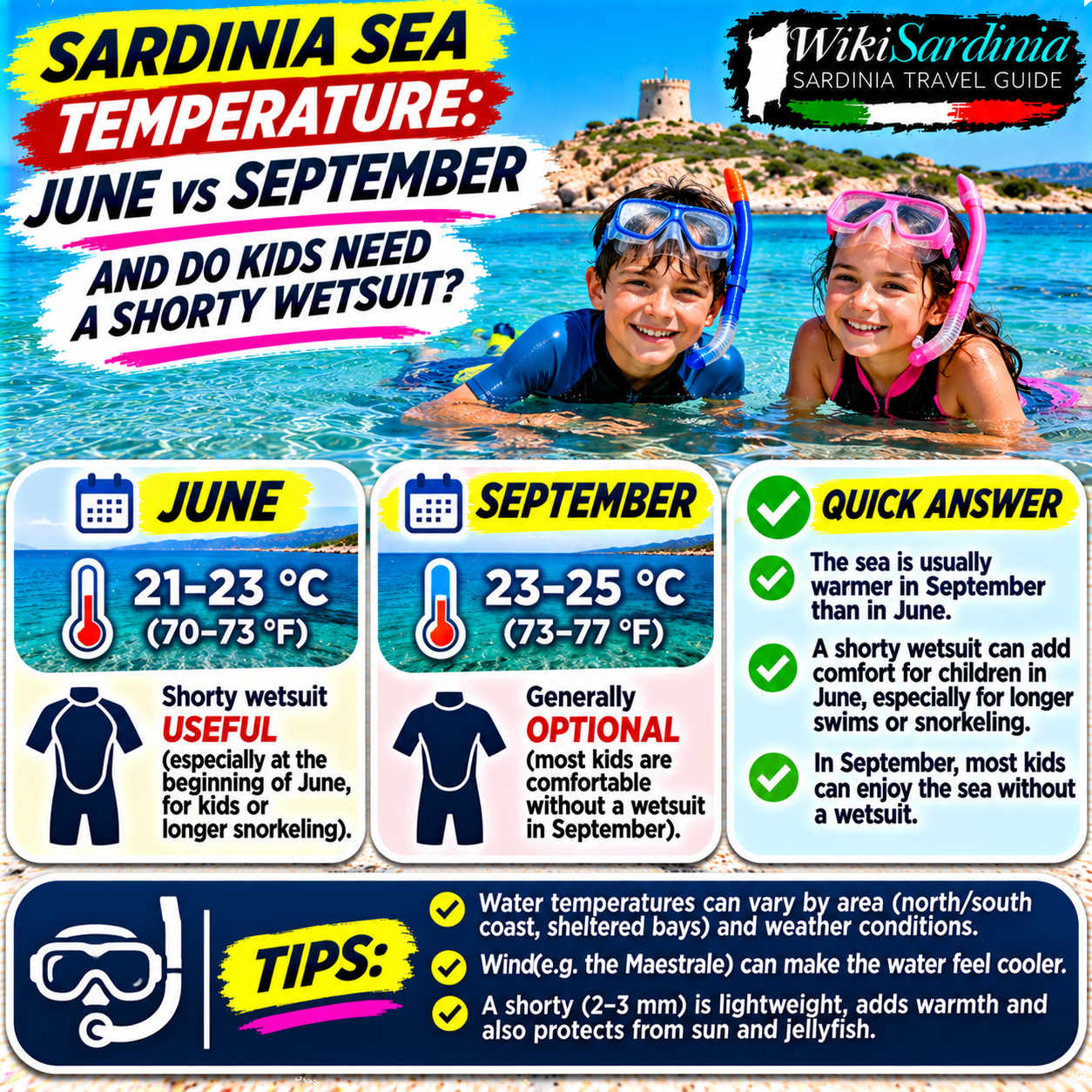
September generally offers warmer seawater than June in Sardinia. Typical indicative temperatures are around 21–23°C (70–73°F) in June and 23–25°C (73–77°F) in September. Children who get cold easily may benefit from a shorty wetsuit, particularly in early June or during extended snorkeling sessions. In September it is often optional, depending on conditions and individual comfort.
June versus September: what to expect
| Month | Indicative sea temperature | Wetsuit advice |
|---|---|---|
| June | 21–23°C / 70–73°F | Consider a shorty for children and longer swims. |
| September | 23–25°C / 73–77°F | Often optional; useful for cold-sensitive swimmers. |
These are broad seasonal planning estimates, not guaranteed temperatures at individual beaches. Early June can be cooler, while late September can bring cooler weather and changing sea conditions. The Mediterranean retains heat accumulated during summer, which explains why September can offer warmer swimming despite shorter days.
Does the coast make a difference?
Water temperatures vary around Alghero, Stintino, San Teodoro, Costa Rei and other coastal destinations. Shallow sheltered bays may warm faster during sunny weather, while exposed beaches can experience mixing and cooler water. Do not assume that one coast is always warmer than another. Wind, currents, depth and recent weather all matter.
What does the Maestrale change?
The northwesterly Maestrale can create rough conditions on exposed shores and make swimmers feel colder, particularly after leaving the water. Wind can also influence local water temperatures through mixing. Choose sheltered swimming locations when conditions permit and obey lifeguard instructions and beach flags.
Should children wear a shorty wetsuit?
A well-fitting 2–3 mm shorty is a practical option for recreational swimming and snorkeling in mild conditions. It covers the torso and parts of the arms and legs, reducing heat loss. It is not mandatory and is not a substitute for a life jacket or close adult supervision. Thickness alone does not determine warmth: fit, activity, wind and individual tolerance matter.
For a brief splash in warm shallow water, ordinary swimwear may be sufficient. For a child spending extended periods snorkeling, a shorty can improve comfort. If a child is shivering, unusually tired or complaining of cold, end the swim, dry them and warm them up. Do not use a wetsuit to extend a swim when a child is already uncomfortable.
Shorty, full wetsuit or rash guard?
- Shorty: useful for extra warmth while retaining freedom of movement.
- Full wetsuit: more coverage and potentially more warmth for cooler conditions.
- Rash guard: useful for sun protection when appropriately rated, but usually offers less insulation than neoprene.
Apply suitable sunscreen to exposed skin. A wetsuit may reduce contact with jellyfish on covered areas, but it does not guarantee protection against stings.
Can you buy or rent a wetsuit in Sardinia?
Sporting-goods shops, dive centres and some water-sports operators sell or rent wetsuits. Children's sizes and rental availability vary. Ask ahead, especially if you need a particular size or plan to visit outside peak season. Bringing a familiar, properly fitting suit can be easier for families.
How to check conditions before swimming
Consult the local marine forecast, ask lifeguards about conditions and check the actual water temperature where possible. The Copernicus Marine Service provides ocean temperature data, while ARPAS Sardinia provides regional meteorological information. Satellite or offshore sea-surface measurements may differ from conditions in shallow bathing areas.
Useful Italian phrases
- Quanto è calda l'acqua oggi? — How warm is the water today?
- Avete mute corte per bambini? — Do you have shorty wetsuits for children?
- Si possono noleggiare le mute? — Can we rent wetsuits?
- Il mare è tranquillo oggi? — Is the sea calm today?
Frequently asked questions
Is June too cold for swimming in Sardinia?
Not necessarily. Many visitors swim in June, but comfort varies, particularly early in the month.
Is September warmer than June in the sea?
Generally yes, because seawater retains summer heat.
Do toddlers need wetsuits?
There is no universal requirement. Consider their comfort, water conditions and short supervised swimming sessions.
Does a shorty keep children afloat safely?
No. Neoprene can add buoyancy but is not a certified flotation device.
Is September always suitable for snorkeling?
No. Wind, waves, visibility and local safety restrictions can change daily.
The bottom line
Choose September if warmer seawater is your main priority. June is also a rewarding time for a family beach holiday, and packing a lightweight shorty can help children who feel cold during longer swims. Always adapt to actual conditions and your child's comfort rather than relying on a monthly average.