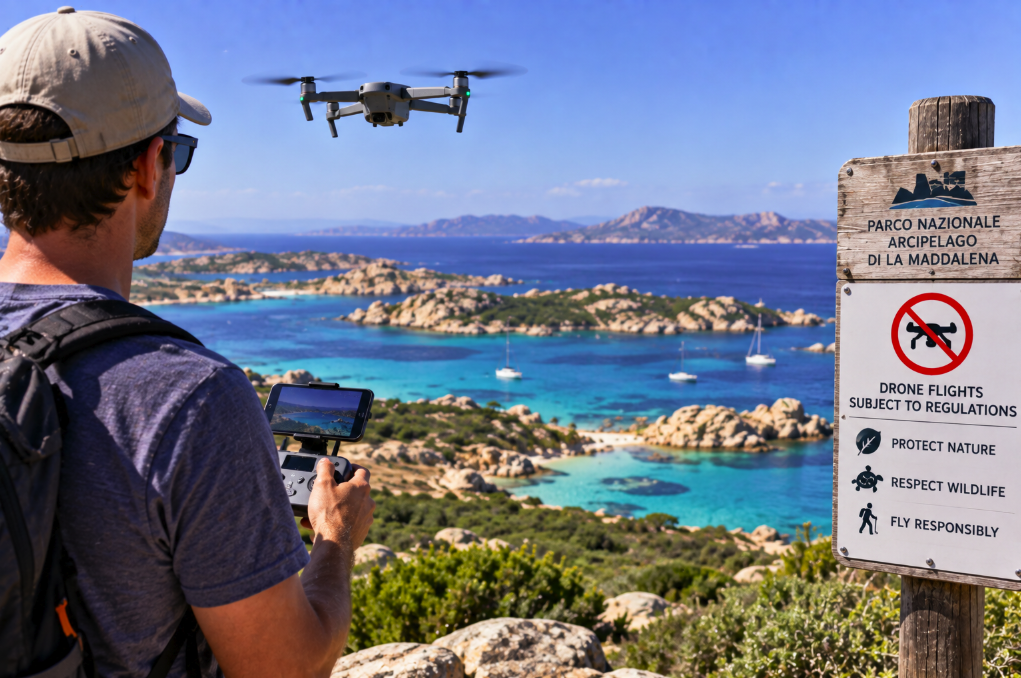
American creators bringing a drone to Sardinia in 2026 need to check more than beaches and weather before launching. Italy applies the European UAS framework, ENAC requires pilots to consult the official D-Flight geographical-zone map before every flight, and protected areas can have additional restrictions. The most important answer for one of Sardinia's most photogenic destinations is simple: a tourist should not arrive in La Maddalena National Park expecting to fly a drone recreationally. The Park currently states that drone overflight is prohibited across the park area, with authorization required for limited qualifying purposes.
That matters because a drone's app may show beautiful takeoff locations without explaining every legal restriction that applies on the ground and in the air. In Sardinia, the correct workflow is to check D-Flight for the exact coordinates and date, then verify whether the location is inside a national park, protected area or another locally regulated site.
Can you fly a drone in La Maddalena National Park?
For ordinary vacation footage, treat the answer as no.
The official Parco Nazionale dell'Arcipelago di La Maddalena website states that drone use is prohibited in the park. A park notice specifically recalls a prohibition on overflight, including remotely piloted aircraft, below 300 metres above sea level from January 1 through October 30.
The same notice identifies limited categories for which authorization from the Park is required for flights below 300 metres: scientific or documentary filming, technical surveys and monitoring, institutional or public-purpose filming, environmental management by public bodies and photogrammetric work.
The Park's current photo and video authorization page is even more direct, reminding applicants that drone overflight is prohibited throughout the park area. Photo, video and cinematographic work inside the park is itself subject to authorization, and operations affecting the relevant protected Natura 2000 area may also require an environmental assessment procedure known as VINCA.
In practical terms, being a YouTuber, Instagram creator or travel photographer does not by itself create permission to fly. A creator planning a professional documentary project should contact the Park well before the trip and describe the purpose, location and proposed operation. A visitor who simply wants aerial holiday footage should plan to use ground-based cameras instead.
D-Flight is the map that matters in Italy
For the rest of Sardinia, do not rely only on the geofencing map inside DJI or another drone manufacturer's app. ENAC, Italy's civil aviation authority, says operators must check the geographical UAS zones published on D-Flight before each flight.
Those zones can restrict operations around airports and heliports, for security reasons or for environmental protection. The colors and permitted heights on the D-Flight map reflect the applicable geographical restrictions. In some safety zones, Open-category drone operations are prohibited entirely.
This is especially relevant around Olbia, Cagliari and Alghero, where airport airspace can affect apparently attractive coastal filming locations. The fact that you are standing on a beach several kilometres from a runway does not mean the airspace is automatically unrestricted.
ENAC also clarified in February 2026 that only protected areas whose drone overflight restriction has been approved by ENAC and published on D-Flight are prohibited for aviation purposes on that basis. ENAC is currently revising some park-related geographical zones so that their mapped boundaries correspond more closely with actual park boundaries. If a D-Flight restriction extends beyond the real protected-area boundary, ENAC says the relevant park authority is the body from which any necessary clearance should be requested.
The useful lesson is not to memorize a list of Sardinian beaches where drones are supposedly allowed. Open the current official map at the place and time you intend to fly.
Basic Open-category rules in Sardinia
Most tourist and creator flights fall within the European Open category when they remain low risk. In that category, ENAC states that the drone must remain below 120 metres from the closest point of the earth's surface and within visual line of sight, known as VLOS.
You cannot fly over assemblies of people, and you must maintain the safety distances required by the relevant Open subcategory. Drones over 25 kilograms are outside the Open category, and dropping materials or carrying dangerous goods is prohibited.
The exact rules around uninvolved people depend on the drone's class and the A1, A2 or A3 subcategory. That is why “under 120 metres” is not enough to determine whether a particular flight is legal.
Privacy rules also remain relevant. A legal airspace does not give a creator unlimited permission to record identifiable people, private homes or sensitive activity.
What if your drone is under 250 grams?
A lightweight camera drone can simplify the pilot-qualification requirement, but it does not make Sardinia a free-flight zone.
ENAC says that for a drone below 250 grams equipped with a camera, a remote-pilot certificate is not required for Open-category operations. However, operator registration, appropriate liability insurance and compliance with geographical zones remain required.
In other words, a sub-250g DJI Mini-type drone does not override La Maddalena's restriction, airport zones or other D-Flight limits. Weight affects the operating category and training requirements; it does not erase geographical prohibitions.
American drone pilots: your FAA certificate is not automatically an EU certificate
This is one of the easiest details for U.S. creators to miss. EASA says a non-EU resident must register as a drone operator with the aviation authority of the first EASA country where they intend to operate. That European operator registration is then valid across EASA member states.
The operator number must be displayed on the drone and, where applicable, uploaded into its remote-identification system.
An FAA remote-pilot certificate does not simply convert into an Italian or European Open-category certificate. ENAC explicitly says certificates issued under a non-EU national system are not recognized or converted under the current framework. If the operation requires an A1/A3 or A2 certificate, the visitor must obtain the appropriate certificate from an EASA member state.
For a sub-250g camera drone, the Open-category pilot certificate may not be required, but the operator still needs to address registration, insurance and the geographical-zone rules.
Insurance is not optional in Italy
ENAC requires suitable third-party liability insurance for UAS operators. This applies even to the under-250g camera-drone case described in ENAC's current guidance.
American travelers should check that their policy is valid in Italy and covers the actual use planned. A U.S.-only recreational policy or a generic travel-insurance policy should not be assumed to satisfy Italian UAS liability requirements.
Commercial creator does not automatically mean Specific category
European drone regulation is risk-based rather than built around the old recreational-versus-commercial distinction familiar to many U.S. pilots. A monetized creator can still conduct an operation in the Open category if the flight itself satisfies all Open-category conditions.
But a more complex operation — for example, one that cannot meet Open-category requirements — can move into the Specific category. ENAC notes that Specific-category operations can include flights beyond visual line of sight, operations above the Open-category limits and other higher-risk scenarios.
There is also a 2026 change worth knowing: Italy's former national standard scenarios IT-STS01 and IT-STS02 expired at the end of 2025. From January 1, 2026 they can no longer be used. Specific-category operators now need to work within the applicable European standard scenarios, an ENAC operational authorization or an eligible LUC framework, depending on the operation.
What about Sardinia's beaches?
There is no honest one-line rule saying that every Sardinian beach is a drone no-fly zone. ENAC specifically clarified that a rule restricting low VFR aircraft over beaches during the summer period does not itself apply to UAS operations.
Drone pilots still have to obey the D-Flight geographical zone and the rules on people. A crowded August beach can make a technically available airspace practically unusable for an Open-category flight because the pilot cannot safely comply with restrictions concerning assemblies and uninvolved people.
Protected beaches may also sit inside parks, marine protected environments or other sensitive areas. Wildlife is another reason not to treat a quiet-looking cove as an automatic launch site, particularly around nesting seabirds.
A safer way to plan drone footage in Sardinia
Start before the trip by registering correctly for European operations and arranging insurance. If your drone and operation require a pilot certificate, obtain the appropriate EASA qualification rather than relying on an FAA credential.
Then check D-Flight for each planned location. Do it again shortly before flying because restrictions can change. Confirm that you can maintain VLOS, stay within the applicable height limit and comply with the rules for people and your drone's class.
If the location is in a national park or other protected area, check the managing authority's current rules as a separate step. For La Maddalena, that means contacting the Park rather than assuming a small drone, early-morning flight or commercial filming purpose creates an exemption.
Finally, have a no-drone version of the shoot. Sardinia has military areas, airports, protected landscapes, busy beaches and sensitive wildlife habitats. A creator who builds an itinerary around guaranteed aerial footage is likely to encounter places where the correct decision is to keep the drone in the bag.
For La Maddalena in particular, that is the right expectation in 2026. The archipelago is spectacular from above, but its protected status is precisely why drone access is restricted. Bring a long lens, shoot from viewpoints and boats where permitted, and pursue formal authorization only when the project genuinely fits the Park's authorized purposes.