Gorropu is not one single hike with one difficulty rating. The famous canyon in Sardinia’s Supramonte can be approached in several ways, ranging from a relatively accessible visit using an off-road transfer to a much more demanding full trekking day. For travelers asking simply “How hard is Gorropu?”, the most useful answer is this: visiting the canyon itself can be manageable for reasonably active people, but hiking down from Ghenna Silana and especially completing the longer routes requires significantly more fitness, sure footing and preparation.
The official Gorropu concessionaire, Chìntula, currently divides its excursion options into three broad levels: an easier approach from the Gorropu Base Camp using a jeep transfer, a panoramic route beginning at Ghenna Silana for people prepared to walk more, and an integral route intended for visitors seeking a greater physical effort. There is also a longer approach from Ponte s’Abba Arva in the Dorgali area.
The easier way to experience Gorropu
Travelers who want to see the canyon without turning the day into a strenuous mountain trek can use the easier formula from the Gorropu Base Camp on the SS125. The official operator specifically presents this option for people who cannot or do not want to walk too much, with off-road transport reducing the approach.
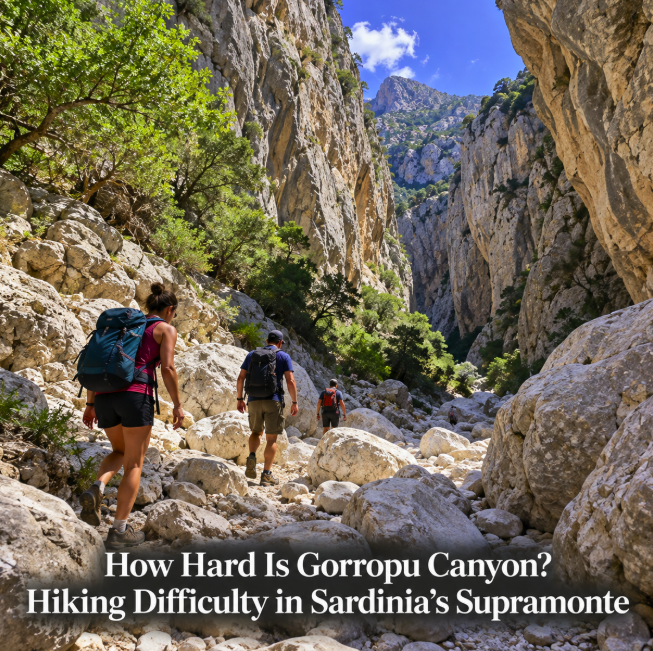
“Easier” does not mean a flat urban walk. Gorropu is a wild limestone environment. Once inside the gorge, visitors encounter stones and large boulders rather than a smooth paved trail, so balance, suitable footwear and attention to footing remain important.
This approach can make sense for travelers who are primarily interested in the canyon walls and geology rather than the physical challenge of descending through the Supramonte landscape.
Ghenna Silana: the classic panoramic hike
The Ghenna Silana approach is the version many hikers picture when researching Gorropu. The official operator describes it as the panoramic option and recommends it for visitors with more strength and willingness to walk. It combines the canyon with the wider scenery, vegetation and history of the Supramonte.
The difficulty comes partly from elevation and terrain rather than technical climbing. You descend through rugged country toward the canyon, which means the route should not be judged only by the comfortable downhill feeling at the start. Depending on the excursion format, hikers may use an off-road transfer for the return rather than climbing all the way back to the starting point.
For a generally fit traveler accustomed to hiking on uneven trails, this is a realistic objective in suitable weather. For someone whose normal exercise is limited to short city walks, it can feel much harder than photographs suggest.
The integral route is a different commitment
Chìntula describes its integral option as requiring a still greater physical effort. This is the category for hikers who deliberately want a demanding Supramonte experience rather than simply a visit to the gorge.
Longer time on rough ground means fatigue becomes a safety factor. Heat, water requirements and slower movement across limestone can make the day considerably more demanding than the distance alone suggests. Visitors should be realistic about fitness and hiking experience, especially when choosing an itinerary that cannot easily be shortened once underway.
Inside the canyon: the terrain changes
Gorropu itself is approximately 1.5 kilometers long, according to the official site. The gorge reaches extraordinary dimensions, dropping roughly 500 meters from the surrounding heights and narrowing in places to only four or five meters.
The interior is famous for huge limestone blocks deposited along the canyon floor. Progress therefore becomes less like conventional trail walking and more like carefully moving through a rocky riverbed. Some visitors will find this fun; others may find repeated stepping between rocks tiring or uncomfortable.
The important distinction is between hiking to Gorropu and moving inside it. A route can involve a substantial approach before the canyon exploration even begins. When estimating your ability, consider the whole day rather than treating the gorge as the only physical section.
Weather can change the difficulty completely
The official operator says Gorropu is generally visitable from mid-March to mid-November and advises against visiting in the remaining period. Adverse weather can create rockfall risk, shorter daylight makes completing the return harder, and visitor services may be reduced or unavailable.
That warning matters in the Supramonte. A hike that is reasonable in dry, mild conditions can become inappropriate after heavy rain or during unstable weather. Travelers should contact the official Gorropu service when forecasts are unfavorable rather than relying on a generic weather app.
Heat is another practical issue. Much of Sardinia can be extremely hot in summer, and the exposed approach can demand more water and energy than visitors expect. Starting earlier and carrying sufficient water are basic precautions, while the exact plan should always reflect current conditions.
Do you need a guide?
The official Gorropu service offers excursions both with and without a guide, so a guide is not universally required for every standard visit. However, guided trekking becomes increasingly useful as the itinerary becomes longer, more remote or more demanding.
Visitors unfamiliar with Mediterranean mountain terrain should not equate a visible trail on a phone with an easy hike. The Supramonte is rugged limestone country, and navigation, water planning and changing weather deserve more attention than on a developed park path.
A practical difficulty guide
For travelers trying to translate the options into everyday terms, the Base Camp and jeep-assisted visit is the most approachable choice. The Ghenna Silana panoramic route is better suited to active walkers comfortable spending hours on uneven mountain terrain. The integral and longer Supramonte routes belong in a more demanding category and should be chosen by hikers with appropriate fitness and preparation.
Good hiking shoes with grip are preferable to casual sneakers or sandals. Carry water, sun protection and a charged phone, and do not plan the day around an unrealistically tight schedule. The official site currently states that the canyon is open daily from 10:00 to 16:30 and that visitors must leave by 17:00; these hours should be rechecked before setting out because operating conditions can change.
Gorropu’s reputation can make it sound like an extreme adventure reserved for expert mountaineers, but that is misleading. There are ways for ordinary active travelers to experience the canyon. What matters is choosing the right approach: the easiest transfer-assisted visit, the more athletic Ghenna Silana descent or a genuinely demanding Supramonte trek. In Gorropu, difficulty is determined as much by the route you choose as by the canyon itself.