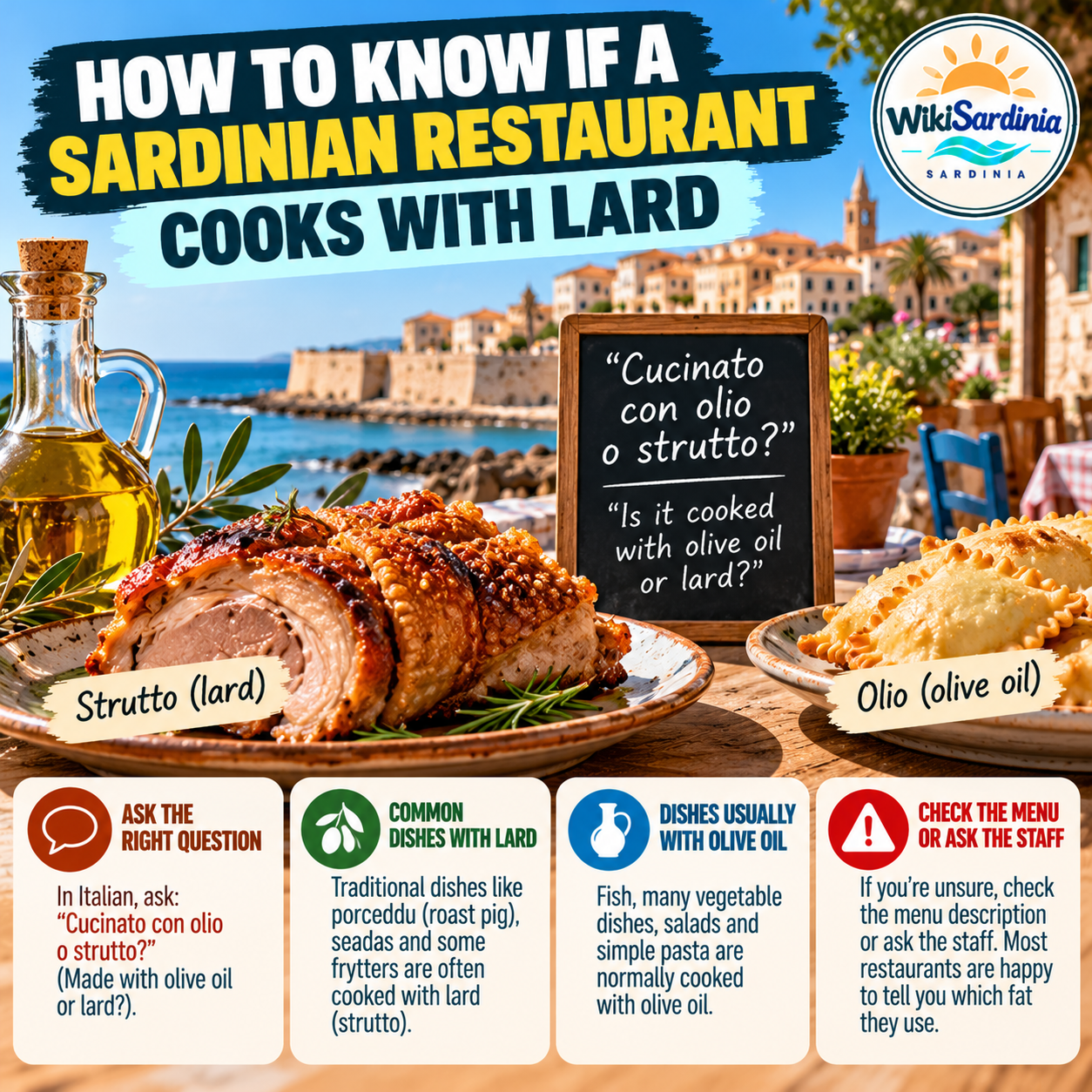
Traditional Sardinian cooking uses a variety of fats, including olive oil and, in some recipes, pork lard (strutto). The choice depends on the dish, the family recipe and the restaurant, so it is best to ask rather than assume that everything is cooked with olive oil—or that lard is used everywhere.
The simplest question to ask
You can ask the waiter:
“È cucinato con olio d’oliva o con strutto?”
“Is it cooked with olive oil or lard?”
For a particular dish, point to the item on the menu and ask about its preparation. You can also say “Quali grassi usate per prepararlo?” (“What fats do you use to prepare it?”).
Which Sardinian dishes might use lard?
Some traditional baked goods, breads, pastries and older-style recipes may use lard, while many other dishes are prepared with olive oil. Ingredients can vary considerably by recipe and producer, so a dish’s traditional name is not enough to establish which fat was used in the version served to you.
How to ask clearly
- Olive oil: “È preparato con olio extravergine d’oliva?” — Is it made with extra virgin olive oil?
- Lard: “Contiene strutto?” — Does it contain lard?
- Other animal fats: “Usate altri grassi animali?” — Do you use other animal fats?
- For a specific dish: “Potete controllare gli ingredienti in cucina?” — Could you check the ingredients in the kitchen?
If you need to avoid lard completely
Explain that you need to avoid it, rather than asking only which fat is more common. For example: “Non posso mangiare strutto. Potete verificare gli ingredienti e come viene preparato il piatto?” (“I cannot eat lard. Could you check the ingredients and how the dish is prepared?”)
If the reason is an allergy, religious observance or a strict dietary requirement, also ask about other animal-derived ingredients and possible cross-contact with cooking surfaces, utensils or fryers. If staff cannot confirm the ingredients, choose a dish they can explain clearly.
Don’t rely on appearance or taste
Olive oil and lard are not always easy to distinguish once they are incorporated into a recipe. A glossy finish, texture or flavour is not a reliable way to identify the cooking fat. Asking staff about the specific preparation is the practical option.
A useful phrase to remember
“È cucinato con olio d’oliva o con strutto?” is a clear, polite starting point. In Sardinia, as elsewhere, recipes vary between kitchens, so ask about the dish you intend to order—especially if avoiding lard is important for health, religious or personal reasons.