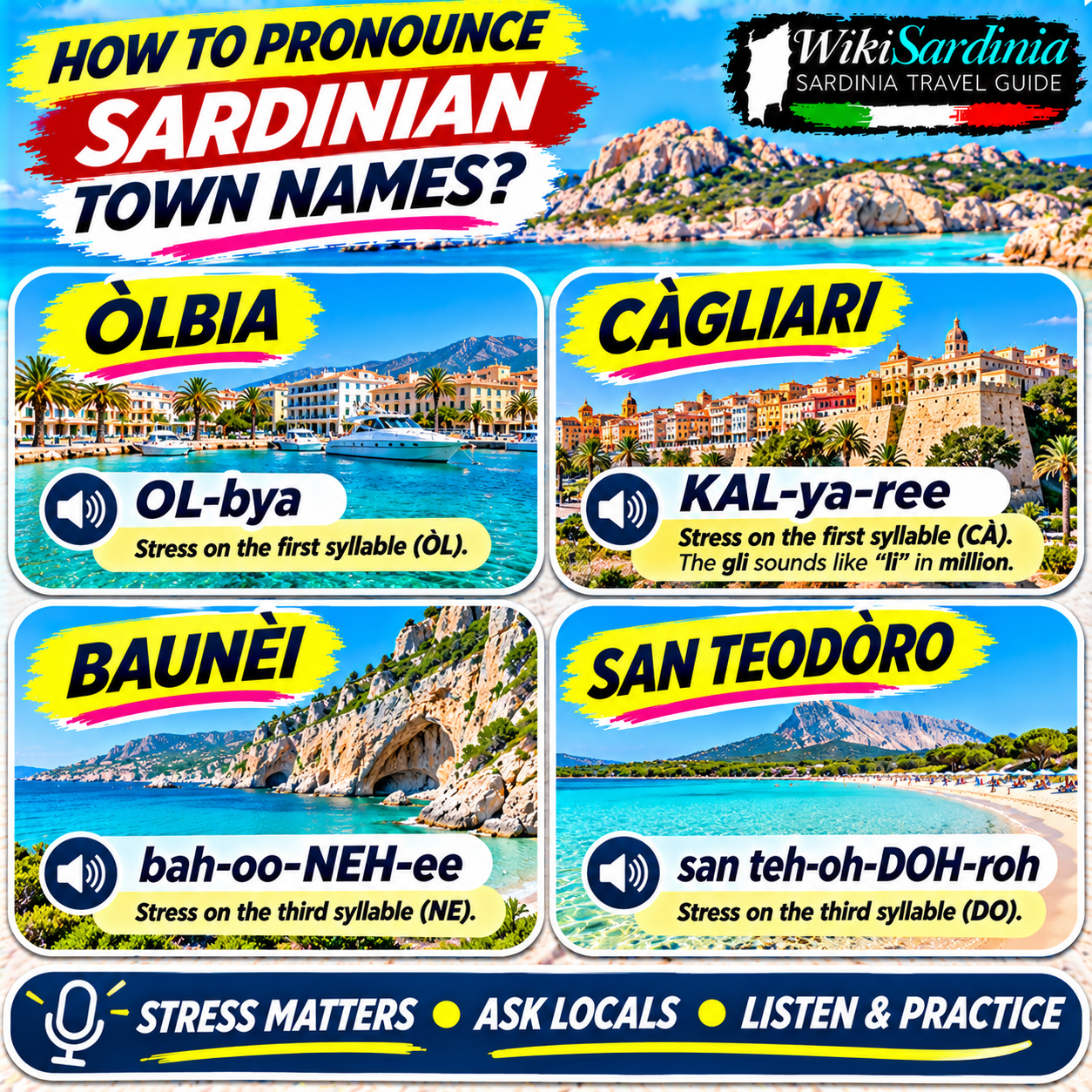
Visiting Sardinia? Four place names worth learning are Òlbia, Càgliari, Baunèi and San Teodòro. Italian spelling often leaves stress unmarked, and Sardinian place names can preserve local sounds and histories. Here is a practical pronunciation guide for English-speaking visitors, with stress marked for learning rather than as part of the official written names.
Quick pronunciation guide
| Place | Stress-marked guide | Approximate English cue | Key tip |
|---|---|---|---|
| Olbia | Òlbia | OL-byah | Stress OL, not bee |
| Cagliari | Càgliari | KAHL-yah-ree | Stress CA; gli is one palatal sound |
| Baunei | Baunèi | bah-oo-NEH-ee | Emphasize the NE portion of the ending |
| San Teodoro | San Teodòro | sahn teh-oh-DOH-roh | Stress DO in Teodoro |
These English cues are approximate; they cannot perfectly represent every Italian or local Sardinian sound. Forvo recordings can help you hear the pronunciation from speakers rather than relying only on English spelling.
Olbia: stress the first syllable
Òlbia is pronounced with the stress at the beginning: OL-byah. Avoid stressing the i, as in ol-BEE-ah. There is a historical twist: a 2026 article in La Nuova Sardegna explains that the ancient Punic and Roman name had stress on the i, while the restored modern name adopted initial stress. The city was also known as Terranova Pausania before its modern name was restored in the twentieth century. So the modern pronunciation is not simply a timeless rule inherited unchanged from antiquity.
Cagliari: the tricky gli sound
Càgliari, Sardinia's regional capital, is pronounced roughly KAHL-yah-ree. The stressed syllable is the first. In standard Italian, the letters gli here represent the palatal lateral consonant /ʎ/, often lengthened in speech. It is similar to the sound in Italian famiglia and not the English sequence of a hard g followed by l. The Forvo Italian pronunciation page gives /ˈkaʎʎari/. Local newspaper L'Unione Sarda has also noted how difficult the name is for foreign visitors.
Baunei: don't flatten the ending
Baunèi is a village in Ogliastra associated with spectacular limestone landscapes and the coast near Cala Goloritzé. An English-friendly cue is bah-oo-NEH-ee, with emphasis on the stressed e in the final sequence. You may hear regional differences in the way the vowels run together. Forvo has a Sardinian-speaker recording of Baunei; use it to refine your ear. The pronunciation marking here is a learning aid, not an instruction to insert an accent in the official name on maps or tickets.
San Teodoro: the emphasis is on DO
San Teodòro is roughly sahn teh-oh-DOH-roh. Say San briefly and place the main stress of Teodoro on DO. English speakers sometimes shift the stress toward the beginning or pronounce it like the English name Theodore. Keep the Italian vowels clear: a short e, an o, the stressed DO, and a final ro.
Why are written accents usually missing?
Most Italian place names are written without stress marks when the stress falls within the word, so official signs show Olbia, Cagliari, Baunei and San Teodoro. The accented forms in this guide are pronunciation annotations. Italy's Istituto Geografico Militare explains that stress normally falls on the penultimate syllable, but geographic names have exceptions and mapmakers may add accents for clarity. Do not add these teaching accents to addresses, booking forms or navigation searches.
How to practise the names
- Say the stressed syllable slowly and slightly louder.
- Repeat the whole name at a natural speed without adding English-style diphthongs to every vowel.
- For Cagliari, practise the Italian gli in famiglia first.
- Listen to an Italian or Sardinian speaker, especially for Baunei.
- Use the ordinary unaccented spelling when searching maps, ferries, hotels or attractions.
Useful phrases for asking locals
- “Come si pronuncia questo nome?” — How do you pronounce this name?
- “Ho detto bene Cagliari?” — Did I say Cagliari correctly?
- “Può ripeterlo più lentamente?” — Could you repeat it more slowly?
- “Dov'è l'accento?” — Which syllable is stressed?
- “Sto imparando i nomi dei paesi sardi.” — I'm learning the names of Sardinian towns.
Frequently asked questions
Is Olbia pronounced with the stress on O or I?
In modern standard usage, stress the first syllable: Òlbia. Historical forms differed.
Why is Cagliari difficult for English speakers?
The Italian gli sound /ʎ/ has no straightforward single-letter English equivalent. The stress is on the first syllable.
Is Baunei pronounced with the stress near the end?
Yes. The commonly represented local pronunciation places stress on the e of the ending, written Baunèi here as a guide.
Where is the stress in San Teodoro?
On DO in Teodoro: San Teodòro.
Should I type accent marks into Google Maps?
No. Use the official spellings without teaching accents.
Do Sardinian and Italian pronunciations always match?
Not necessarily. Local Sardinian languages and dialects can preserve different names or phonetic details. Listening to residents is valuable.
Is it rude to mispronounce a town name?
Not generally. Making a sincere effort and politely asking for the correct pronunciation is a friendly way to connect with local people.
The bottom line
Remember four stress patterns: Òlbia, Càgliari, Baunèi and San Teodòro. For Cagliari, practise the Italian gli; for Baunei, listen carefully to local pronunciation. A little practice makes asking for directions and chatting with Sardinians much easier.