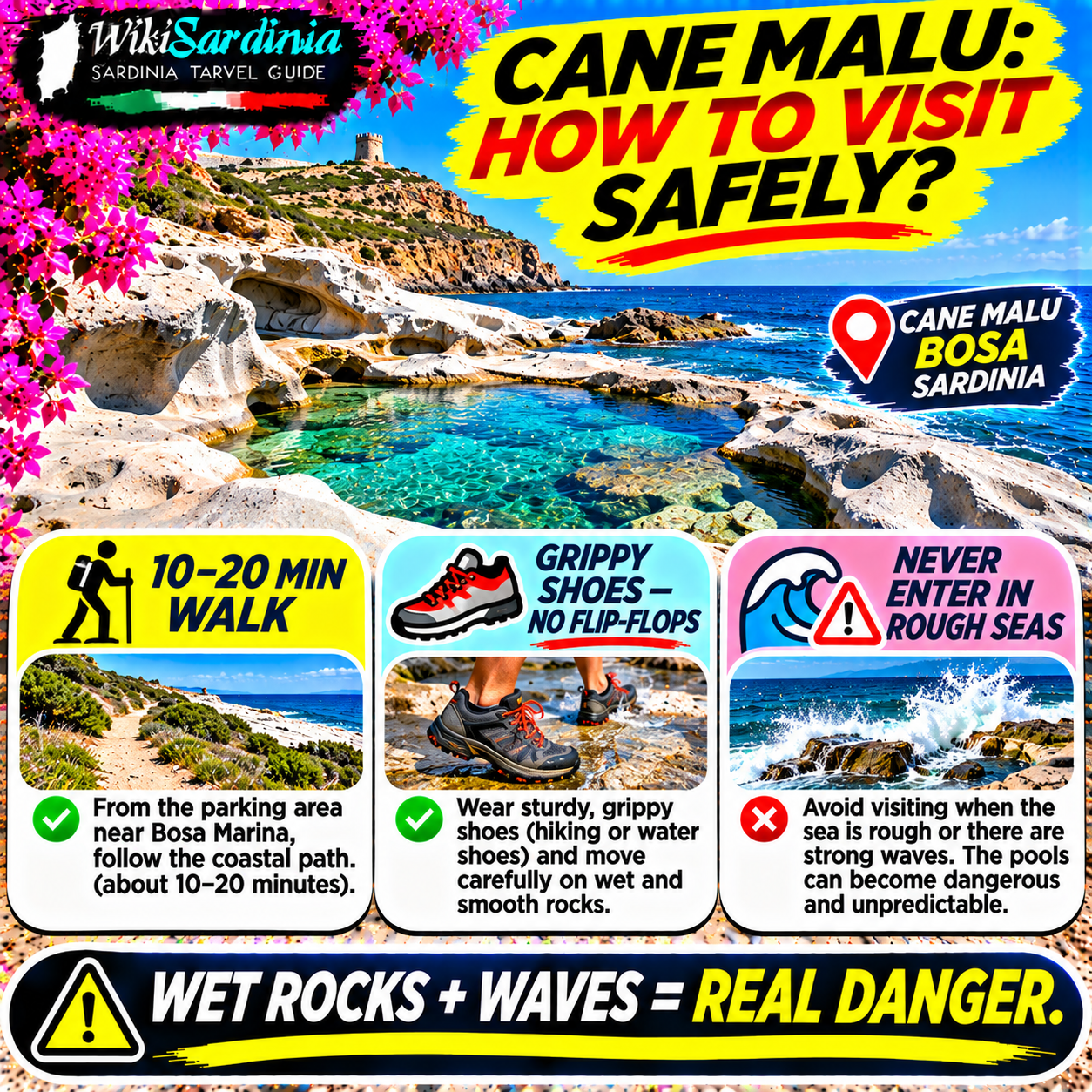
Cane Malu is reached on foot from the Bosa Marina river-port area, along a short coastal path that ends on smooth, uneven trachyte rock. The walk typically takes around 10–20 minutes, but the final descent and wet rock beside the natural pool require care. Wear sturdy shoes with reliable grip, avoid the site in rough seas, and never assume that a calm-looking pool is safe to swim in.
Where is Cane Malu?
Cane Malu lies at Cabu d'Aspu, just north of Bosa Marina on Sardinia's west coast, about three kilometres from historic Bosa. The sea has carved pale trachyte into an extraordinary basin surrounded by rock ledges. Although often described as a “tide pool,” it is an open coastal natural pool influenced by waves and sea conditions, not a protected swimming pool. SardegnaTurismo's official guide describes the coastal path and the distinctive white-rock landscape.
Where should you park?
Head toward the river port at the mouth of the Temo in Bosa Marina, around the Sas Covas area. Travel descriptions identify a starting point near the SLF boatyard. Park only where parking is legally permitted; do not block boatyard access, gates or narrow lanes. There is no guarantee of a dedicated staffed parking lot or available spaces. From the port area, continue on foot toward the coastal path rather than attempting to drive down to the rock pools.
How do you find the trail?
From the Sas Covas/river-port area, follow the approach road on foot to the fork, then take the dirt route to the right toward the coast. Descriptions of the trail mention a small wooden Cane Malu sign near a seafront villa, before the final descent across the pale rocks. Follow the actual marked path and respect private property and any new closure signs. Do not cut across unstable slopes to shorten the walk.
How long and difficult is the walk?
The regional tourism website describes roughly ten minutes from the port, while visitors commonly allow 15–20 minutes from their parking place, especially with photo stops or cautious footing. The Italian Ministry of Culture's Idese guide classifies the trail as medium difficulty, with only partial mobility accessibility and no bar. The first approach can feel straightforward, but the final descent is irregular and the smooth rocks become slippery when wet. It is not a stroller-friendly promenade.
What shoes prevent slipping?
For the walk, choose closed walking shoes or lightweight hiking shoes with grippy soles. Near the water, secure water shoes designed for slippery rock can be useful, but no footwear guarantees traction on algae or wet trachyte. Avoid flip-flops, smooth-soled sandals and barefoot scrambling. Move slowly, keep your hands free, maintain three points of contact on steeper sections and test each foothold before transferring your weight.
How do you approach the pool safely?
Stop on dry, stable rock well back from the edge and watch the water for several minutes. Look for occasional larger waves, spray reaching the ledges and water surging into or out of the basin. If rocks are wet from surf, do not approach the exposed edge. Never step onto a narrow outer rim to take a photograph. The safest decision may be to enjoy the view without entering the water.
Can you swim in Cane Malu?
Swimming is sometimes possible in calm conditions, but it is not guaranteed safe. The basin is connected to the open sea; surge and backwash can be powerful even when the surface briefly appears placid. There are submerged rocks, slippery surfaces and potentially sea urchins. There is no lifeguard or rescue service directly at the pool. Avoid jumping or diving from the rocks: depth, submerged hazards and water movement are not reliably predictable.
What weather conditions should make you cancel?
Do not enter the pool or approach exposed ledges when the sea is rough, waves are breaking over the rocks, or wind is strengthening. The west coast is particularly exposed to the Maestrale, a northwesterly wind that can generate dangerous surf. Even after the wind eases, residual swell can persist. Check a marine forecast and observe actual conditions; sunshine and blue water alone are not safety indicators.
Is Cane Malu suitable for children or visitors with reduced mobility?
The Idese cultural-heritage guide reports only partial accessibility, and the uneven trail and final rock descent make it unsuitable for strollers or visitors who cannot safely negotiate irregular surfaces. Children need close supervision well away from the water's edge. If anyone in your group is unsure of their balance, do not pressure them to complete the descent. The landscape can be appreciated from safer viewpoints where accessible.
What should you bring?
Carry drinking water, a hat, sun protection, a charged phone, a small first-aid kit and a bag for your rubbish. Shade and services are limited or absent at the pools. A dry bag can protect valuables, but it should not tempt you to swim in unsafe conditions. Travel light enough to keep both hands available on the rocks and return before dark; a sunset photograph is not worth descending unfamiliar terrain in fading light.
What if the rocks are already wet?
Wet rock is a warning, especially when it is wet from waves. Stay farther inland on dry ground and do not cross algae-covered or polished surfaces. If the route to the pool requires stepping onto wet, exposed ledges, turn back. Wait for a different day rather than trying to outrun the next wave. A calm interval between waves does not make an exposed ledge safe.
Are there toilets, shops or lifeguards?
No reliable facilities are available directly at Cane Malu. The Idese guide lists no bar, and local travel descriptions report no toilets, showers or lifeguard at the rock pools. Buy water and supplies before starting and plan to use facilities in Bosa Marina.
What if the sea is too rough?
Skip the pools and consider a walk around Bosa or Bosa Marina instead, checking beach flags and conditions before any swim. A sandy beach is not automatically safe in rough weather, but it may offer more accessible services and seasonal supervision. Do not try to find a more exposed pool farther along the same coast.
Frequently asked questions
How do I reach Cane Malu from Bosa?
Drive to the Bosa Marina river-port/Sas Covas area, park legally and follow the coastal path toward Cabu d'Aspu. Allow around 10–20 minutes on foot.
Is the Cane Malu trail easy?
It is short but uneven; Idese classifies it as medium difficulty. The final rock descent requires good balance and footwear.
Can I wear flip-flops?
They are a poor choice. Wear secure, grippy walking shoes and use appropriate water shoes only where conditions are safe.
Can I swim after a windy day?
Not necessarily. Swell may remain after the wind drops. Assess the sea and stay out if waves or surges reach the pool.
Is it safe to jump into the pool?
No jump should be assumed safe. Hidden rocks, variable depth and surge make diving or jumping hazardous; avoid it.
Can I bring a stroller?
No, the irregular path and rocky descent are not suitable for strollers.
Is there an entry fee?
The Idese guide lists free entry, subject to any later access restrictions or closures.
Is there a lifeguard?
No lifeguard service is documented directly at the pools.
The takeaway
For Cane Malu, footwear and sea conditions matter more than speed. Start from the Bosa Marina river-port area, allow 10–20 minutes, follow the established trail, and approach only on dry, stable rock. Never enter in rough seas or when waves wash over the ledges. If conditions are uncertain, admire this remarkable lunar landscape from a safe distance.
Sources: SardegnaTurismo — Cane Malu; Idese, Italian Ministry of Culture — Cane Malu trail and access; Non c'ero mai stata — Route and parking description.