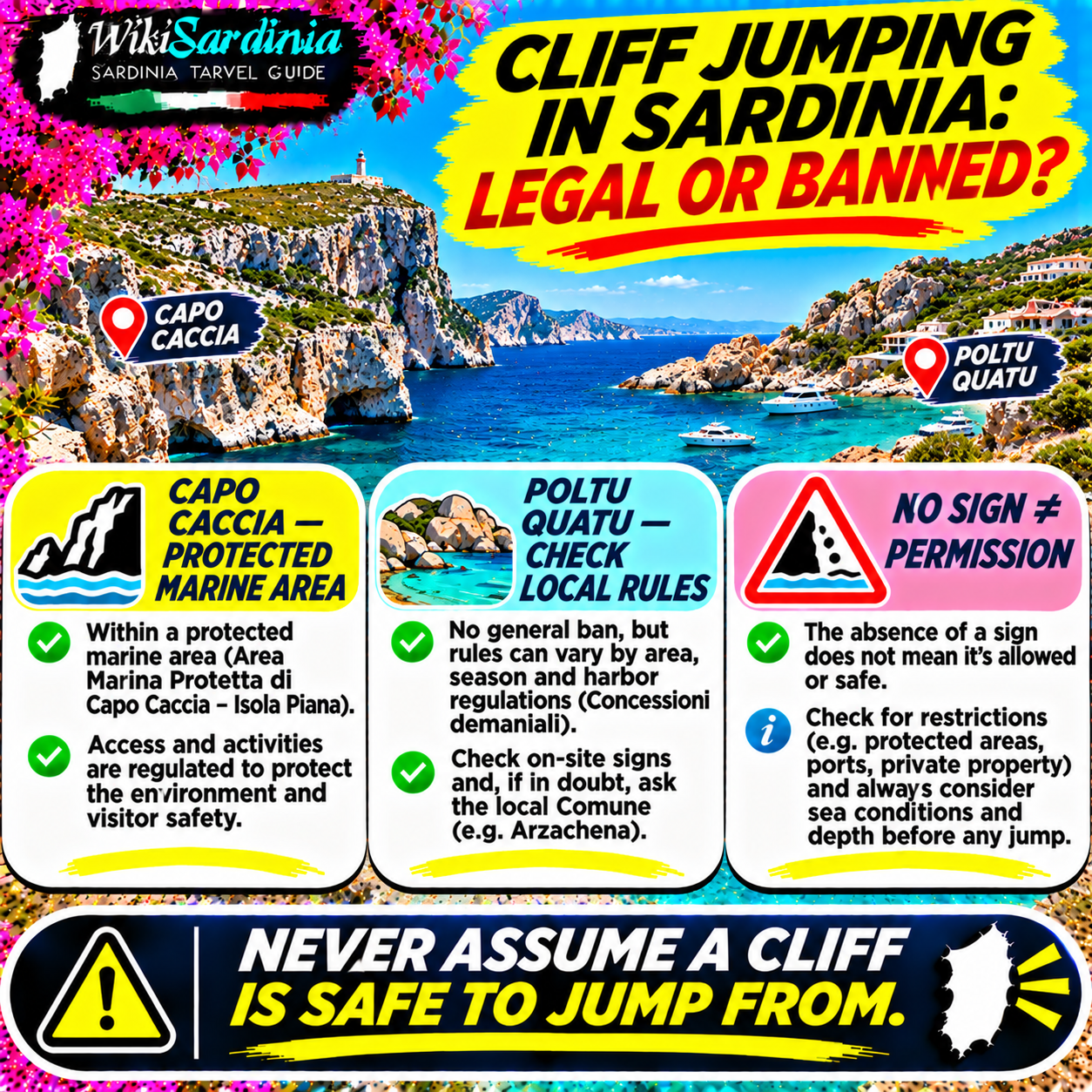
Cliff jumping and tombstoning are not automatically legal everywhere in Sardinia. At Capo Caccia near Alghero, marine-protected-area zoning and access restrictions apply. At Poltu Quatu in Arzachena, local coastal and harbor rules may apply. We could not verify a blanket, location-specific legal permission for recreational cliff jumping at either place, nor a universal ban covering every rock. The absence of a warning sign is not authorization—and an accessible cliff is not necessarily safe.
Is cliff jumping illegal throughout Italy?
There is no single nationwide rule that automatically prohibits every recreational jump from a natural rock into the sea. Whether an activity is allowed depends on the precise site: maritime ordinances, protected-area rules, harbor navigation zones, restricted property, posted closures and the nature of the activity. Swimming permission does not necessarily mean permission to use a cliff as a jumping platform. Never assume that a social-media video demonstrates legality.
What rules apply at Capo Caccia?
Capo Caccia is within the Capo Caccia–Isola Piana Marine Protected Area. The managing authority's 2026 implementing rules regulate swimming, diving, navigation and other marine activities. The reserve is divided into Zone A (integral protection), Zone B (general protection) and Zone C (partial protection), with different restrictions. Zone A is subject to the strictest protection; do not enter or jump into restricted waters. Swimming may be allowed in designated B and C areas, but this does not establish that jumping from cliffs is permitted. Check the exact location on the official zoning map and ask the managing authority or Coast Guard before planning any activity.
What about the high cliffs and viewpoints?
The spectacular limestone cliffs at Capo Caccia are not designated cliff-jumping platforms. Access routes, viewpoints and protected habitats may have additional restrictions. The coastal cliffs can be extremely high, with caves, submerged rock shelves and strong swell. Do not climb beyond barriers or descend unmarked routes to attempt a jump. Even where swimming is lawful below, that does not make a jump from above lawful or safe.
Is tombstoning allowed at Poltu Quatu?
No verified blanket permission was found. Poltu Quatu is in the municipality of Arzachena and includes a marina and coastal inlets. Swimming and jumping can be restricted around harbor entrances, boat channels, moorings, private facilities or specific coastal areas. The Comune di Arzachena's permanent-ordinance page lists applicable local rules, including beach-use provisions. Before entering the water or approaching a rock ledge, check on-site signs and the relevant Coast Guard and municipal ordinances. Never jump into a harbor or active boat route.
Does a 'no diving' sign apply to jumping?
Yes, treat a sign reading Vietato tuffarsi or Divieto di tuffi as a prohibition on jumping or diving into the water. Other signs such as Divieto di balneazione (no swimming), Zona A – Riserva integrale (strictly protected area), Accesso vietato (no entry) and harbor restrictions can also prevent access or water entry. Respect temporary barriers and directions from authorities, even if other people ignore them.
Can you be fined?
Yes, violating an applicable maritime, protected-area, municipal or access restriction can lead to administrative or other legal consequences, depending on the rule breached. There is no single verified standard 'cliff-jumping fine' for both Capo Caccia and Poltu Quatu. Do not trust websites quoting one fixed penalty without identifying the exact ordinance and violation. The protected-area founding decree and local ordinances are the relevant legal starting points.
Why is cliff jumping especially dangerous here?
Water depth can change abruptly and submerged ledges may be invisible even through clear water. Sea swell, wind, currents and boat wakes can alter the landing area. Wet limestone and granite can be slippery; returning to land may be much harder than entering the water. A jump that appears survivable in a video may cause spinal injury, head trauma, drowning or death. Never infer safety from the apparent height, clarity of water or the actions of other visitors.
Is it safe to jump if the water looks deep?
No. Looking down from a cliff does not reliably establish underwater clearance, water movement or a safe exit. Even apparently deep water can hide rock shelves, and changes in tide, swell and sea conditions can make a location dangerous. We do not recommend attempting an unsupervised jump or giving a 'safe height' or takeoff point. Choose supervised swimming or a professionally managed activity instead.
Can you jump from a boat or marina wall?
Do not jump from harbor walls, moorings, jetties or vessels without explicit authorization and a properly managed activity. Harbors are working areas with moving boats, propellers, ropes and restricted swimming zones. The fact that a marina has clear water is not evidence that recreational jumping is allowed.
How can visitors verify the rules?
For Capo Caccia, consult Alghero Parks' 2026 permitted-activities page and the official zoning map. For Poltu Quatu, consult the Arzachena municipal ordinances and any current local maritime notices. Ask the relevant Capitaneria di Porto or Guardia Costiera about the precise spot, not just the general place name. Describe the exact access point and planned activity, and seek a clear response before acting.
What are safer alternatives?
Enjoy Capo Caccia from authorized panoramic viewpoints, take a permitted boat excursion or swim at a designated beach with suitable conditions and seasonal supervision. Around Poltu Quatu, choose authorized swimming areas away from marina traffic. If you want an adventure activity involving height or water entry, use a qualified provider operating at a permitted site with appropriate risk assessment and rescue arrangements. Professional supervision reduces risk but cannot eliminate it.
What should you do if someone is injured?
Call 112 for emergency assistance, or 1530 for maritime emergencies, and provide the precise coastal location, access route and number of people involved. Do not jump after an injured person or move someone with a suspected spinal injury unless immediate danger requires it and you can do so safely. Alert nearby lifeguards or boat crews and follow emergency-service instructions.
Frequently asked questions
Is cliff jumping at Capo Caccia legal?
It cannot be assumed legal. Protected-area zoning and current restrictions apply; no general cliff-jumping authorization was verified.
Can you jump from rocks at Poltu Quatu?
Do not assume permission. Check local coastal and harbor rules and avoid navigation zones and restricted facilities.
Does 'swimming permitted' mean jumping permitted?
No. Swimming and jumping are different activities and may be governed by different restrictions.
Is there a standard fine for cliff jumping?
No single location-independent fine was verified. Penalties depend on the actual ordinance or rule violated.
Are there safe cliff-jumping spots near Alghero?
We cannot certify an unsupervised cliff as safe. Choose a legally authorized, professionally supervised activity if available.
What does 'Vietato tuffarsi' mean?
It means 'No diving or jumping into the water.' Follow the sign even if others are jumping.
Who should I ask for official confirmation?
The Capo Caccia marine-protected-area authority, the relevant municipality and the local Coast Guard, specifying the exact site.
The takeaway
Neither Capo Caccia nor Poltu Quatu should be treated as a freely authorized cliff-jumping destination. Capo Caccia has protected marine zones, while Poltu Quatu may be subject to local and harbor restrictions. A lack of signs is not permission. More importantly, the risks of hidden rocks, swell and serious injury make unsupervised tombstoning a poor choice. Enjoy the cliffs from approved viewpoints and swim in designated areas instead.
Official sources: Alghero Parks — Activities permitted under the 2026 rules; Alghero Parks — Protected-area zoning; Italian Official Gazette — Capo Caccia marine reserve decree; Comune di Arzachena — Permanent ordinances.