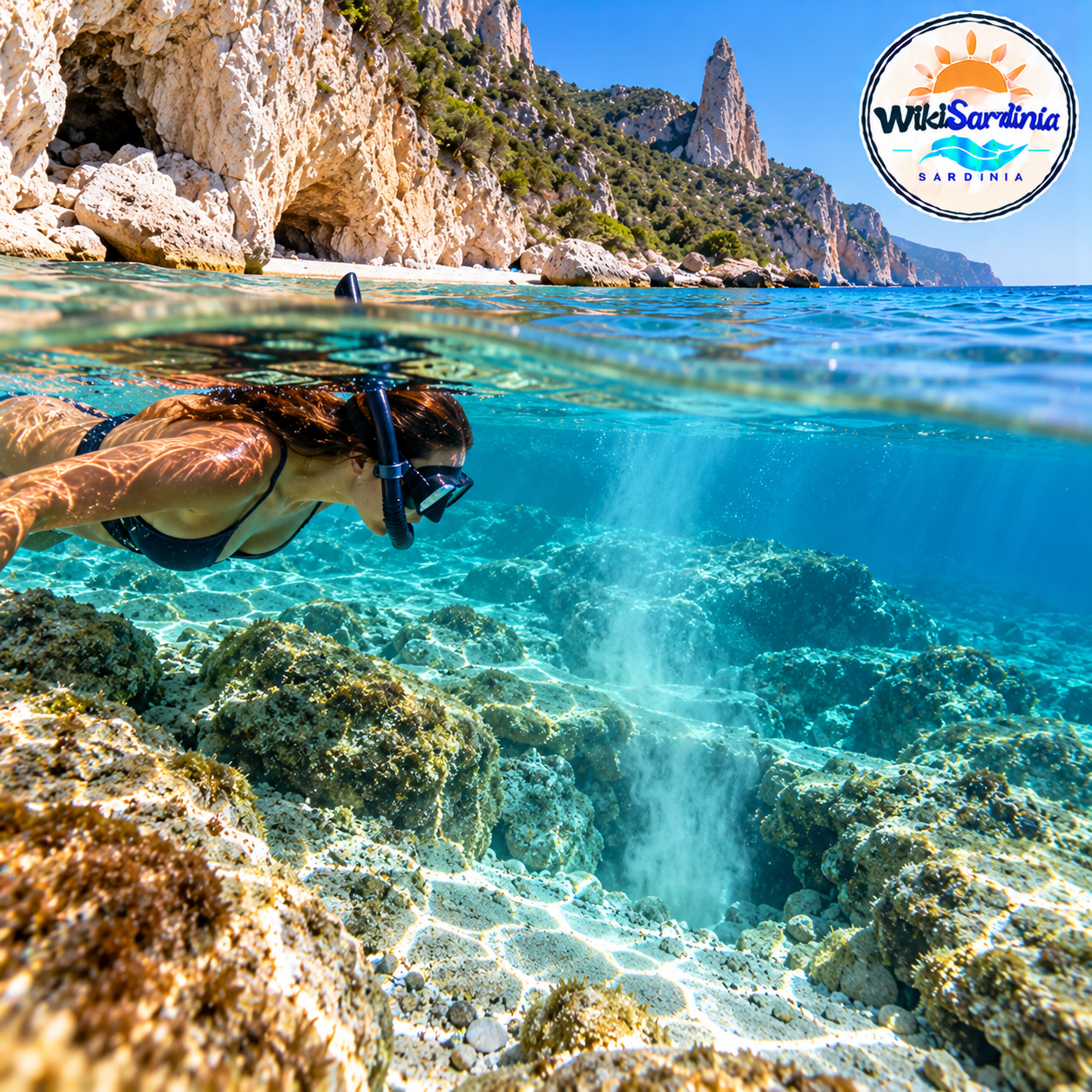
Have you ever been swimming in Sardinia and suddenly felt the sea turn much colder in one small area? Along parts of the island’s limestone coast, that can be a clue to an underwater freshwater spring, where groundwater travels through the rock and emerges beneath the sea. But a sudden temperature change alone does not prove that a spring is present: shade, depth, currents and mixing can also change how the water feels.
What does an underwater spring feel like?
Fresh groundwater often stays cooler than the sea during summer. Where it emerges, swimmers may notice a distinct cold patch or a boundary between water masses. In some places, the flow can also create subtle movement in sand or a shimmering plume. These signs vary with the strength of the spring, sea conditions and how quickly freshwater mixes with saltwater, so there is no single visual clue that works everywhere.
Research on submarine groundwater discharge in the Mediterranean confirms that groundwater can create temperature and salinity contrasts at the coast. Waves, tides and currents can quickly weaken those contrasts, which is why a spring may be noticeable one day and difficult to detect another.
Where can you experience this in Sardinia?
Cala Goloritzè, in the Gulf of Orosei, is a well-known example. The local official visitor website describes sudden drops in water temperature—sometimes up to 10°C—associated with an underwater freshwater spring. Conditions vary, and this is not a guaranteed temperature difference on every visit.
Scientific studies also document a network of coastal karst springs around the Gulf of Orosei, including systems associated with the Sisine coast, Cala Luna and Bue Marino. These are geological features, not necessarily places where a spring is easy or safe for casual swimmers to approach. Some outlets are connected to complex underwater cave systems.
Can you identify a spring just by feeling cold water?
No. A cold patch is a useful observation, not a reliable test. A shaded section of water, a change in depth, a current bringing water from elsewhere or normal mixing can feel similar. Confirming a spring requires more than a swimmer’s sensation; scientists may measure temperature and salinity or use specialised surveys.
How to enjoy the phenomenon safely
- Stay near the surface: observe from a comfortable swimming or snorkelling depth and never dive into holes or underwater openings.
- Do not swim alone: use a buddy, stay within your ability and follow local sea and beach warnings.
- Respect currents: freshwater discharge and coastal circulation can create local movement that may be hard to judge.
- Do not drink the water: an underwater spring mixes with seawater, and its quality is not established by appearance.
- Use expert guidance: leave cave entrances and submerged outlets to appropriately trained professionals.
Why Sardinia has underwater springs
Large areas of Sardinia contain limestone and dolomite, rocks that can develop cracks, conduits and caves as water slowly dissolves them. Rain can infiltrate the ground, travel through underground karst networks and eventually emerge at the coast, sometimes below sea level. The Gulf of Orosei’s rugged limestone landscape is particularly suited to this kind of groundwater system.
A cold patch may be a clue, not a guarantee
If the sea suddenly feels colder around Cala Goloritzè or another rocky Sardinian cove, you may be experiencing a freshwater spring—but you cannot identify one with certainty by touch alone. Enjoy the unusual sensation, keep a safe distance from underwater openings and let the coast’s geology remain something to admire rather than explore recklessly.
Further reading: Cala Goloritzè official visitor information; CNR — Groundwater geochemistry of the Sisine coastal karst system; Hydrology and Earth System Sciences — detecting submarine groundwater discharge in the Mediterranean.