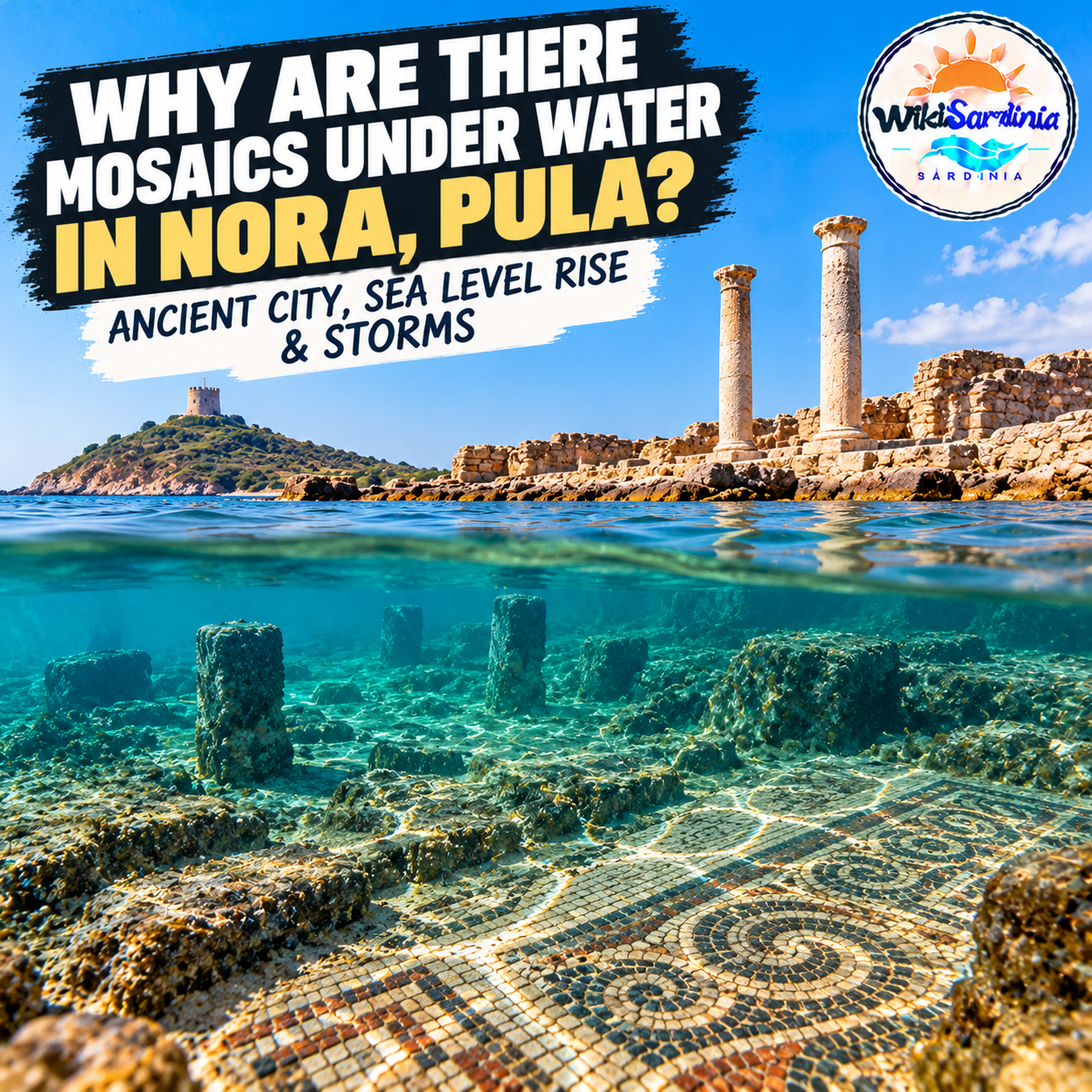
At Nora, near Pula in southern Sardinia, ancient streets, houses and Roman remains sit remarkably close to the sea. Some coastal structures are partly eroded, and parts of the ancient landscape now lie at or below today’s waterline. The reason is not simply that one storm “swallowed” a city: changes in sea level and centuries of coastal erosion have gradually reshaped the peninsula, while powerful storms can accelerate damage or reveal archaeological layers that had been hidden.
Was Nora a city built underwater?
No. Nora developed on a coastal peninsula and became an important Phoenician, Punic and later Roman settlement. Its inhabitants built homes, public buildings, baths and streets on land that has changed significantly over the centuries. Archaeological research on Nora’s southern coastal residential district notes that the shoreline has retreated and that some structures near the present beach have been eroded by the sea.
That means a ruin visible close to the water—or a structure now partly submerged—does not necessarily indicate that it was originally built underwater. The coastline in antiquity was not exactly where it is today.
Why are mosaics associated with Nora?
Nora preserves Roman houses and bath complexes with decorated floors. The official Ministry of Culture description highlights mosaics in the residential quarter, including the House of the Tetrastyle Atrium, as well as structures and thermal buildings dating to the Roman period. These mosaics were interior architectural features, not decorations designed to sit on the seabed.
When people refer to “underwater mosaics,” they may be combining images of the site’s colourful Roman floors with the fact that parts of Nora’s coastal remains are affected by the sea. Not every mosaic at Nora is underwater, and a dramatic split-view image should not be taken as proof that a particular mosaic lies beneath the waves.
How sea-level change and erosion affect the ruins
Over many centuries, sea-level change, local geological processes and wave action have altered the shape of Nora’s coastline. The University of Padua’s archaeological project describes the coastal houses as being affected by progressive sea-level rise and shoreline retreat. The Sardinian regional government has also identified erosion and repeated flooding as threats to the archaeological area, including the Roman baths.
Waves can undercut walls, move stones and remove the sediment that once protected buried remains. Once exposed, fragile archaeological layers may deteriorate more quickly. Conservation teams therefore have to balance protection of the site with the natural dynamics of a coast that remains active.
What happens after a major storm?
A storm can shift sand and sediment, uncover previously hidden remains, carry loose archaeological material away or damage exposed walls. Nora’s history includes a notable discovery after a strong sea storm in the late nineteenth century, when part of the Punic tophet came to light and helped prompt further archaeological investigation.
More recently, severe storms have again highlighted the site’s vulnerability. In January 2026, reports citing the archaeological authorities described substantial coastal damage at Nora after powerful waves, with inspections needed to assess affected structures. Such events show why exposed ruins should be protected—not why visitors should search the shoreline for artefacts.
Can visitors see the mosaics today?
Yes, Nora’s archaeological area includes visible Roman remains and mosaics, but access to particular areas depends on the official visitor route and conservation arrangements. Do not enter the water to reach ruins, cross barriers or attempt to view damaged sections from unstable rocks. After rough weather, check official notices before visiting because access and safety conditions can change.
For opening information and the archaeological site’s history, consult the Italian Ministry of Culture’s Nora page. For details on the coastal residential remains, see the University of Padua’s study of Nora’s southern coastal houses.
Why protecting Nora matters
Nora is more than a photogenic ruin beside turquoise water. Its buildings record centuries of Phoenician, Punic and Roman life, and their location helps archaeologists understand how the settlement interacted with trade, harbours and the changing coastline. Erosion can reveal evidence, but it can also destroy the context that makes that evidence meaningful.
The short answer
Some of Nora’s ancient coastal structures are at the water’s edge or partly submerged because sea levels and the shoreline have changed over centuries. Storms can expose remains and cause further damage. Roman mosaics are found in the city’s houses and baths, but it is inaccurate to suggest that all Nora’s mosaics are underwater or that one storm alone submerged the city. Visit the authorised archaeological area, enjoy the mosaics from permitted routes and leave every stone where it belongs.