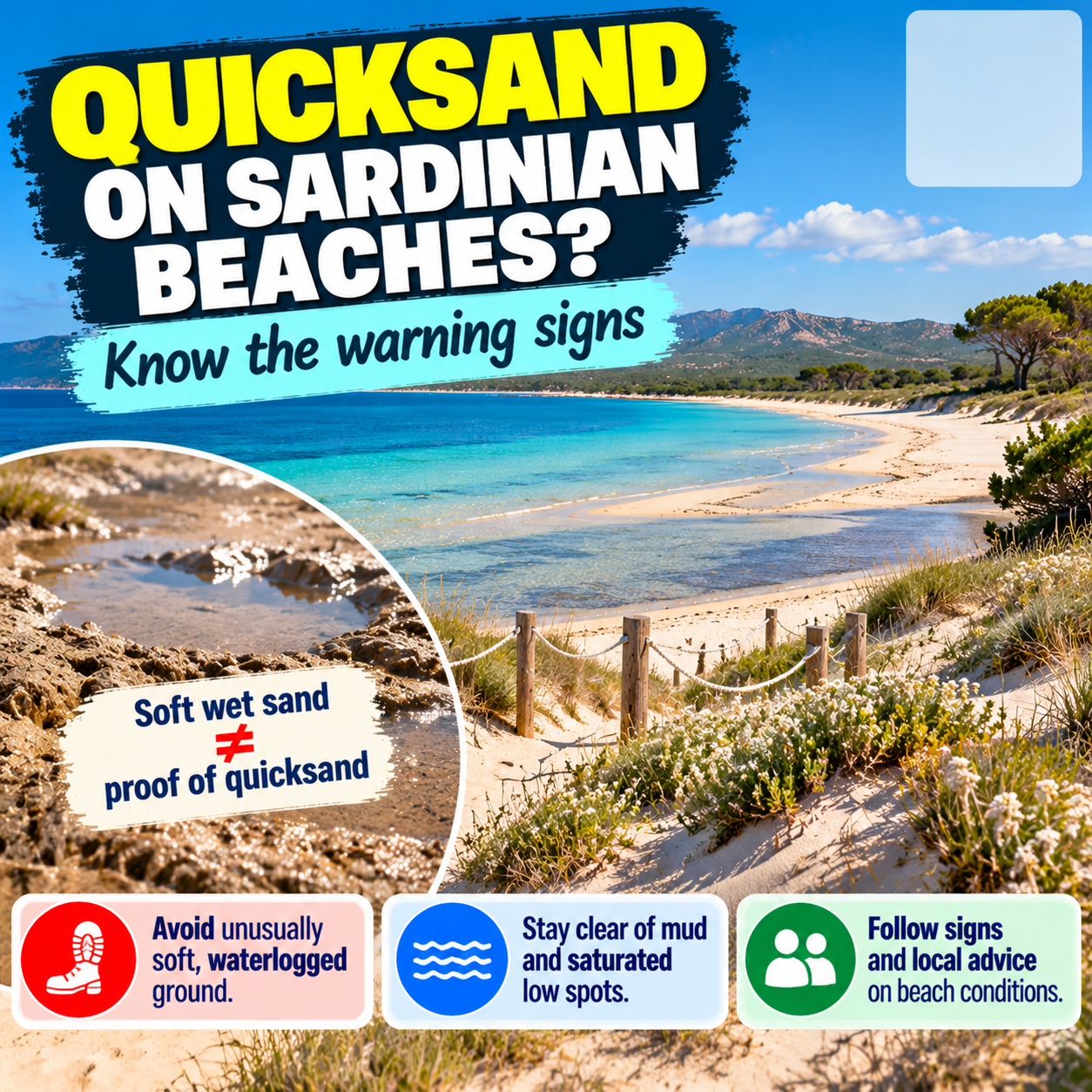
Quicksand is not something visitors should assume they will encounter on an ordinary Sardinian beach. However, sand or fine sediment saturated with water can sometimes become unstable, especially in low-lying areas or after changes in weather and water levels. The important point is that wet sand or mud alone does not prove that quicksand is present.
Can Sardinian beaches have quicksand?
Unstable, waterlogged sediment is a possible coastal hazard in some environments, but we could not verify that quicksand is a known or recurring danger at Porto Pino. Porto Pino is documented as a sandy coastal area with beaches, dunes and nearby wetlands; that description is not evidence of a quicksand hazard. Do not treat local mud after rain as proof of quicksand.
What warning signs should you notice?
Be cautious around ground that is unusually soft, spongy or saturated, especially where water seeps up, pools unexpectedly or the surface shifts. Fine mud or silt in low spots and around water channels may be unstable. These signs are not a reliable diagnosis, so do not approach or step onto suspicious ground to test it.
- Unusually soft patches: ground that gives way or compresses unexpectedly.
- Waterlogged depressions: low areas with standing water or seepage.
- Shifting sediment: rippling or movement in wet, fine sand or mud.
- Warning signs or barriers: always obey local restrictions and keep away from marked hazards.
How to stay safe at the beach
Stay on firm, familiar sand and use marked paths. Avoid walking across muddy flats, drainage channels, wet depressions or unfamiliar areas exposed after storms or changing water levels. Do not jump onto suspicious ground, probe it while standing on it, or send children ahead to check it. If you are unsure, turn back and ask a lifeguard or local authority for advice.
What if your foot starts sinking?
Stop moving deeper into the soft area and avoid sudden, forceful movements that could make you lose balance. Try to reduce pressure by spreading your weight and moving slowly back towards firm ground only if you can do so without pulling yourself further in. Warn others to keep away. If you are stuck, the ground is shifting, or water is nearby, call emergency services and follow professional instructions rather than asking another person to walk onto the same unstable surface.
Does rain create quicksand at Porto Pino?
Rain can leave muddy or waterlogged ground in some places, but that does not automatically create quicksand. We found no reliable source establishing Porto Pino as a specific quicksand location after rainfall. If you see mud or unusually soft ground there—or anywhere else—avoid it without assuming what it is, and follow any local warnings.
The practical rule
You do not need to fear every wet patch of sand. Instead, stay alert to unusually soft, waterlogged or shifting ground, avoid muddy low areas and obey signs and local advice. At Porto Pino, enjoy the beach and dunes while staying on permitted routes; there is no verified basis here for labelling it a quicksand hotspot.
Sources: National Park Service — recognising possible quicksand; Italian cultural heritage portal — Porto Pino landscape; Italian Ministry of Health — water safety advice.