A stay at an agriturismo can be a wonderful way to experience Sardinia’s countryside, local food and rural traditions. But how can you tell whether a place is genuinely connected to farming or is mainly a restaurant with a rustic look? The best approach is to check what agricultural work actually takes place, ask clear questions and look beyond the dining room.
First, what is an agriturismo?
In Italy, an agriturismo is a hospitality or food service connected to an agricultural business and governed by specific rules. It is not simply a country-style restaurant. The exact requirements depend on the applicable legislation, so if you want to verify a particular business, check its official details rather than relying on its name or décor alone.
1. Look for signs of real agricultural activity
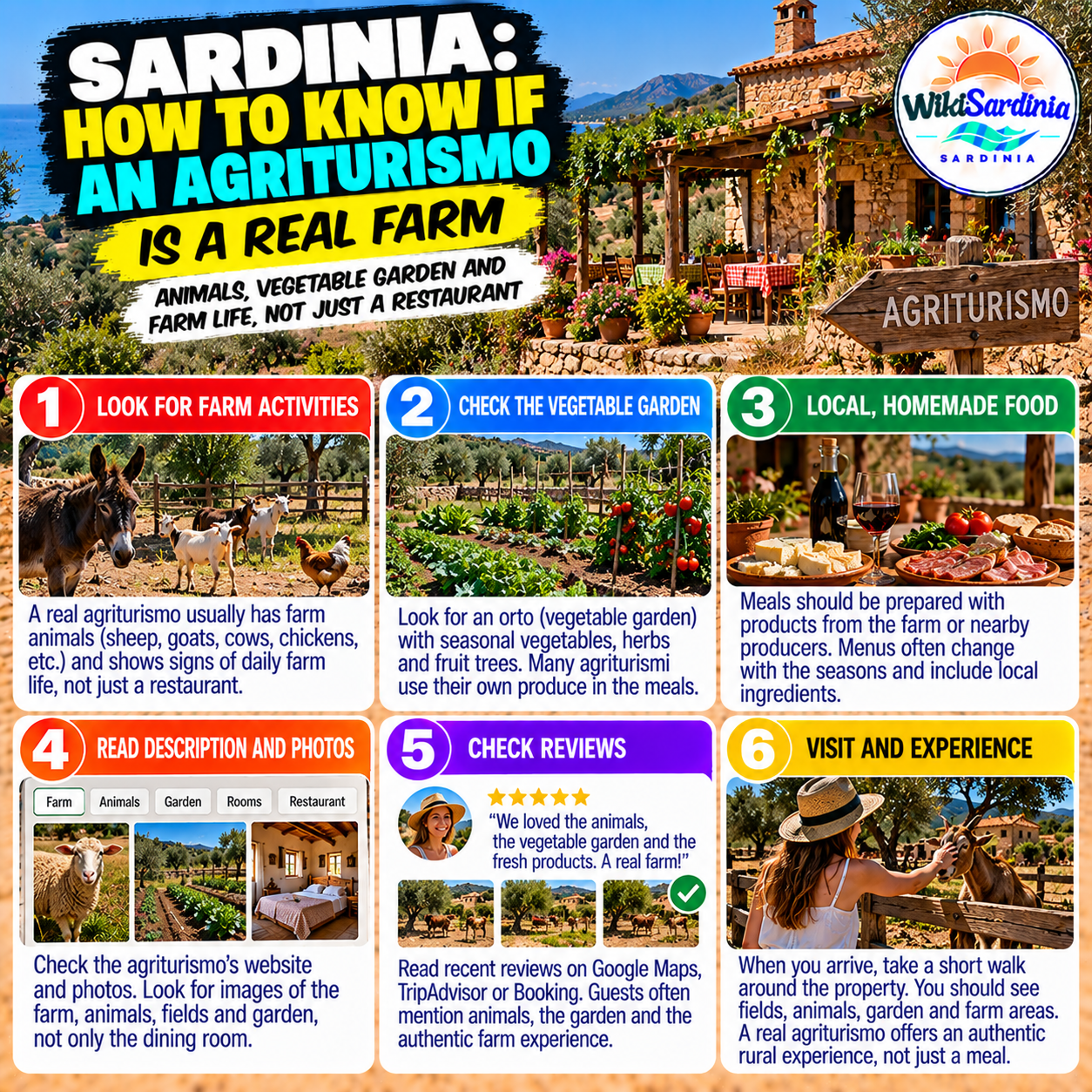
Animals can be a clue: you might see sheep, goats, cattle, chickens or other livestock, depending on the farm. But not every genuine agriturismo keeps animals. Some focus on vineyards, olive groves, orchards, vegetable crops, grain or other agricultural production.
Look for evidence of the activity described by the business: cultivated land, working fields, harvests, equipment or products grown on the property. A farm does not need to look like a postcard to be genuine.
2. Check for a garden—but do not make it a requirement
An orto (vegetable garden) can be a lovely feature, especially when seasonal produce appears on the menu. Fruit trees, olive groves and vineyards may be just as relevant, depending on the farm’s specialisation. Ask which crops are grown on site and when they are harvested.
A small decorative garden alone does not prove that a business is a working farm. Look for a clear connection between the agricultural activity and the products or experience offered to guests.
3. Ask where the food comes from
Many agriturismi highlight seasonal dishes and ingredients from their own production or from nearby farms. Ask which products they grow or make themselves and which they buy from other local producers. A transparent answer is more useful than a vague promise that everything is “traditional.”
Not every ingredient has to come from the property itself, and menus may change with the season. The important thing is that claims about farm production are clear and credible.
4. Read the website and look at the photos carefully
Look for descriptions of the farm’s crops, animals, land, production methods and agricultural activities. Photos of fields, orchards, vineyards, olive trees, farm buildings or harvest work can help you understand what the business does. If every image shows only tables, bedrooms and plated meals, ask for more details—but remember that a limited photo gallery is not proof of a problem.
Check the business name, address and contact details, and compare them with its official listings. If you are unsure, ask whether guests can see the agricultural areas and whether visits need to be arranged in advance.
5. Use reviews as supporting evidence
Recent reviews can tell you whether guests mention a working farm, produce grown on site, animals, harvest activities or explanations from the owners. Read several detailed reviews rather than relying on the overall star rating. Reviews are useful clues, but they do not replace official information about the business.
6. Ask a few simple questions before booking
You can write or ask in Italian:
- “Quali attività agricole svolgete?” — What agricultural activities do you carry out?
- “Coltivate prodotti direttamente in azienda?” — Do you grow products on the farm?
- “Gli ospiti possono visitare la fattoria?” — Can guests visit the farm?
- “Quali prodotti del menu sono di vostra produzione?” — Which menu items use products you produce yourselves?
A genuine operator should be able to explain its activities in a straightforward way. A farm visit may not always be possible, especially for safety, animal-welfare or operational reasons, so arrange it beforehand rather than walking into work areas uninvited.
7. Know what would count as a warning sign
Be cautious if the description makes strong claims about farm production but the business cannot explain what it grows or produces, or if the information on its website conflicts with its official details. However, the absence of animals, a vegetable garden or guest farm tours does not by itself mean the agriturismo is fake.
If legal status matters to your booking, verify the business through the relevant official regional or municipal tourism and agricultural information channels.
Enjoy the countryside responsibly
Follow the host’s instructions around livestock, machinery and cultivated land. Do not feed animals without permission, enter fenced areas or pick crops unless invited. Farms are workplaces as well as places to stay, and respecting that helps protect both visitors and the people who run them.
The takeaway
To choose a genuine agriturismo in Sardinia, look for a clear connection to agricultural production—not just rustic décor or a country menu. Animals and an orto can be useful clues, but vineyards, olive groves, orchards and other crops can also indicate a real farm. Check the details, ask what is produced on site and confirm official information if you need certainty.