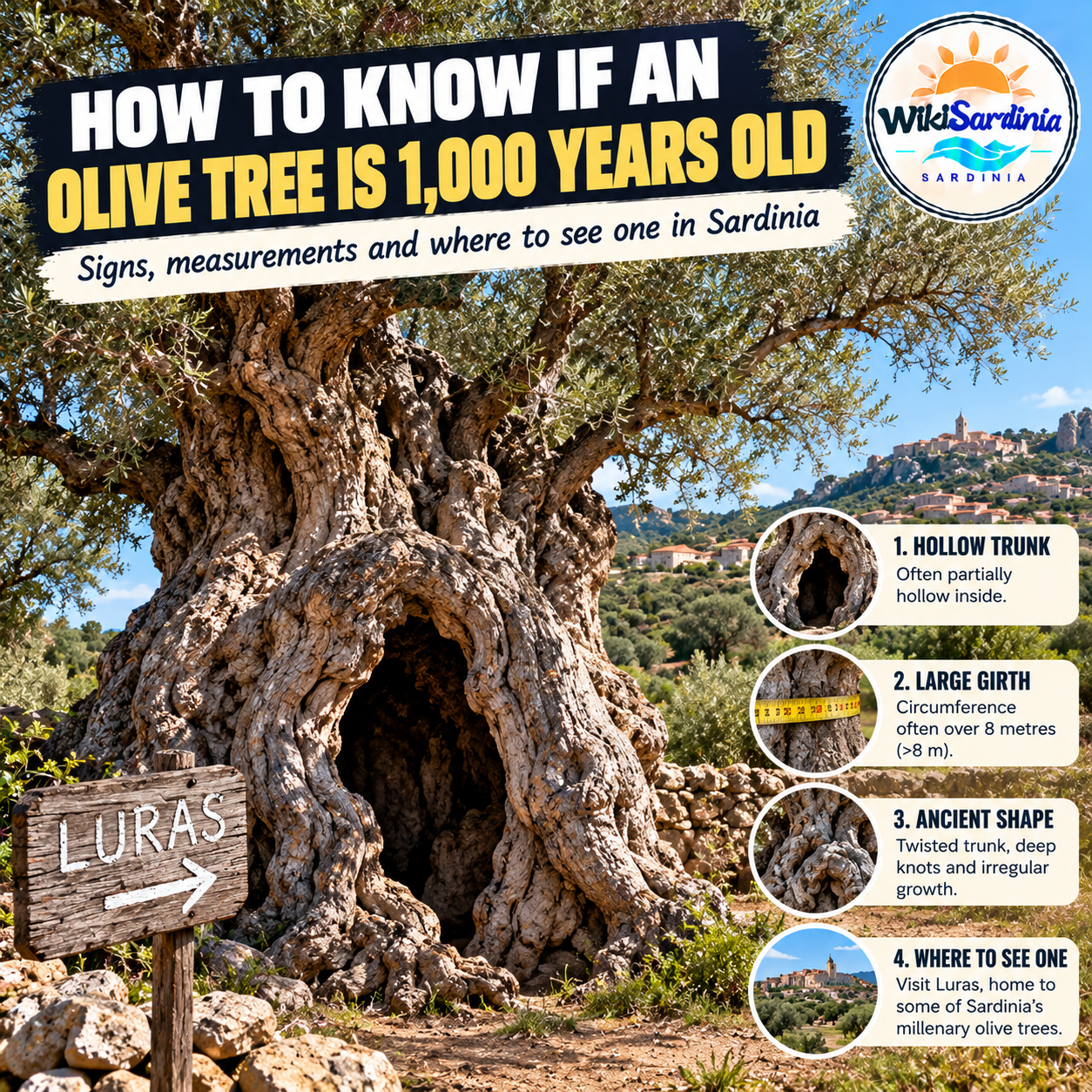
A hollow trunk, deeply twisted bark and a huge circumference can make an olive tree look ancient—but none of these features can prove that it is 1,000 years old. Trees grow differently depending on species, climate, soil, pruning and past damage. A reliable age estimate needs specialist assessment and, for some trees, scientific methods; a hollow centre can also make simple ring counting impossible.
What signs suggest an olive tree may be very old?
Look for a combination of features rather than one magic measurement. Monumental olive trees often have thick, irregular trunks, deep fissures, large cavities and branches shaped by centuries of growth, pruning and weather. A very large circumference is a useful clue, but growth rates vary so much that it cannot be converted into an exact age using a universal rule.
- Large trunk circumference: a sign of a substantial, mature tree, not a precise age certificate.
- Hollow or split trunk: old trees may develop cavities as internal wood decays, but cavities can form at different ages.
- Twisted, knotted bark: often reflects long growth and environmental history, but does not reveal a specific number of years.
- Local records and expert estimates: the most useful evidence for a famous monumental tree.
Why “over 8 metres around” is not proof
An olive tree with a circumference above eight metres is certainly impressive, but trunk size depends on growing conditions and how the tree has developed. Measurements also differ depending on where around the trunk they are taken: at ground level, at chest height or around a swollen base. For that reason, circumference should always be reported with its measurement point and should not be used alone to claim a tree is 1,000 years old.
Where to see an extraordinary ancient olive tree: Luras
One of Sardinia’s best-known ancient trees is S’Ozzastru, the monumental wild olive tree in the Santu Baltolu area of Luras, in Gallura, near Lake Liscia. Official sources give its estimated age as roughly 3,000–4,000 years. The tree stands about 14 metres tall and has a circumference of around 11.54 metres measured at chest height; its base is considerably wider.
S’Ozzastru is a protected natural monument and a remarkable example of how a tree can become part of a place’s identity. Its age is an estimate, not a number that can be read directly from its hollow trunk.
How to visit S’Ozzastru
The tree is in the countryside near the church of Santu Baltolu and Lake Liscia, outside the village of Luras. Access and visiting arrangements can vary by season, so check the official visitor website before travelling. Follow the marked route and any instructions on site, and do not climb on the trunk, enter cavities or remove bark or wood.
Official visitor information: Olivastri Millenari di Luras. For measurements and monument status, consult the Italian cultural heritage portal entry for S’Ozzastru and the Municipality of Luras.
Can you estimate the age of a tree yourself?
You can observe and measure a tree, photograph it and compare it with documented monumental specimens, but you cannot determine its exact age from appearance alone. Counting annual rings is not a simple solution: old olive trees may have hollow or irregular trunks, and sampling can damage a protected tree. For a private tree, consult an arborist or tree specialist; for a monumental tree, look for documented estimates from the responsible authority.
The takeaway
A hollow trunk and a circumference greater than eight metres may suggest an exceptionally old olive tree, but neither proves it is 1,000 years old. Look for reliable local records and expert assessments. If you want to see a genuine Sardinian giant, S’Ozzastru in Luras is estimated to be several thousand years old—and deserves to be admired without touching or damaging it.