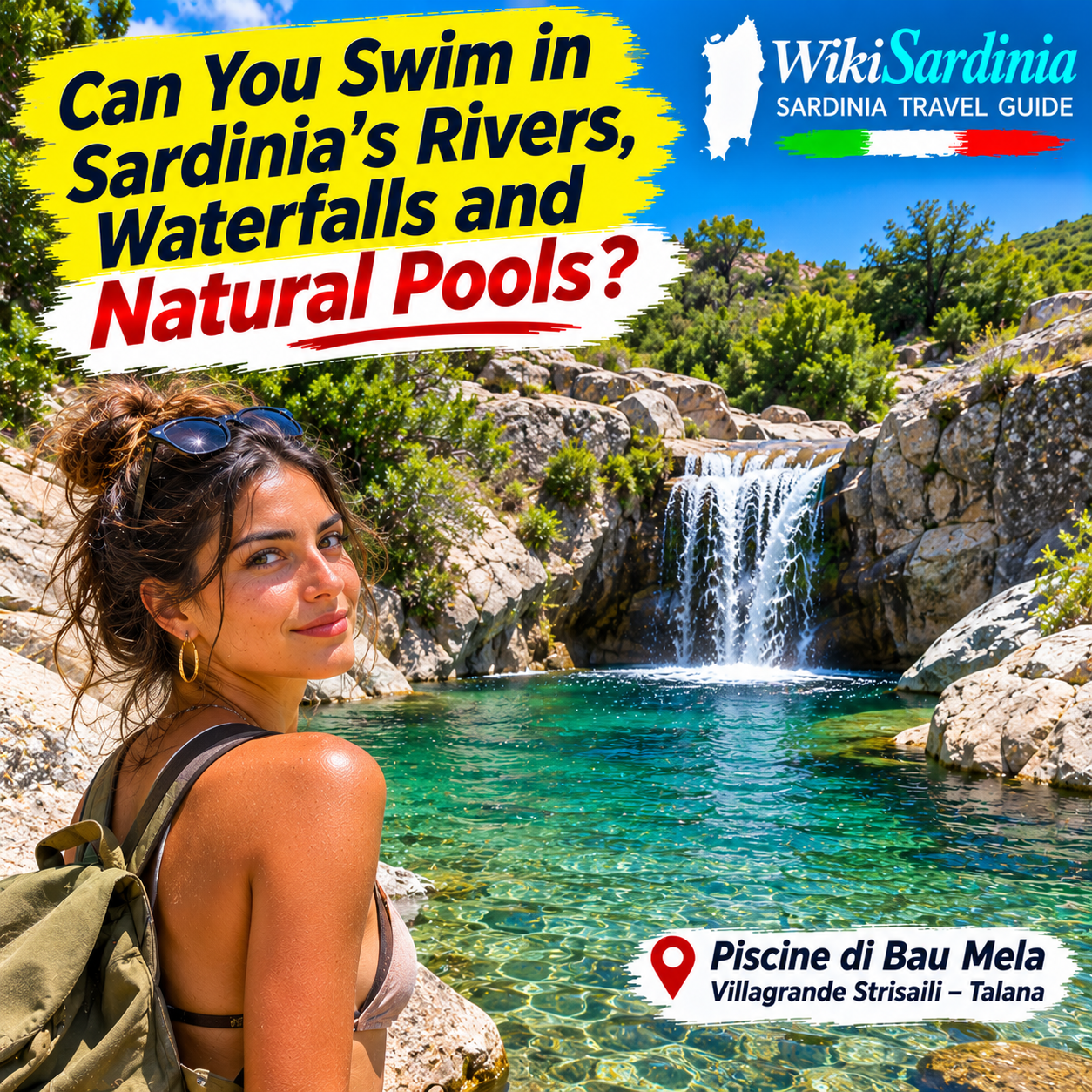
Sardinia's rivers, waterfalls and natural rock pools can look inviting in summer, but clear water is not proof that swimming is safe or permitted. Conditions vary by site and day. Slippery granite, hidden depth changes, cold water, currents, sudden rises in water level and unmonitored water quality can all create hazards. At Piscine di Bau Mela, do not assume that its popularity or beautiful photographs establish official bathing approval.
What are the Piscine di Bau Mela?
The Italian Ministry of Culture's Idese cultural-landscape catalogue describes the Piscine naturali di Bau Mela near Villagrande Strisaili, in the area between Villagrande Strisaili and Talana. The Rio Baccu Silacaccero flows over pale granite near 1,000 meters above sea level and forms cascades, potholes and clear rock pools surrounded by oak, juniper and Mediterranean vegetation. The catalogue describes the landscape and access to its pools; it does not certify the site as a supervised or officially approved swimming area.
Is swimming at Bau Mela officially allowed?
No site-specific, currently valid bathing authorization or prohibition has been verified for Bau Mela in the sources consulted. That uncertainty matters: absence of a verified ban is not permission, and an attractive tourist description is not a safety certificate. Before entering the water, check signs on site and ask the Comune di Villagrande Strisaili or the relevant land manager about any current restrictions. If there is a prohibition, obey it. If no clear information is available, viewing the pools from a safe distance is the prudent option.
Why are natural pools different from beaches?
Unlike a designated bathing beach, a remote river pool may have no lifeguard, no marked swimming area, no reliable depth information and no regular microbiological testing. Water conditions can change after rainfall upstream, even when the sky above you is sunny. Rocks that look dry can be slick with algae. Small waterfalls can conceal powerful turbulence, submerged branches or uneven granite ledges.
Does clear water mean it is clean?
No. Bacteria and other microorganisms are invisible. Italy's official bathing-water system identifies designated areas and monitors indicators such as Escherichia coli and intestinal enterococci. Sardinia's 2026 bathing-water circular lists monitored waters, unmonitored areas and areas not designated for bathing. The regional ARPAS coastal-monitoring results cannot be extrapolated to every inland stream or waterfall. Check the exact site in the official Portale Acque and the Sardinia bathing-water portal, and ask local authorities when it is not listed.
Can a river become dangerous after rain?
Yes. Rainfall in an upstream catchment can raise water levels and strengthen currents downstream, even if your immediate location remains sunny. Narrow gorges can leave few escape routes. Avoid entering water during or after heavy rain, when storms are forecast upstream, or when water becomes cloudy or rises. If a river is changing rapidly, move to higher ground rather than waiting on a rock beside the channel.
Can you jump from rocks into a natural pool?
Do not jump or dive. Transparent water can hide shallow shelves, boulders, submerged branches and unpredictable depths. Even places where others have jumped before may change after floods or sediment movement. The safest approach is not to use a natural pool for cliff jumping or head-first diving.
What about waterfalls?
Avoid swimming directly beneath or behind waterfalls. Falling water can create strong turbulence, recirculating currents and slippery rock faces. Loose stones and debris may also fall from above. Do not climb wet rock beside a cascade for photographs, and do not treat a waterfall as a natural waterslide.
Is the water cold in summer?
It can be. Shaded mountain streams and spring-fed pools may remain much colder than the surrounding air. Sudden immersion after a hot hike can trigger a strong breathing response and impair swimming ability. Do not dive in or enter abruptly; if entering water is lawful and locally confirmed safe, assess conditions carefully and avoid swimming alone.
What about children and weak swimmers?
Natural pools are especially unsuitable for unsupervised children or inexperienced swimmers because depths, footing and currents can change abruptly. Keep children away from steep, slippery edges and moving water. Do not assume a shallow-looking pool is safe or that flotation toys make river swimming risk-free. For families, a supervised and officially designated bathing area is a better choice.
Are there snakes or other wildlife?
Wildlife may be present around streams, but slipping, drowning, cold water and water quality are generally more immediate practical concerns. Avoid disturbing animals, do not put hands into unseen crevices and wear suitable footwear on approach trails. Take all litter away and avoid contaminating the water with soap or other products.
How do I check local restrictions?
Before visiting, look for municipal ordinances, park or forest-management notices and on-site signs. Ask the local municipality or authorized visitor center whether access and bathing are permitted and whether there are seasonal closures. The Ministry of Culture's landscape listing is useful for locating Bau Mela, not for confirming legal swimming status. Conditions and regulations can change, so an old blog or social-media post is insufficient.
What should I bring for a safe visit?
Wear shoes with good grip for the approach and stay on established paths. Carry drinking water, sun protection, a charged phone and offline maps; mobile coverage can be unreliable in valleys. Tell someone where you are going and when you expect to return. Do not visit alone or leave a group member without a safe way back. Take photographs from stable, dry ground rather than leaning over wet ledges.
What if someone gets into trouble?
Call 112, Italy's emergency number, and provide the exact location, coordinates, nearest road or trail and the number of people involved. Do not jump into dangerous currents to attempt an untrained rescue. If possible, reach the person from safe ground with a flotation device or other suitable aid while following emergency dispatch instructions. Remote locations can make rescue slower, so early and accurate location reporting is essential.
Are other Sardinian waterfalls safe for swimming?
There is no universal rule covering every waterfall or pool. A waterfall's presence on a tourism map does not mean bathing is permitted, monitored or safe. Apply the same checks at sites such as Piscina Irgas, Sa Spendula and other inland cascades: local restrictions, water quality, access, current conditions and emergency access. Do not extrapolate permission at one site to another.
Frequently asked questions
Can tourists swim in the Piscine di Bau Mela?
A current site-specific bathing authorization has not been verified. Check local rules and on-site signs; do not assume swimming is allowed.
Are Bau Mela pools monitored like beaches?
No evidence of an equivalent official routine bathing-water monitoring program for these pools was established in the sources checked.
Is clear mountain water safe to swallow?
No. Clarity does not establish microbiological safety. Avoid swallowing untreated river water.
Can flash floods happen in summer?
Yes. Upstream storms can affect a stream even when conditions seem calm nearby.
Is jumping from waterfalls safe?
No. Hidden rocks, changing depths and turbulence make jumping and diving hazardous.
Can I bring young children?
Children should stay away from unprotected slippery edges and moving water. Prefer supervised designated swimming areas.
What emergency number should I call?
Call 112 and provide precise coordinates or a recognizable location.
Is a popular Instagram swimming spot officially approved?
Not necessarily. Social-media popularity does not establish permission, water quality or safety.
The takeaway
Visit Sardinia's natural pools for their scenery, but never equate beautiful water with safe swimming. Bau Mela is a documented natural attraction, yet its current bathing authorization and water quality have not been independently established here. Check local rules, avoid jumping and waterfalls, watch for sudden water changes and choose a designated bathing area when you want a more predictable swimming experience.
Sources: Italian Ministry of Culture — Piscine naturali di Bau Mela; Regione Sardegna — 2026 bathing-water circular; Sardegna Ambiente — Bathing-water information; SNPA — Designated bathing waters; Italian Ministry of Health — Portale Acque.