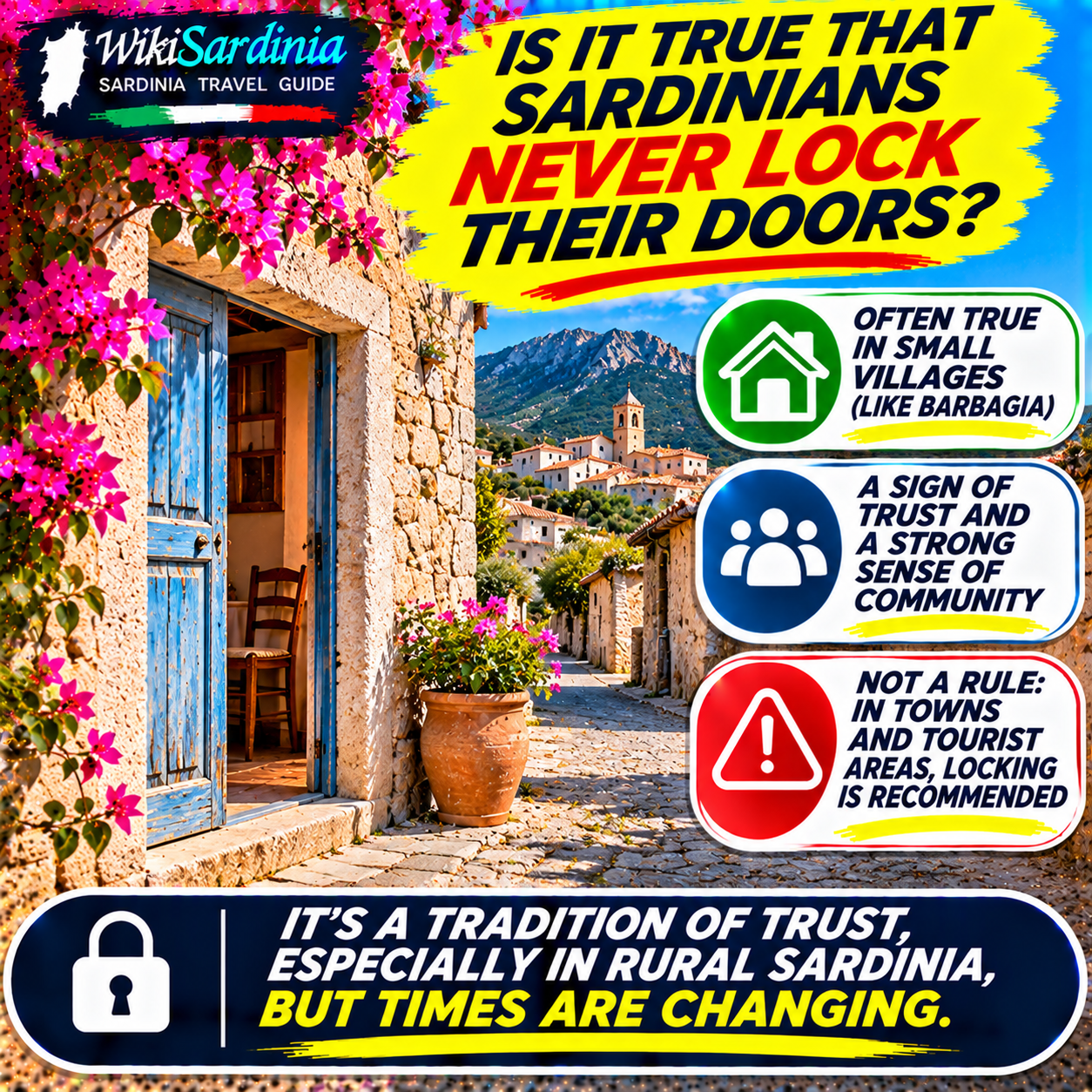
No, it is not true that Sardinians never lock their doors. The idea comes from stories about trust and close community ties in small rural villages, especially in inland areas such as Barbagia. In some households, leaving a door unlocked while neighbors came and went was—and in some circumstances may still be—a familiar practice. But this is not a rule followed by everyone in Sardinia, and visitors should not assume that a house, rental villa or apartment is safe to leave unlocked.
Where does the story about unlocked Sardinian doors come from?
In a small village, families may know one another across generations. Neighbors exchange favors, look out for elderly residents, share food and notice when something unusual happens on their street. In that setting, a door left open can symbolize familiarity and mutual trust. Accounts of unlocked homes are part of the island's popular image of traditional village life, but they are not evidence that every home in every Sardinian village has always been left unsecured. Personal habits differ, even between neighbors.
Is the tradition associated with Barbagia?
Barbagia, the mountainous interior of central Sardinia, is often associated with strong local identity, family ties and village customs. Communities around places such as Orgosolo, Mamoiada, Fonni and Oliena are well known for distinctive traditions and social life. These places provide a useful cultural setting for discussing trust among neighbors, but it would be misleading to claim that their residents universally leave their doors unlocked. There is no reliable village-by-village count establishing that practice today.
Did Sardinian families really leave doors open in the past?
Some residents recount memories of homes being open to relatives and neighbors during the day, particularly when people were nearby or moving between house and courtyard. Such memories should be understood as personal or local experience rather than an island-wide historical law. An open front door may have reflected a household that was occupied and socially active, not a decision to leave the property unprotected overnight or during a long absence.
Does an open door mean anyone can walk inside?
Absolutely not. A door standing open does not mean a home is public property or that tourists are welcome to enter. It may simply be open for ventilation, for family members or because the resident is working nearby. If you want to speak to someone, remain outside the threshold, greet them politely and wait for an invitation. Privacy and personal boundaries matter in Sardinia just as they do anywhere else.
Why are village communities sometimes described as close-knit?
In small settlements, everyday interactions can happen repeatedly in the same streets, cafés, shops and squares. People may know who lives in a particular house and recognize visitors quickly. This familiarity can encourage informal support networks, but it does not eliminate theft, disagreements or the need for ordinary security. The phrase 'everyone knows everyone' is a useful shorthand for social closeness, not a guarantee that every resident knows every other person or that crime never occurs.
Is it different in Cagliari, Sassari, Olbia or Alghero?
Large towns and tourist destinations have different patterns of housing, visitors and daily life. Many people live in apartment buildings with entry systems, security doors or locked gates. Others live in houses where the front door is sometimes open while family members are present. The sensible conclusion is not that city residents always lock up and villagers never do, but that security habits depend on the property, household and circumstances.
Do Sardinians still leave doors unlocked today?
Some individuals may, particularly while they are home, working in a courtyard or expecting relatives. Others lock their doors routinely, even in tiny villages. Modern travel, changing household arrangements, second homes and personal preferences all affect behavior. There is no verified current statistic showing what percentage of Sardinians leave doors unlocked, so claims such as 'most families in Barbagia never use a key' should be treated skeptically.
Should tourists lock the door of a holiday villa?
Yes. Follow your accommodation's security instructions and lock doors and accessible windows whenever you leave. This applies whether you are staying in a remote agriturismo, a village apartment or a seaside villa. Check gates and shutters where appropriate, and do not leave keys in visible outdoor locations. If a host says a door can be left unlocked while you are in the garden, clarify exactly what they mean; do not interpret that as permission to leave the property unsecured during an excursion.
What about an agriturismo in the countryside?
A rural property may feel isolated and peaceful, but distance from a city is not a substitute for security. Ask the host which entrance to use, whether exterior gates should be closed, how to secure windows and whether other guests or staff have access to shared areas. If the accommodation has livestock, dogs or agricultural equipment, gates may also serve practical purposes unrelated to crime. Follow the property's rules rather than copying what neighboring residents appear to do.
Is Sardinia generally safe for visitors?
Many travelers enjoy Sardinia without serious problems, but no destination is free from opportunistic theft or property crime. Avoid turning cultural stories about trust into a promise of safety. Use the same precautions you would at home: lock your accommodation, keep valuables out of sight, avoid leaving electronics in parked cars and remain aware of your surroundings. If something is stolen, contact the appropriate authorities and your accommodation provider.
Why might you see a door left open in summer?
Ventilation is one possible reason. On warm days, residents may open a door or windows to encourage airflow, especially when someone is at home. A doorway can also connect a kitchen or living room with an outdoor courtyard where family members are working or eating. Seeing a door open in the afternoon tells you little about whether the same household locks it at night or while away.
What is the difference between hospitality and unlocked doors?
Sardinian hospitality is often expressed through invitations, conversation, food and a willingness to help guests. But hospitality does not require residents to leave their homes unsecured. A family may be generous with visitors and still lock every door. Conversely, a door left ajar may simply be practical, with no invitation intended. Respect the difference between being welcomed by a person and assuming access to a private space.
Can you photograph picturesque village doorways?
Public streets and traditional architecture can make wonderful subjects for travel photography. However, a doorway is often the entrance to someone's private home. Avoid photographing people inside without permission, entering courtyards, leaning through open doors or blocking access while taking pictures. If a resident is present, a simple polite request is better than assuming that an attractive old door is a tourist attraction.
What should you do if a rental's door does not lock properly?
Contact the host or property manager promptly and ask for a functioning lock or a secure alternative. Document the issue and follow the booking platform's procedures if necessary. Do not assume a broken lock is acceptable because 'people in Sardinia never lock their doors.' If you cannot secure the accommodation, especially when leaving luggage or valuables inside, ask for the problem to be resolved before settling in.
Are village crime rates lower than city crime rates?
It would take comparable, recent local crime statistics to answer that reliably. Small communities can have different crime patterns, but a few personal stories or an unlocked-door anecdote cannot establish a crime rate. Visitors should not rely on unsupported rankings of the 'safest villages' or assume that a place is risk-free because it is remote. If security is a major concern, consult official police guidance and ask your accommodation about practical precautions.
What should you do if you accidentally walk into a private courtyard?
Step back immediately, apologize and leave unless you are clearly invited to stay. In Italian you can say “Mi scusi, pensavo fosse un ingresso pubblico” ('Sorry, I thought this was a public entrance'). Many old Sardinian buildings have attractive passages, arches and courtyards, but they are not automatically open to visitors. Look for signs, gates and obvious boundaries.
What if you are invited into a local home?
Wait for an explicit invitation, greet the hosts and follow their lead about shoes, seating and where to go. A warm welcome is a lovely opportunity to learn about everyday life, but do not assume that an invitation extends to photographing every room or bringing additional guests. If you are curious about local customs, ask respectfully rather than treating the household as an example of a stereotype.
What if you forget to lock your villa?
Return to secure it if you can do so safely, or contact the host to ask whether someone can check the property. If you discover signs of a break-in, avoid disturbing the scene and contact the authorities. Italy's emergency number is 112 for urgent assistance. For non-emergency matters, ask your host or local police office how to report the issue. Keep booking information and insurance details accessible.
Useful Italian phrases
“Qui si usa lasciare la porta aperta?” — Is it customary to leave the door open here? “Devo chiudere a chiave?” — Should I lock the door? “Questa è una casa privata?” — Is this a private home? “Permesso?” — May I come in? (Use only when you have a legitimate reason to approach and wait for a response.) “Mi scusi, non volevo disturbare.” — Sorry, I didn't mean to disturb you. “La serratura non funziona.” — The lock doesn't work.
Where can you learn more about Sardinian village life?
For a grounded introduction to Sardinia's inland communities, cultural heritage and village events, explore the official Sardegna Turismo portal. Its information about Barbagia and local traditions is a better starting point than sensational claims that everyone lives with permanently open doors. For practical safety advice during an Italian holiday, consult the Polizia di Stato and follow your accommodation provider's instructions. Neither source should be treated as providing a statistical estimate of how many households leave doors unlocked.
The WikiSardinia takeaway
The unlocked door is a memorable symbol of trust in some Sardinian village stories, not a rule for the entire island. In Barbagia and other rural areas, close neighborhood relationships may help explain why certain families have felt comfortable leaving a door open while at home. But Sardinians have different habits, and modern homes are often locked like homes anywhere else. Enjoy the hospitality, respect private spaces and always secure your holiday accommodation.