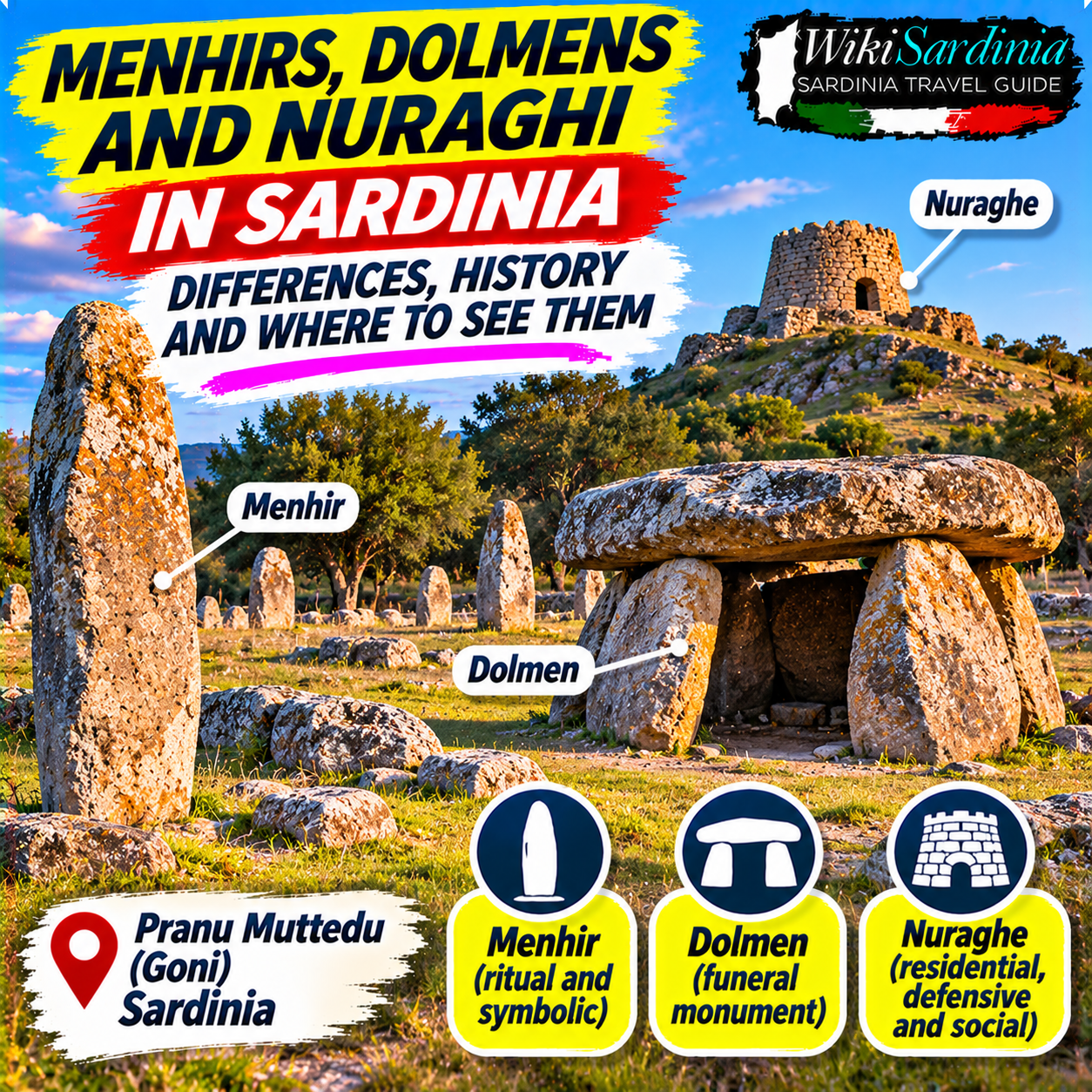
Menhirs are upright standing stones, dolmens are megalithic burial chambers, and nuraghi are substantial stone towers associated with Sardinia’s later Bronze Age civilization. Pranu Muttedu near Goni is an exceptional place to explore the earlier megalithic traditions.
Menhirs: mysterious standing stones
Known in Sardinian as perdas fittas, menhirs consist of individual upright stones. Some have human-like features. Their association with graves suggests ritual or commemorative purposes, but their precise meanings remain uncertain.
Dolmens: prehistoric burial monuments
A typical dolmen consists of upright slabs supporting a large horizontal capstone, creating a chamber. Some were originally covered by burial mounds. More complex monuments include corridors or enclosing stone circles. They differ from domus de janas, which are tombs excavated into rock.
Nuraghi: later stone towers
Nuraghi are dry-stone structures characteristic of the Nuragic civilization of the Bronze Age, beginning around the second millennium BC. Many have corbelled internal chambers; some developed into complexes of several towers. Their proposed functions include residence, defense and territorial or community organization. They are not simply enlarged dolmens, and their precise functions varied.
Explore Pranu Muttedu in Goni
The park contains around sixty menhirs, arranged in groups, pairs and rows, alongside burial monuments. The Italian Ministry of Culture archaeological catalogue identifies a Late Neolithic and Copper Age funerary complex containing concentric stone circles, burial chambers and dolmen-like structures. The site is associated with the Ozieri and later cultural traditions. It predates the classic Nuragic towers by centuries.
The regional tourism guide describes a roughly 20-hectare park in the Gerrei countryside. The nickname Sardinia’s Stonehenge reflects the striking standing stones, not an identical design or a demonstrated cultural connection with Britain.
Were the stones astronomical instruments?
Some alignments have inspired astronomical interpretations. However, the presence of aligned stones does not by itself establish their intended astronomical purpose. Funerary and ritual interpretations are supported by the archaeological setting.
Practical visiting tips
The park is near Goni along SP23. Allow around one to two hours as a planning estimate. Wear walking shoes, bring water and avoid climbing or moving stones. The national tourism guide describes independent and guided visits. Contact the operator at +39 070 982059 to confirm opening hours, admission, English-language guides and accessibility before traveling. Published official opening information is inconsistent, so do not rely on an old timetable.
Useful Italian phrases
- Dove sono i menhir? — Where are the standing stones?
- È possibile fare una visita guidata in inglese? — Is an English-language guided tour available?
- Qual è la differenza tra un dolmen e un nuraghe? — What is the difference between a dolmen and a nuraghe?
FAQ
Are menhirs older than nuraghi?
Generally yes, particularly the Late Neolithic and Copper Age examples at Pranu Muttedu.
Were all menhirs gravestones?
No. Their significance varied and is not always understood.
Are dolmens the same as Giants’ Tombs?
No. Giants’ Tombs are characteristic Nuragic collective burial monuments, with a different architectural tradition, although both belong to the broader history of megalithic construction.
Can you see a nuraghe nearby?
The surrounding region contains Nuragic monuments, making it possible to explore different periods of Sardinian prehistory on the same trip. Confirm access separately.