Alghero is an excellent base for tasting Sardinian extra-virgin olive oil at the source, especially if you visit around the autumn harvest. The countryside surrounding the city is filled with olive groves, and several local producers offer visits or tastings rather than simply selling bottles. For travelers specifically looking for Sardegna DOP and freshly pressed olio nuovo, the most important distinction is timing: DOP oil can be tasted throughout the year, while the vivid, just-milled character of new-season oil belongs to the harvest period.
One of the clearest choices is Accademia Olearia, the Fois family's estate and mill in the Alghero countryside. Its current range includes several Sardegna DOP oils as well as a Novello, and Alghero's official tourism consortium confirms that the producer offers guided olive-oil tastings and mill visits.
Accademia Olearia: a strong choice for Sardegna DOP
Accademia Olearia grows olives on its estates around Alghero and produces its extra-virgin oils locally. Its official range currently includes Sardegna DOP, Sardegna DOP Fruttato Verde and Sardegna DOP Bio, alongside single-cultivar oils such as Bosana, Semidana and Tonda di Cagliari.
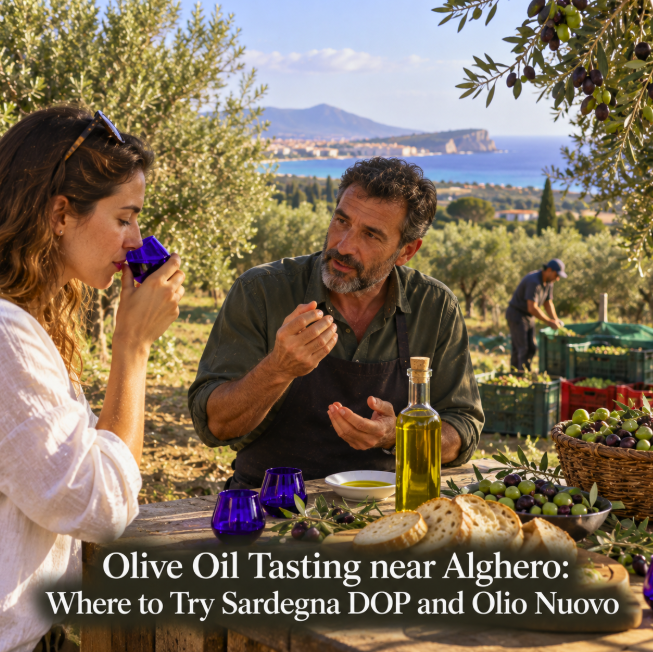
The tasting experience described by Visit Alghero begins in the modern mill, where visitors learn about the path from harvest to extraction and packaging. A guided sensory tasting then introduces the differences between oils, including fruitiness, bitterness and pungency. These are not defects: in a well-made extra-virgin olive oil, bitterness and the peppery sensation in the throat can be positive characteristics connected with fresh olives and phenolic compounds.
Visits should be booked rather than assumed to be available as a walk-in activity. This is a working agricultural producer, and the harvest period is also one of the busiest times of the year.
Why the Sardegna DOP label matters
Sardegna DOP is a protected designation of origin, not simply a marketing phrase meaning that a bottle was sold in Sardinia. The official production specification includes Alghero within the permitted geographical area.
Under that specification, at least 80% of the olives in a Sardegna DOP oil must come from the recognized varieties Bosana, Tonda di Cagliari, Nera or Tonda di Villacidro, Semidana and their synonyms, either individually or combined. Other local varieties can make up the remaining share within the rules.
This makes DOP a useful label for travelers who want a product with a defined relationship to Sardinian territory and production standards. It does not mean that every excellent oil made around Alghero must carry the DOP seal; small producers may make very good extra-virgin oil under other classifications.
Bosana: the olive to remember around Alghero
Bosana is particularly important in northern Sardinia. Accademia Olearia describes it as the most widespread cultivar in the north of the island and produces a monocultivar Bosana from green olives processed shortly after harvest.
The resulting style is typically assertive rather than neutral. The producer describes green-fruit intensity with herbaceous and vegetable notes, including artichoke and thistle. For American visitors accustomed mainly to mild supermarket olive oil, a fresh Bosana can therefore be surprisingly bitter and peppery.
A guided tasting is useful because you can compare oils without bread or other foods masking the aromas at first. Once you understand the oil on its own, trying it with Sardinian bread, vegetables, cheese or other local food becomes much more informative.
Other mills and tastings around Alghero
Accademia Olearia is not the only option. Olio Corax, produced by the Francesco Piras agricultural estate, currently advertises mill visits and tastings by reservation at its facility on SS127 Bis in the Alghero countryside. Its published visitor information says tastings can be booked by telephone and lists weekday opening hours for visits and purchases.
Oleificio San Marco, in Alghero's San Marco industrial area, also currently invites visitors to contact the mill for tastings and direct purchases. Its 2026 information lists shop hours during the week and on Saturday, although anyone seeking a structured guided tasting rather than a quick sample should contact the producer in advance.
For a more rural experience, Alghero's tourism directory lists Azienda Agricola Nure at Santa Maria La Palma, with visits to its mill, a museum of farming traditions, the Nuraghe Flumenelongu and tastings of organic extra-virgin olive oil. The same local directory lists Francesco Loru's farm at Guardia Grande for olive-oil tasting and visits to vineyards, olive groves and other agricultural areas, with booking recommended.
Another possibility is to combine oil with wine. Current Alghero experiences at local farms include guided wine tastings that finish with extra-virgin olive oil, useful for couples or groups whose interests are broader than olive oil alone.
When can you taste olio nuovo?
Olio nuovo, sometimes sold as novello, is the new oil from the current olive harvest. It is prized for its intense aroma, bright green notes and often pronounced bitterness and pepperiness immediately after milling.
There is no single harvest date for every Alghero producer. Olive maturity, cultivar, weather and the style of oil a producer wants to make all influence when picking begins. In practical terms, travelers interested specifically in new oil should focus on autumn and contact the mill shortly before visiting to ask whether the new season's pressing has started.
September can be too early for a guaranteed tasting of that year's new oil. October and November are generally more promising, but even then a particular producer may be harvesting different groves on different dates. Never book a trip around “olio nuovo” without confirming that the current vintage is actually available.
What happens during a proper olive-oil tasting?
Professional-style tastings often use small colored glasses, commonly blue, so the oil's color does not influence judgment. The glass is warmed gently in the hand, then the oil is smelled before a small amount is tasted and distributed through the mouth.
Look for clean aromas that can suggest freshly cut grass, herbs, tomato leaf, artichoke, almond or other vegetal notes depending on cultivar and ripeness. Bitterness is perceived on the tongue, while pungency can create the characteristic peppery sensation at the back of the throat.
Color is much less useful than many visitors expect. A greener oil is not automatically better than a golden one, which is exactly why professional tasters use colored glass.
Buying oil to take home
Tasting at the mill has a practical advantage: you can choose a bottle according to flavor rather than label design. Ask about cultivar, harvest year, storage and whether the oil is filtered or unfiltered.
Protect bottles from heat and light after purchase. Extra-virgin olive oil is fresh food, not a wine intended to improve for years in a cupboard. Once opened, use it regularly rather than saving it indefinitely for a special occasion.
For travelers staying in Alghero during harvest season, an oil tasting also offers a different view of the destination. The beaches and old town may be the obvious attractions, but a few kilometres inland the olive groves reveal another side of northwest Sardinia — one that can be smelled and tasted within hours of the fruit leaving the tree.