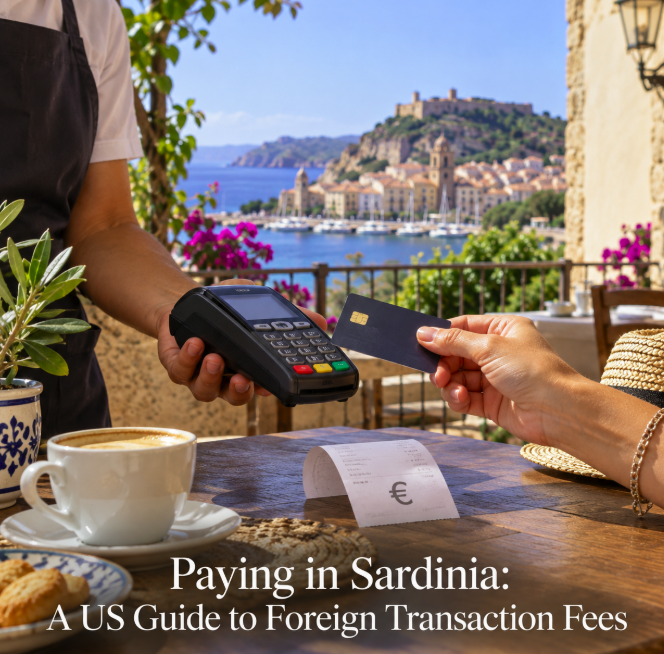
For Americans traveling to Sardinia, one small line in a credit card agreement can make a difference to the cost of a holiday: the foreign transaction fee. A US card with no foreign transaction fee can be a practical way to pay for hotels, restaurants, car rentals and other purchases on the island. Sardinia is part of Italy and uses the euro, so US-issued cards may involve currency conversion even when no separate foreign transaction fee is charged.
The important point is that there is no special “Sardinia card” to look for. Before traveling, Americans should check the terms of a card they already have or compare US cards whose agreements explicitly state that the foreign transaction fee is zero. The US Consumer Financial Protection Bureau notes that foreign transaction fees can apply to purchases made outside the United States, with foreign merchants or in foreign currencies, and recommends that frequent overseas travelers consider cards with lower or no foreign transaction fees.
What is a foreign transaction fee?
A foreign transaction fee is a charge associated with using a card internationally. The CFPB explains that these fees can include charges when a foreign-currency purchase is converted into US dollars and, depending on the card agreement, transactions made outside the United States even when the transaction itself is expressed in dollars.
That is why checking the actual cardholder agreement matters more than relying on the logo printed on the card. Visa or Mastercard acceptance, for example, does not by itself tell a traveler whether the issuing bank will add a foreign transaction fee. The fee is determined by the terms attached to the specific account.
The CFPB maintains a database of credit card agreements submitted by hundreds of issuers, and issuers are generally required to make their agreements available. Travelers can also check the pricing and fees section of their own account or contact the issuer before departure.
In Sardinia, choose euros at the terminal
There is another potential cost that is separate from a card issuer’s foreign transaction fee: dynamic currency conversion. At some shops, hotels, restaurants or ATMs, a US visitor may be offered a choice between paying in euros or having the amount converted immediately into US dollars.
EU consumer guidance warns that paying in the traveler’s home currency can involve extra conversion costs and notes that paying in the local currency is often the cheaper option. In Sardinia, the local currency is the euro. If a payment terminal asks “EUR or USD?”, choosing EUR generally leaves the currency conversion to the traveler’s card network and issuer instead of accepting the merchant or terminal provider’s conversion service.
European rules require providers of dynamic currency conversion at points of sale and ATMs to disclose the conversion charge as a percentage mark-up over the latest available European Central Bank reference rate. That disclosure can help travelers see the cost before accepting the conversion.
No foreign transaction fee does not mean no possible fees
A card advertised with no foreign transaction fee can still have other costs. Annual fees, interest charges, cash-advance fees and ATM-related charges are separate issues. This distinction is especially important when withdrawing cash.
Using a credit card at an ATM can be treated as a cash advance by the issuer, potentially triggering different fees and interest rules. An ATM operator can also impose its own fee. For cash withdrawals, travelers should check the terms of their debit or ATM card rather than assuming that a credit card with zero foreign transaction fees is automatically the cheapest way to obtain euros.
It is also sensible to carry more than one payment method. Cards are widely useful for travel expenses, but a backup card and a modest amount of cash can help when a terminal is temporarily unavailable or a small local situation is easier to handle with euros.
What to check before flying to Sardinia
American travelers can make the payment side of a Sardinia trip much simpler by checking three things before departure: whether their card charges a foreign transaction fee, whether their bank needs any travel-related account settings updated, and what fees apply to cash withdrawals. Keeping the issuer’s contact details available is also useful if a card is blocked or lost.
Once on the island, pay in euros when a terminal offers a currency choice and read the screen carefully before confirming the transaction. A “no foreign transaction fee” card prevents one type of charge; it does not make every conversion option or ATM automatically free.
For a traveler comparing new cards specifically for Sardinia, the most relevant wording to look for is simple: a foreign transaction fee of 0% or “none.” Other features such as annual fees, rewards, insurance and eligibility depend on the traveler’s broader needs and can change over time, so current terms from the issuer should be checked before applying.
The practical formula is straightforward: a US card with no foreign transaction fee, purchases processed in euros, and a separate plan for occasional cash withdrawals can eliminate some of the most avoidable payment costs during a Sardinian holiday.