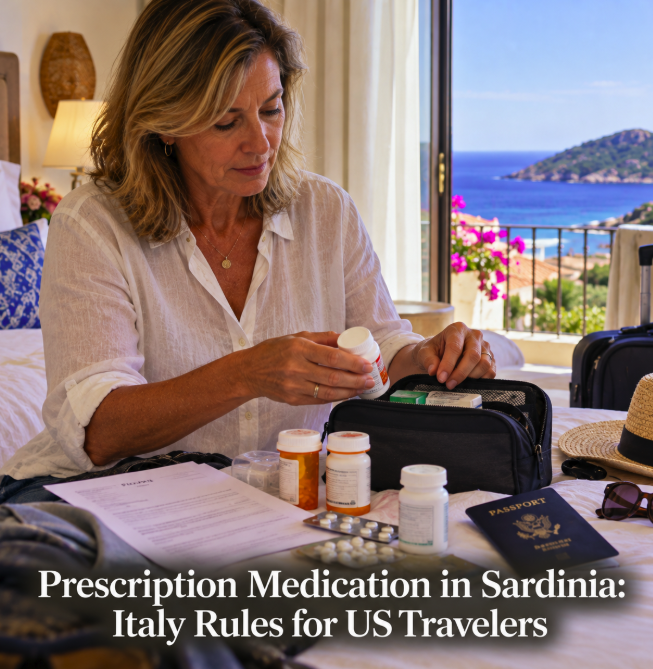
US travelers can bring prescription medication to Sardinia for personal use, but the paperwork depends heavily on what the medicine contains. Ordinary prescription drugs and controlled narcotic or psychotropic medicines should not be treated as the same category. For controlled substances, Italy requires specific medical documentation, and travelers should prepare it before leaving the United States.
Sardinia follows Italian national and European customs and medicines rules. There is no separate Sardinian declaration for arriving with medication. The key questions are whether the quantity is clearly for personal treatment and whether the active ingredient falls under Italy’s controlled narcotic or psychotropic drug rules.
Keep prescription medicine identifiable
The safest practical approach is to carry prescription medicines in their original pharmacy packaging with the patient name and dispensing information visible. Bring enough for the trip, plus a reasonable contingency supply if medically appropriate, rather than loose tablets or unusually large quantities that are difficult to explain as personal use.
Carry a copy of the prescription and a doctor’s letter listing the medication by both brand name and active ingredient or generic name. The letter should explain that the medicine is required for personal treatment, along with dose and daily use. This is particularly useful because American and Italian brand names may differ even when the active ingredient is the same.
Keep essential medicines in hand luggage where airline security rules allow. Checked baggage can be delayed or lost, and replacing a US prescription in Sardinia is not always straightforward.
Controlled medicines need special attention
Italy’s Ministry of Health maintains specific rules for travelers carrying medical preparations containing narcotic or psychotropic substances. These include some medicines used for pain, anxiety, sleep disorders, ADHD and other conditions, although classification depends on the active ingredient rather than the reason it was prescribed.
The Ministry publishes a certificate format for travelers under treatment with these substances. The documentation identifies the prescribing physician, patient, destination and medicine, including trade name, dosage form, active ingredient, quantity and duration of treatment.
Italian Ministry guidance states that the certificate must remain with the traveler during the stay and be available for presentation to authorities such as customs or police. Because controlled-drug tables and documentation requirements can change, travelers should check the Ministry’s current narcotic and psychotropic medicines information for the exact active ingredient before departure.
Do you have to declare medicine at Italian customs?
There is no blanket rule requiring every traveler to make a customs declaration simply because they have an ordinary prescription bottle in their luggage. Italian customs rules allow personal baggage and goods intended for a traveler’s own use when their nature and quantity are non-commercial.
Controlled narcotic or psychotropic medicines are different because specific health documentation can be required and must be available to authorities. If you are unsure whether your medicine falls into a controlled category, verify it before traveling rather than deciding at the airport.
Travelers carrying unusual quantities, injectable medicines, controlled substances or products whose legal status is uncertain should obtain guidance from the Italian authorities or an Italian consular office before departure. Customs officers retain authority to inspect baggage and supporting documentation.
Why the active ingredient matters more than the US brand
A medication legally prescribed in the United States is not automatically treated identically in Italy. Drug schedules, approved products and dispensing rules differ between countries.
Check the generic or international name of the active substance. A doctor’s letter that says only an American brand name can be less useful to an Italian pharmacist or customs official than one that also identifies the active ingredient and dosage.
This is particularly important with controlled medicines and combination products. Never assume that an over-the-counter or commonly prescribed product in the US has the same status in Italy.
What documents should you carry?
- The medicine in its original labeled pharmacy container or packaging.
- A copy of the current prescription.
- A physician’s letter explaining the medical need, active ingredient, strength, dose and quantity.
- The required controlled-medicine certificate when the drug falls under Italy’s narcotic or psychotropic rules.
- Contact details for the prescribing physician and your US pharmacy.
- A list of medicines and allergies stored separately from the medication bag.
For controlled medicines, use the documentation specified by the Italian Ministry rather than relying solely on an informal doctor’s note. Check the certificate’s current validity requirements and completion instructions before travel.
Can a US prescription be filled in Sardinia?
Do not plan a Sardinia trip on the assumption that an American prescription can simply be handed to an Italian pharmacy and refilled. Italian Ministry guidance on cross-border prescriptions primarily addresses prescriptions meeting European Union requirements, while US prescriptions sit outside that EU framework.
If a pharmacist cannot dispense the medicine based on your documentation, you may need to see an Italian doctor or out-of-hours medical service and obtain an Italian prescription when clinically appropriate. The exact medicine or US brand may also be unavailable.
For this reason, travelers who depend on daily medication should arrange an adequate legal supply before departure whenever possible.
Controlled drugs are not the place to improvise
Opioid pain medicines, certain stimulants, sedatives and other controlled substances deserve advance verification. Italy updates its narcotic and psychotropic substance tables, including regulatory changes made during 2026.
If your medicine contains a controlled ingredient, confirm the current rule with the Italian Ministry of Health and prepare the required certificate. Do not repackage it into an unlabeled pill organizer for the international journey and do not carry medication prescribed to another person.
Medical cannabis also requires special caution. Its legal and medical status in Italy does not mean a US traveler can automatically enter the country carrying a cannabis product purchased or prescribed in the United States. Travelers using cannabinoid-based medicines should obtain specific official guidance before bringing them across the border.
What about refrigerated or injectable medicine?
Medicines such as insulin and some injectable therapies require an additional travel plan. Confirm storage temperatures with the manufacturer or pharmacist, use an appropriate medical cooling system and contact the airline about needles, syringes and cooling materials before flying.
Do not place temperature-sensitive medicine directly against ice unless its storage instructions allow it. Freezing can damage some medications just as excessive heat can.
Sardinian summers can be very hot, especially inside a parked car. A medicine that must remain below a certain temperature should not be left in luggage in a vehicle while you visit a beach.
Prepare for delays and lost medication
Photograph the prescription label and doctor’s documentation and keep secure digital copies. Write down the generic name, strength and dose separately. If the medicine is lost, this information will help an Italian clinician understand what you normally take.
Travel insurance may provide assistance locating a doctor or replacing essential medication, but coverage varies and does not override Italian prescription rules. Check the policy before departure if replacement medication is important to your trip planning.
A practical pre-flight checklist
Several weeks before traveling, list every prescription, injectable, controlled drug and medically necessary over-the-counter product you intend to carry. Identify the active ingredient for each one and check whether any is controlled in Italy.
Ask your physician for appropriate documentation, keep medicines in labeled packaging and place essential supplies in hand luggage. If a drug is narcotic or psychotropic under Italian law, obtain the correct certificate and verify the current requirements before departure.
Most travelers carrying an ordinary personal supply of clearly labeled prescription medicine will find the process straightforward. The mistake is assuming that all prescriptions are ordinary. For US visitors to Sardinia, checking the active ingredient before packing is the simplest way to discover whether a bottle needs only sensible documentation or Italy’s more formal controlled-medicine paperwork.