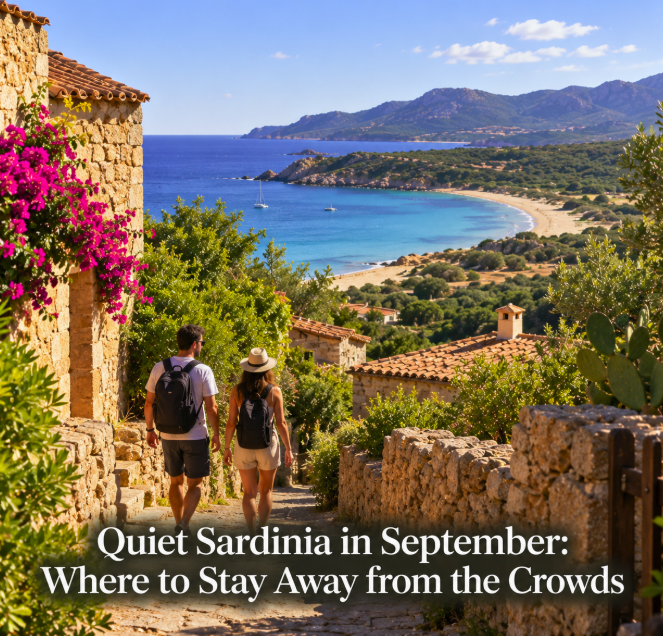
September is one of the smartest months for travelers who want Sardinia without the full intensity of peak summer, but choosing the right base still matters. The island recorded almost 22 million overnight stays in 2025, and Sardinia’s tourism authorities have publicly acknowledged that June, July and August are approaching saturation in the busiest areas. Beach-access limits have also become part of the conversation, with places such as Punta Molentis using controlled entry in 2026. The answer is not to avoid Sardinia: it is to look beyond the same handful of famous resort towns.
For a quieter September trip, focus on the western coast, the southwest, smaller Ogliastra communities and inland villages rather than building the entire holiday around Costa Smeralda, San Teodoro or the island’s most photographed beaches. September is still a travel month, so nowhere can be promised empty, especially on sunny weekends.
Montiferru and the central-west coast
The stretch around Santu Lussurgiu, Cuglieri, Santa Caterina di Pittinuri and S’Archittu is a strong choice for travelers who want a slower base without giving up the sea. This side of Sardinia receives much less international attention than the northeast, while still combining coastal scenery, historic villages and access to the Montiferru landscape.
Staying in Cuglieri or Santu Lussurgiu puts you inland from the beach rather than inside a purpose-built resort. You can drive to the coast during the day and return to a village atmosphere in the evening. S’Archittu and Santa Caterina di Pittinuri work better if waking close to the water matters more.
A rental car is highly useful here. The reward is flexibility: instead of chasing one famous beach, you can move between small coves, viewpoints and villages according to weather and wind.
Planargia: Bosa without staying in the busiest streets
Bosa is no secret, and its colorful houses and Temo river attract day-trippers. But the surrounding Planargia area can still work well for a quieter September stay, particularly if you sleep outside the most visited center.
Consider villages and countryside accommodation around Bosa rather than insisting on a room beside the main riverfront. You retain easy access to Bosa for dinner and evening walks while gaining a more relaxed base for exploring the western coastline.
The scenic road toward Alghero is one of the attractions of this area, but the two towns have very different tourism profiles. Regional tourism statistics show Alghero among Sardinia’s most visited municipalities, so travelers whose priority is avoiding crowds should treat it as an excursion rather than automatically making it their base.
Sulcis and the southwest
Southwestern Sardinia is another useful alternative to the northeast resort belt. The wider Sulcis area combines beaches, former mining landscapes, archaeological sites, islands and small towns without relying on a single internationally famous resort.
Bases around Sant’Antioco are particularly practical because the island is connected to mainland Sardinia by road. You can combine coastal days with the town, archaeological heritage and excursions toward Calasetta. The area is not deserted in September, but its geography spreads visitors across multiple beaches and communities.
Farther along the southwest, the mining coast around Nebida and Masua provides dramatic scenery. Accommodation and restaurant choice can be more limited than in Cagliari or the northeast, so travelers should check September opening days rather than assuming every seasonal business remains open.
Ogliastra beyond the headline beaches
Ogliastra is often promoted through spectacular places such as Cala Goloritzé, Cala Mariolu and the Gulf of Orosei. Those individual destinations can be extremely popular. The region as a whole, however, is much larger than its social-media beaches.
Instead of choosing accommodation solely to be as close as possible to a famous boat departure, look at inland or semi-inland bases such as Baunei itself, or communities farther south in Ogliastra. You can reach the coast when you want it while spending mornings and evenings away from the busiest beachfront zones.
This strategy is particularly effective for travelers interested in hiking, food and mountain landscapes as much as swimming. September temperatures can make walking more appealing than in midsummer, although heat can still be significant and mountain conditions should always be checked before longer routes.
Go inland — but check the festival calendar
Moving inland is the most obvious way to escape beach crowds, but September 2026 comes with an important caveat. Autunno in Barbagia began on September 5 and runs through December 13, bringing events to 33 villages across 32 municipalities in the Nuoro area. The program is designed precisely to draw visitors into inland communities during the shoulder season.
That is excellent if you want open courtyards, crafts, food and village culture. It is less ideal if your only goal is silence. A Barbagia village can feel wonderfully calm during the week and become busy during its scheduled festival weekend.
Before booking accommodation in the Nuoro interior, check whether the village is hosting Autunno in Barbagia during your stay. You can either avoid that weekend or deliberately embrace it and move your quiet days elsewhere.
Why September is different from August
Sardinia’s current overtourism debate is mainly about the concentration of visitors in the summer season and at a limited number of famous coastal locations. In July 2026, the regional tourism councillor said June, July and August were already close to saturation and explicitly discussed protecting beaches through controlled numbers and other measures.
Punta Molentis in Villasimius illustrates the approach. A 2026 municipal rule limits simultaneous access by land and caps daily vehicles, with the current ordinance running through October 31. The exact rules at controlled beaches vary, so travelers should check each municipality or official booking system rather than assuming September automatically removes restrictions.
September also marks the transition out of some peak-season services. For example, Cagliari’s 2026 municipal lifeguard service at Poetto and Cala Mosca was scheduled through September 15. Elsewhere, seasonal transport, beach concessions and restaurants may reduce their hours as the month progresses.
Where not to base yourself if avoiding crowds is the priority
There is nothing wrong with Alghero, Olbia, San Teodoro, Arzachena or the Costa Smeralda. They are popular because they offer beaches, restaurants, transport and substantial accommodation. But regional tourism data shows Alghero, Arzachena, Olbia, Cagliari and San Teodoro among the island’s major visitor centers.
If your search begins with “away from crowds,” booking seven nights in one of the island’s biggest tourism hubs and then driving every morning to its most famous beach works against your goal.
A better compromise is to spend one or two nights in a larger town for restaurants and airport convenience, then move to a quieter district for the main part of the trip.
A simple September strategy
For a first quiet trip, choose one broad region rather than crossing the island repeatedly. The Montiferru–Planargia coast works well for western scenery and villages. Sant’Antioco and Sulcis suit travelers interested in beaches plus archaeology and mining heritage. Ogliastra is the choice for mountains and dramatic east-coast landscapes, provided you accept that its famous coves themselves are not secret.
Book a rental car, select accommodation with several possible day trips within an hour, and decide where to go each morning based on wind, weather and local events. Visit famous beaches early when you genuinely want to see them, then spend the rest of the trip exploring places that are not dominating everyone else’s itinerary.
Most importantly, interpret “quiet Sardinia” realistically. September does not transform the Mediterranean into an empty island, and the current discussion about visitor limits is evidence that certain places remain heavily desired. The advantage of Sardinia is its size and variety: move a little away from the headline resorts, and a much slower version of the island is still possible.