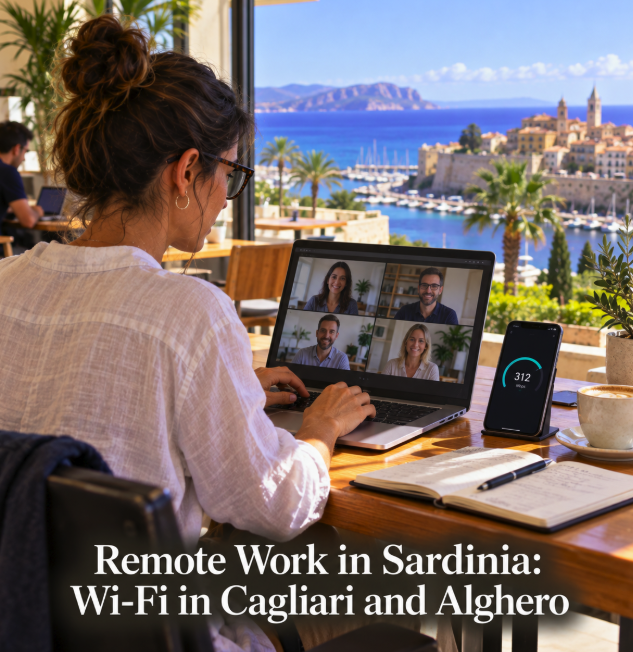
Cagliari and Alghero can both work well as Sardinian bases for remote workers, but there is no trustworthy citywide Wi-Fi speed that guarantees what you will get inside a particular apartment. In 2026, Sardinia has extensive fiber infrastructure — regional FTTH coverage is above the Italian average — yet the connection that matters is the one at the exact address where you plan to work. For a long stay, ask for a fresh speed test from the accommodation before paying.
Between the two cities, Cagliari offers the deeper year-round work ecosystem, with more coworking and business services. Alghero is smaller and easier to combine with a seaside lifestyle, and fiber is available at many addresses, but remote workers should pay particular attention to the specific building and backup connection.
Sardinia’s fiber coverage is stronger than its island image suggests
The latest AGCOM broadband data for the second quarter of 2026 puts FTTH coverage in Sardinia at 86.91% of resident households, above the Italian figure of 82.90%. That does not mean 86.91% of every town has identical service, but it challenges the idea that working from an island automatically means slow internet.
National broadband investment is also continuing. The official Piano Banda Ultralarga update published in September 2026 reports ongoing FTTH and fixed-wireless work across Italy, while FiberCop's Sardinia page for the Piano Italia 1 Giga provides municipality-level status updated to September 11, 2026.
Mobile coverage is less uniform. The Sardinian regional government said in August 2026 that areas with absent or insufficient mobile signal still exist, particularly in parts of the interior and along some major roads. That matters if your backup plan is tethering a laptop to a phone.
Cagliari: the strongest all-round base for work infrastructure
Cagliari is Sardinia's largest city and offers the broadest mix of offices, coworking, transport and year-round services. Current coworking options include spaces with fiber connections, meeting rooms and day desks rather than forcing remote workers to depend on café Wi-Fi.
Etechus Business Center, at Via Giuseppe Mercalli 2, currently advertises fiber internet and bookable coworking desks from €25 per day plus VAT. Monthly shared-office plans start from €300 plus VAT. This is useful for travelers who need a predictable professional setting for client calls or concentrated work.
Other coworking choices exist around the city, so a worker staying for several weeks can compare location, opening hours and meeting-room access instead of choosing accommodation solely because it advertises “free Wi-Fi.”
Cagliari also has the practical advantage of a major airport and urban services throughout the year. For remote workers who expect frequent video meetings, deliveries, printing, business appointments or occasional travel back to mainland Italy, that infrastructure can matter as much as raw download speed.
Alghero: fiber plus a smaller coworking scene
Alghero is a realistic remote-work base, not merely a holiday town with hotel Wi-Fi. Current September 2026 broadband data derived from AGCOM figures indicates FTTH reaches roughly 15,130 households in the municipality, with about 28,520 broadband addresses overall. The same current analysis reports a municipal average download figure of around 100 Mbps and approximately 136 Mbps on FTTH lines.
Those figures are useful context, but they are not a promise for your rental. A historic apartment inside Alghero's old town and a newer building elsewhere in the municipality may have completely different last-mile technology, router quality and indoor Wi-Fi.
Commercial fiber availability is also visible in current operator coverage. Sky Wifi, for example, advertises FTTH and FTTC service in Alghero with plans capable of up to 1 Gbps download and 300 Mbps upload where its full-fiber service is available. Fastweb-related current coverage data also indicates FTTH availability at up to 2.5 Gbps in parts of the city.
Always treat “up to” speeds as network capability rather than a measured result inside your accommodation.
Alghero coworking can provide useful redundancy
For a remote worker, the best backup is sometimes another workplace rather than another SIM card. Alghero has a smaller coworking market than Cagliari, but current options include ApotecA and Red Donkey.
Red Donkey, at Via Gramsci 6, describes an unusually redundant internet setup: Starlink, a Vodafone FTTC fiber line and a 4G mobile router. It offers Wi-Fi and wired LAN workstations as well as a meeting room. That multi-connection approach is useful for people whose work cannot tolerate a single broadband failure.
Current 2026 coworking listings also identify ApotecA as an active central Alghero workspace, with recent remote-worker feedback mentioning comfortable desks, air conditioning and a central location.
Availability, prices and access policies should be confirmed directly before relying on a coworking space for a specific workday.
Do not compare towns using one speed-test screenshot
A single 300 Mbps test from a Cagliari apartment does not prove that Cagliari is faster than Alghero, and a 50 Mbps hotel result does not prove that Alghero is slow. Wi-Fi performance depends on the fixed line, router, distance from the router, interference, number of simultaneous users and the device running the test.
For remote work, upload speed and latency can matter more than spectacular download numbers. Video conferencing, large cloud backups and sending media files can expose a connection that looks impressive when measured only by download speed.
Ask a host to run a current test from the actual desk or room where you will work, not next to the router. Request download, upload and ping figures. If your job involves daily video calls, ask whether the accommodation uses FTTH, FTTC, FWA or mobile internet.
What speed do you actually need?
Most ordinary remote work does not require gigabit fiber. Email, cloud documents and standard video meetings can work on much lower speeds when the connection is stable. Multiple simultaneous calls, large creative files, software builds and cloud backups increase the requirement.
A stable 100 Mbps connection with good upload and low latency can be more useful than an erratic 500 Mbps connection. The practical goal is not winning a speed test; it is having enough reliable capacity for your real workload.
Remote workers who handle confidential company data should also follow their employer's security requirements. Public café Wi-Fi may be convenient for casual browsing but is not automatically appropriate for sensitive work.
Build a backup before arriving
If missing a meeting would have serious consequences, use two independent ways to connect. A fiber apartment plus a mobile hotspot is a straightforward combination. For especially important workdays, identify a coworking space in advance.
Check mobile coverage for the exact neighborhood rather than assuming a carrier performs equally across Sardinia. The regional government's 2026 investment in filling mobile coverage gaps is evidence that dead or weak zones still exist outside the strongest urban areas.
A dual-SIM phone can add resilience when traveling around the island, but buying two SIMs on networks that ultimately share the same weak local coverage may not solve the problem. Test the backup before you need it.
Cagliari or Alghero for a long workation?
Choose Cagliari when you want the widest selection of year-round services, professional workspaces, transport connections and urban life. It is the more city-like option and makes it easier to separate work from the beach rather than expecting a holiday rental to function as an office.
Choose Alghero when a compact coastal town is part of the appeal and you are willing to verify the exact broadband connection before booking. Its fiber footprint and coworking options make serious remote work entirely possible, while the historic center and nearby coast provide a very different daily rhythm from the capital.
Other Sardinian towns can also perform well. Olbia, Sassari and even some villages now have excellent fiber, and rural coworking spaces can be surprisingly fast. Ruja Coworking, for example, currently advertises a 10 Gbps download and 2 Gbps upload FTTH connection despite its rural setting. The lesson is that geography alone no longer predicts broadband quality.
The booking checklist
- Ask the host for a fresh speed test from the room where you will work.
- Check download, upload and ping rather than download alone.
- Ask whether the line is FTTH, FTTC, FWA or mobile.
- Confirm there is a desk and a usable power outlet, not just “Wi-Fi included.”
- Check whether the router is inside your apartment or shared with other units.
- Identify a nearby coworking space before arrival.
- Verify mobile coverage for a backup hotspot.
- For a month-long stay, test the connection before committing to a non-refundable long rental whenever possible.
Sardinia in 2026 is perfectly capable of supporting remote work, but choosing the right town is only half the decision. Cagliari has the strongest overall professional ecosystem, while Alghero combines credible broadband with a more compact seaside setting. In either place, the best Wi-Fi test is not a city average: it is the current speed measured at the desk where you will actually open your laptop.