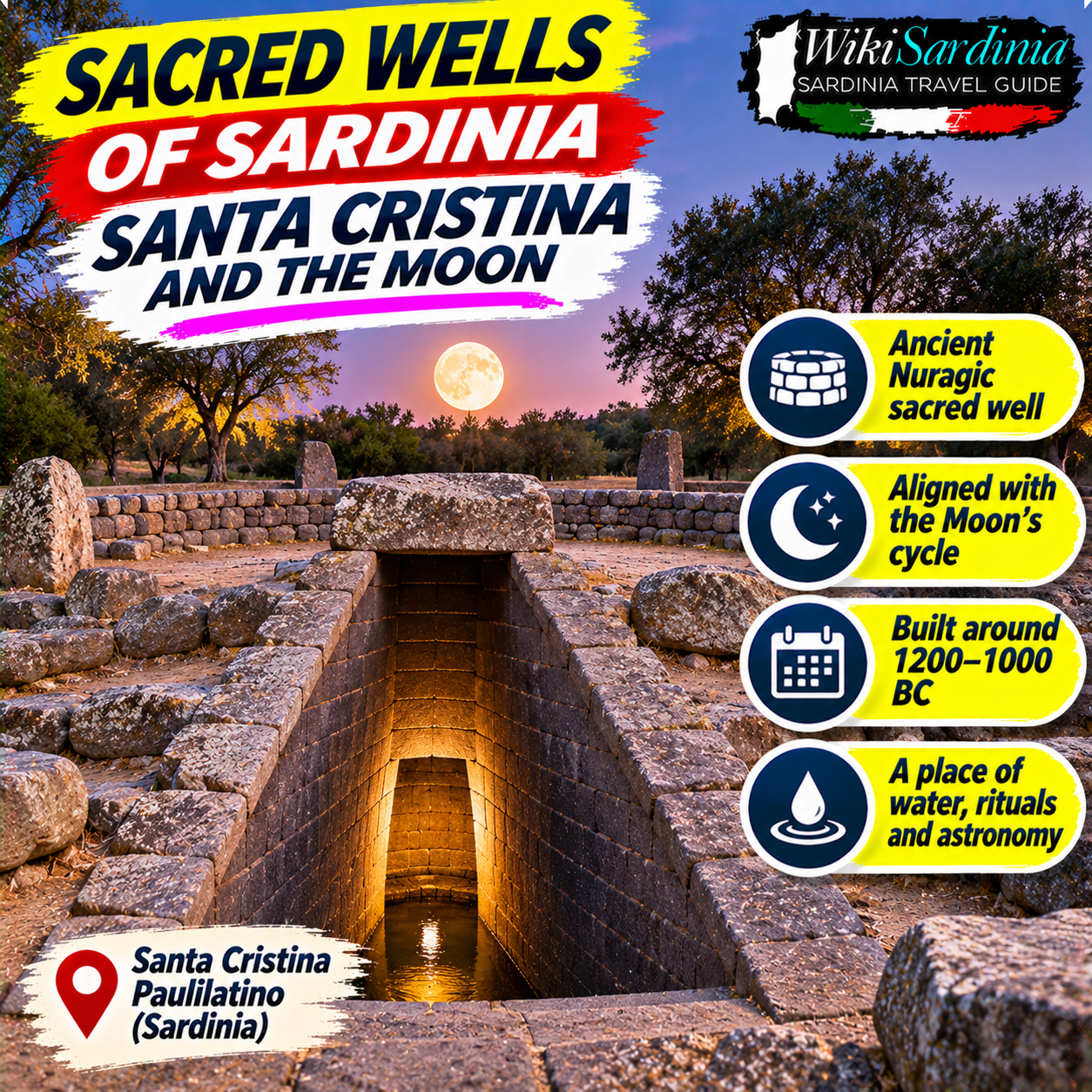
Sardinia’s sacred wells (pozzi sacri) are Nuragic religious monuments built around water sources. Santa Cristina near Paulilatino is particularly famous for its precise stonework and a proposed astronomical relationship with the Moon’s approximately 18.6-year cycle.
What were sacred wells used for?
These sanctuaries protected springs and provided settings for communal rituals and offerings. Water was central to their religious significance, although the exact beliefs and ceremonies remain uncertain. The regional tourism guide describes several surviving well temples and sacred springs. Not all share the same architecture or astronomical orientation.
Santa Cristina: a masterpiece of Nuragic architecture
Dating approximately to the eleventh century BC, the temple consists of an entrance area, a descending staircase and an underground circular chamber covered by a corbelled vault called a tholos. Precisely shaped basalt blocks form its walls. A small opening at the top of the vault allows light into the chamber. Surrounding remains include a meeting hut, Nuragic settlement structures and a later Christian sanctuary. The name Santa Cristina comes from the nearby medieval church, not from the original Nuragic religion.
How does the Moon align with the well?
The Moon’s orbital plane gradually changes orientation relative to Earth. Over approximately 18.6 years, its maximum declination varies, reaching an extreme during the major lunar standstill. Around the northern extreme, the Moon can pass unusually high across the sky above Sardinia. At Santa Cristina, the proposed alignment allows moonlight to enter through the roughly 30-centimeter aperture above the underground chamber and illuminate the water.
The official archaeological park website explains this phenomenon. The relevant passage is through the upper opening, not simply a full Moon rising at the end of the entrance staircase. A standstill is a period of extreme lunar declinations, not one instant when the Moon literally stops moving, and it is not the same as a lunar eclipse.
Was it an ancient lunar observatory?
In a 2008 academic paper, researcher Arnold Lebeuf examined whether the geometry could have enabled measurements of lunar declination. His preliminary findings support the feasibility of such observations. This does not independently establish that astronomical measurement was the builders’ original purpose, or that they could predict eclipses. The ritual interpretation and astronomical hypothesis can coexist, but should not be confused with proof of ancient intentions.
What happens at the equinoxes?
The park also describes sunlight traveling down the staircase to illuminate the water around the March and September equinoxes. This solar effect follows a different optical path from the proposed lunar alignment through the vault opening. Exact observation conditions depend on geometry, weather and access arrangements.
When is the next major lunar standstill?
The recent major standstill period centered on 2024–2025. The next is expected around 2043–2044, based on the approximate cycle. This is not a confirmed viewing date for Santa Cristina. Ordinary lunar illumination may occur outside the extreme period, and a particular reflection depends on lunar altitude and local conditions. Night visits require explicit confirmation from the park.
How to visit Santa Cristina
The archaeological complex lies about 3.5 kilometers southwest of Paulilatino, close to the SS131 highway, according to the Ministry of Culture archaeological report. Check the park website for tickets and access arrangements. Allow roughly one to two hours for the wider complex as a planning estimate. The underground staircase may be difficult for visitors with reduced mobility; ask about accessible alternatives. Never enter closed areas or touch the water without permission.
Other sacred wells to discover
Santa Vittoria at Serri and Sant’Anastasia at Sardara are important examples of Sardinia’s water sanctuaries. Their individual architecture and history merit separate visits; do not assume the same lunar alignment occurs at every well.
Useful Italian phrases
- Quando si può visitare il pozzo sacro? — When can we visit the sacred well?
- Organizzate visite notturne? — Do you organize night visits?
- La visita è accessibile a chi ha difficoltà motorie? — Is the visit accessible to people with mobility difficulties?
FAQ
Is the well Roman?
No. Its original construction is Nuragic, although the sanctuary experienced later phases of use.
Does the Moon align every full moon?
No. Lunar phase alone does not determine the required altitude or declination.
Is the astronomical purpose proven?
No. It is a studied hypothesis supported by geometrical investigations, not definitive proof of the original intention.
Can you see the well without waiting 18 years?
Yes. The monument can be visited independently of the astronomical cycle, during authorized opening times.
Sources reviewed November 2026. Current admission prices and special observing sessions have not been independently confirmed.