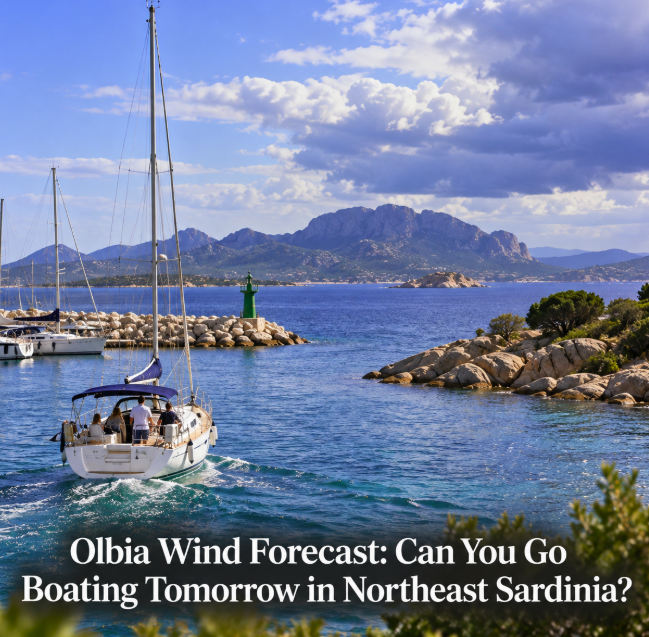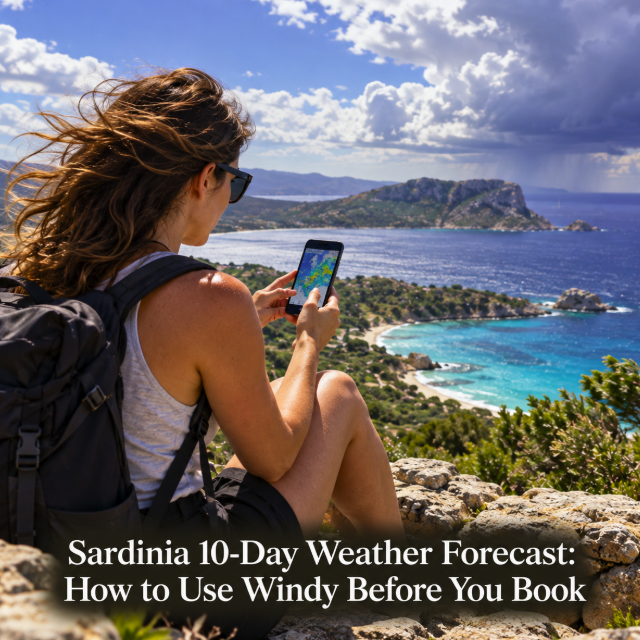
A 10-day weather forecast can help decide whether a Sardinia trip looks promising, but it should not be read as a ten-day promise of sunshine or rain. Windy currently displays medium-range forecasts and lets travelers compare several numerical models, including ECMWF, GFS and ICON. That makes it particularly useful for Sardinia, where wind, coastline and mountains can produce very different conditions around the island on the same day. The most important trick is to watch whether the models agree rather than trusting a single weather icon ten days in advance.
Why Windy is useful for Sardinia
Windy is much more than a row of sun-and-cloud symbols. Its forecast interface lets users inspect wind, temperature, rain, clouds, waves and other variables at a specific point, while its multimodel view can compare forecasts from different weather models. The current platform includes global ECMWF, GFS and ICON output, with additional regional models available in some areas. citeturn0search0turn0search8
For a Sardinia holiday, start by searching for the place where you will actually stay — Cagliari, Alghero, Olbia, San Teodoro, Villasimius or another specific destination — rather than looking at a generic “Sardinia” forecast. The island is large enough for the northwest to be windy while the southeast is calmer, or for showers over inland mountains to coexist with brighter weather on the coast.
Windy’s forecast pages can extend beyond ten days, but the fact that a model produces numbers that far ahead does not mean every hourly detail should be taken literally. citeturn0search0
At day 10, uncertainty matters more than the exact temperature
ECMWF classifies forecasts out to 15 days as medium-range and uses an ensemble system to represent uncertainty. Its ensemble contains 51 forecasts: one control run and 50 members with slightly altered initial conditions and model physics. When those possible outcomes spread apart, uncertainty is higher; when they cluster together, confidence in the broader pattern is stronger. citeturn0search2
This is the right mindset for a ten-day Sardinia forecast. A prediction of exactly 24°C with a shower at 3 p.m. on day nine is less useful than the larger signal: are several models showing a cooler unsettled period, or is only one run producing rain while the others remain dry?
Forecast skill generally declines as lead time increases. ECMWF itself emphasizes probabilistic ensemble information at medium range because atmospheric uncertainty grows with time. citeturn0search2turn0search14
Use Windy’s “Compare forecasts” view
Windy’s multimodel interface can place ECMWF, GFS and ICON forecasts together for the same location, making disagreements easy to spot. Current Windy pages show a comparison horizon extending to 15 days for supported models. citeturn0search12
If ECMWF, GFS and ICON all show a similar wind increase on the same day, that broad signal deserves more attention than a feature appearing in only one model. The same applies to a multi-day rain period or a clear warm spell.
Do not turn model agreement into certainty, however. Forecasts can shift together as new observations enter later runs. Recheck the forecast each day as departure approaches rather than making a non-refundable decision from a single screenshot.
For a beach trip, wind may matter more than the rain icon
Sardinia’s beaches can feel completely different according to wind direction and strength. A forecast showing 25°C and sunshine may look perfect, yet strong wind can make an exposed beach uncomfortable and produce rougher water. Conversely, another coast may be relatively sheltered.
On Windy, inspect the wind layer and the forecast at the exact beach or coastal town. If boating, sailing or taking a ferry, also look at waves rather than assuming wind speed alone describes sea conditions. Windy includes wave and tide forecast views alongside its atmospheric layers. citeturn0search0
For swimming or boating decisions, a medium-range forecast is only an early planning signal. Check updated marine information and local conditions close to the activity, especially when strong wind or thunderstorms are possible.
Rain percentages need context
A rainy symbol on one day of a ten-day forecast does not necessarily mean an entire holiday day will be washed out. Mediterranean precipitation can arrive as a short shower or thunderstorm rather than continuous rain, and model timing can shift substantially several days ahead.
Open the detailed forecast and examine when precipitation is expected, how much is modeled and whether other models show the same event. A small isolated rainfall signal far in the future should not carry the same weight as a broad multi-model wet pattern that persists through successive forecast updates.
Do not use one city to represent the whole island
This is one of the most common mistakes when planning Sardinia. A Cagliari forecast is not an Olbia forecast, and conditions in Alghero do not automatically describe the Gulf of Orosei.
If your itinerary is flexible, save several locations in Windy. For a northern trip, compare Alghero or Stintino with Olbia or San Teodoro. For the south, compare Cagliari with Villasimius and the southwest. A poor forecast on one exposed coast may coexist with much more comfortable conditions elsewhere.
Mountain destinations deserve their own forecast as well. Temperature, cloud and wind at higher elevations can differ markedly from conditions beside the sea.
How to decide whether to book
Ten days out, use the forecast to identify a trend rather than to cancel or book solely because of one symbol. If several models repeatedly show stable, dry weather across multiple runs, that is a useful positive signal. If they repeatedly show a significant unsettled pattern, build flexibility into the trip.
Five to seven days before departure, model agreement becomes more useful for practical planning. At two or three days, start choosing specific beaches, hikes and boat days around the latest local forecast. On the morning itself, check current observations and warnings rather than relying on the forecast you saved earlier in the week.
Travelers making expensive non-refundable bookings should also consider whether the accommodation or transport can be changed. Weather uncertainty does not disappear because a forecast app looks precise.
Windy is a model viewer, not a guarantee
Windy explains that numerical weather prediction models use different resolutions, physical schemes and initial conditions, which is why ECMWF, GFS and ICON can produce different outcomes from the same starting period. citeturn0search8
That disagreement is useful information. Instead of asking, “What will Sardinia’s weather be in exactly ten days?”, ask, “What weather pattern are the main models suggesting, how strongly do they agree, and is that signal becoming more stable as the trip approaches?”
For deciding whether to travel, that is the most sensible use of a Sardinia 10-day forecast. Check your exact destination, compare models, pay particular attention to wind and sea conditions for coastal plans, and update the forecast as departure gets closer. A ten-day outlook can help you plan; it cannot eliminate Mediterranean weather uncertainty.