Planning to film Sardinia’s coastline with a drone? Before packing your aircraft and batteries, check the airline’s rules. Lithium batteries are regulated because they can overheat or catch fire if damaged or short-circuited, and airlines may apply restrictions beyond the general guidance.
Can you bring a drone battery on a plane to Italy?
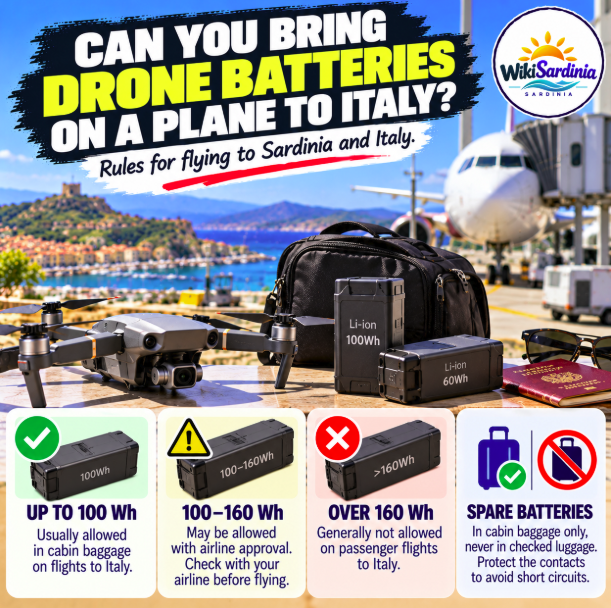
In general, lithium-ion batteries rated at up to 100 watt-hours (Wh) are usually permitted in cabin baggage. Spare batteries must be carried in the cabin, not checked baggage, and their contacts must be protected against short circuits. Keep each spare battery in its original packaging or a separate protective pouch, or cover exposed terminals as directed by the airline.
The drone itself must also comply with the airline’s baggage size and handling rules. Do not assume that every carrier treats the aircraft and its batteries in exactly the same way.
What do the 100 Wh and 160 Wh limits mean?
- Up to 100 Wh: generally allowed in cabin baggage, subject to the airline’s rules and applicable quantity limits.
- More than 100 Wh and up to 160 Wh: normally requires the airline’s prior approval. Spare batteries in this range are generally limited in number.
- Over 160 Wh: generally not permitted on passenger aircraft under standard passenger-baggage rules.
These are general guidelines, not a promise that a particular airline will accept your battery. Some carriers impose stricter conditions for drones. For example, Ryanair’s published guidance says drones are not permitted in checked baggage and may be carried in the cabin only if they meet cabin-bag size requirements and the lithium battery does not exceed 100 Wh.
How do you check your drone battery’s Wh rating?
Look for a watt-hour (Wh) figure printed on the battery label or in the manufacturer’s specifications. If only voltage (V) and capacity in milliamp-hours (mAh) are shown, you can estimate the energy using this formula:
Wh = (mAh × V) ÷ 1,000
For example, a battery rated at 2,000 mAh and 15 V is approximately 30 Wh. Use the manufacturer’s stated rating where available, and do not guess if the label is unclear.
How should you pack drone batteries?
- Put spare lithium batteries in your cabin baggage, never in checked baggage.
- Protect each battery individually so metal objects cannot bridge the terminals.
- Keep batteries in good condition; do not travel with swollen, damaged or recalled batteries.
- If your cabin bag is taken at the gate and checked into the hold, remove spare batteries and keep them with you in the cabin, following crew instructions.
- Check whether your airline sets a maximum number of spare batteries or requires advance approval.
What does ENAC say?
ENAC, Italy’s Civil Aviation Authority, advises passengers to contact their airline about the permitted dimensions of the drone and restrictions on lithium batteries, which are treated as dangerous goods. This matters because the general battery threshold does not override a carrier’s own rules.
Before leaving for the airport, check the current rules on your operating airline’s official website. If you have a battery above 100 Wh, obtain written approval before travelling rather than relying on a general online summary.
Quick checklist before flying to Sardinia
- Check the Wh rating printed on every drone battery.
- Read your airline’s current rules for drones and lithium batteries.
- Pack spare batteries in cabin baggage and protect their terminals.
- Get airline approval in advance for batteries above 100 Wh where required.
- Confirm the drone fits the airline’s cabin baggage dimensions and policy.
The short answer
You can often take a small drone and its batteries on a flight to Italy, but the exact conditions depend on the battery rating and airline. Up to 100 Wh is generally permitted in cabin baggage; 100–160 Wh usually requires approval; over 160 Wh is generally prohibited on passenger aircraft. Spare batteries belong in the cabin, with their contacts protected. Always confirm the latest policy with your airline before travelling.
For official guidance, read IATA’s passenger guidance on lithium batteries and ENAC’s FAQ on transporting a drone on board. If flying with Ryanair, also check its current list of permitted cabin items.