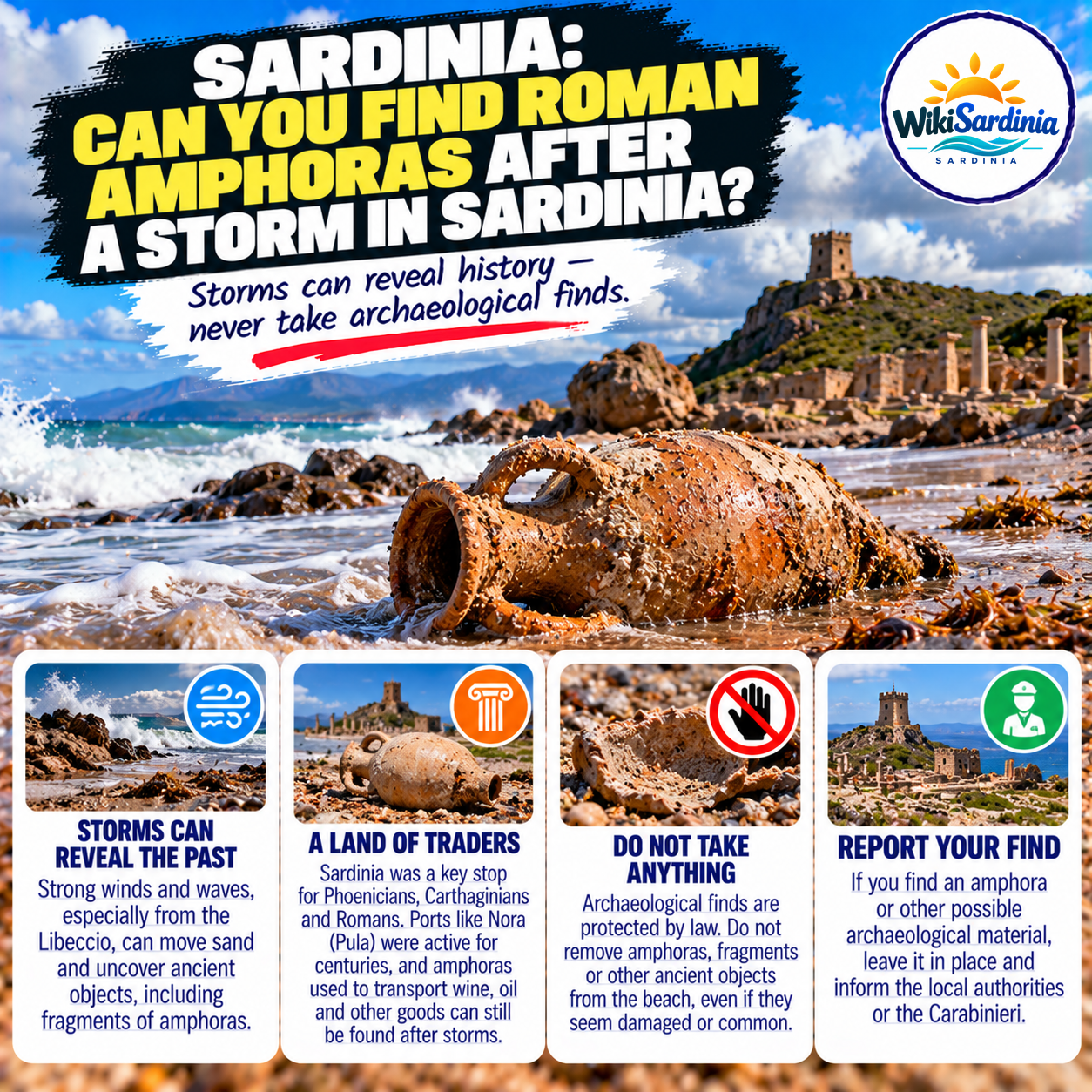
After a strong storm, Sardinia’s beaches can look completely different. Waves shift sand and pebbles, expose buried layers and sometimes reveal objects that have been hidden for centuries. Could one of those objects be an ancient amphora? It is possible—but a dramatic find is rare, and anything that looks archaeological should be treated carefully rather than picked up as a souvenir.
Can storms uncover ancient artifacts in Sardinia?
Yes. Storms and coastal erosion have exposed archaeological remains in several parts of Sardinia. In January 2026, severe weather brought Phoenician-era tombs and pottery, including amphorae, to the surface on a beach in the Domus de Maria area near Chia. In 2023, two amphorae of possible archaeological interest were found washed ashore at Sant’Antioco after stormy weather.
These discoveries show that the sea can expose buried material, but they do not mean that every storm will reveal a complete Roman amphora or that any particular beach is a reliable place to search for one.
What about Nora, near Pula?
Nora is one of Sardinia’s most important coastal archaeological sites. It was occupied in the Phoenician and Punic periods and later developed into a Roman city, with remains including streets, public buildings, baths and a theatre. Its history is closely tied to the sea and to ancient Mediterranean trade.
The official history of the archaeological area records that the first excavations in the late nineteenth century followed a strong storm that exposed the tophet, a sacred area associated with the Phoenician-Punic settlement. Archaeological work and underwater research around Nora have also documented ancient commercial amphorae. That history makes Nora a compelling example of how coastal conditions can reveal the past—but it is not a promise that Roman amphorae will appear on the beach after every Libeccio storm.
Why were amphorae in the sea?
Amphorae were ceramic containers used across the ancient Mediterranean to transport goods such as wine, olive oil, sauces and other products. Ships travelled between ports, and cargo containers could end up underwater when vessels sank, lost cargo or were damaged. Others may have been discarded or deposited near ancient harbours.
Because Sardinia was connected to Phoenician, Punic and Roman trade networks, archaeological material can be found on land and underwater. However, identifying a fragment’s age and origin usually requires specialist examination; shape, colour or a layer of marine growth is not enough for a reliable identification.
What should you do if you find a possible amphora?
Leave it in place and do not remove it from the beach or seabed. Its location and the material around it can be as important to archaeologists as the object itself. Lifting, cleaning or moving it can damage fragile surfaces and destroy information about where it came from.
In Italy, accidental discoveries of objects that may be of archaeological interest must be reported within 24 hours to the competent Soprintendenza, the mayor or a public-safety authority, according to Article 90 of Legislative Decree 42/2004. You can contact the Carabinieri or local authorities for help passing on the report. If the area is cordoned off or access is restricted, do not enter it.
How to report a discovery responsibly
- Do not pick up, clean, dig around or carry away the object.
- Take a photograph from a safe distance without disturbing it, if permitted.
- Note the general location and time of the discovery without moving the object.
- Notify the local authorities, Carabinieri or the competent archaeological Soprintendenza promptly.
- Keep the exact location off social media if sharing it could attract people who might remove artifacts.
- Follow any instructions from officials and stay clear of unstable cliffs, surf and restricted areas.
Is it safe to search the beach after a storm?
Be cautious. Strong waves, unstable sand, slippery rocks and sudden changes in the sea can make the shoreline dangerous even after the weather appears to improve. Do not walk onto exposed reefs or unstable edges to investigate an object, and never enter the water to retrieve something that may be archaeological.
The short answer
Yes, storms can expose ancient archaeological material on Sardinian shores. Nora’s archaeological history includes a major storm that revealed the tophet before excavations began, while other Sardinian beaches have produced finds such as amphorae after rough seas. But a Roman amphora is not a predictable post-storm discovery. If you see something that may be ancient, leave it where it is and report it—protecting its context helps preserve Sardinia’s history.
For further reading, consult the official Nora archaeological area history, the Ministry of Culture’s account of underwater archaeological finds near Nora, and the report on amphorae found after storms at Sant’Antioco.