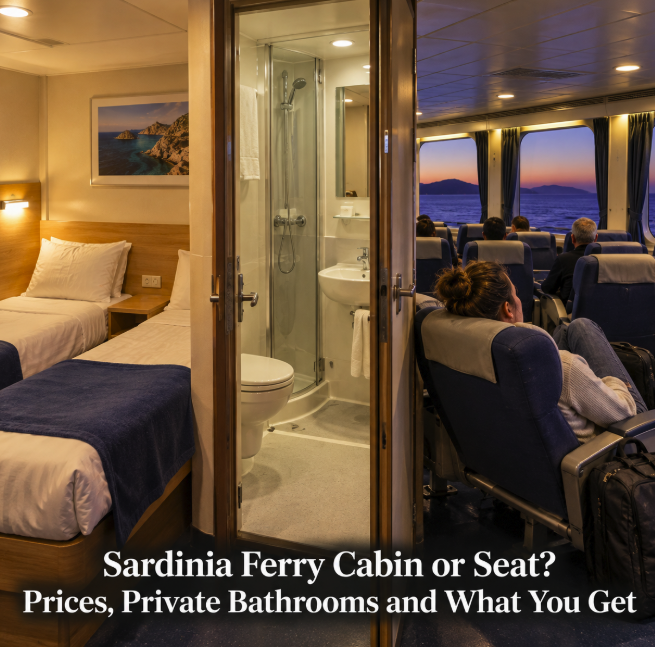
On an overnight ferry to Sardinia, the difference between a reserved seat and a private cabin is much bigger than a wider chair. A standard cabin gives you a bed, a door you can close and, on the main operators, a private bathroom with a shower. A numbered reclining seat costs less but leaves you sleeping in a shared passenger lounge and using the ship’s public toilets. For a long night crossing, that difference can determine whether you arrive in Sardinia ready for the day or looking for somewhere to sleep.
There is no single cabin price for Sardinia. Fares change by route, date, season, ship, occupancy and availability. Current 2026 published examples, however, make it possible to understand the size of the upgrade.
Does a Sardinia ferry cabin have a private bathroom?
On the principal overnight ferry operators, standard cabins are normally equipped with their own bathroom. MOBY currently describes its internal double cabin as having two beds and an ensuite bathroom with a shower. Its other cabin categories include internal and external options, with the external versions adding a porthole.
Grimaldi Lines likewise describes cabin accommodation with internal facilities, while Sardinia Ferries offers several cabin categories for overnight crossings, including internal, external and luxury cabins.
The exact layout varies by vessel. Some cabins use bunk beds, others have lower beds or a double-bed arrangement, and accessible or pet-friendly cabins have specific configurations. Always check the cabin description attached to the actual sailing rather than relying on a generic photograph.
How much more does a cabin cost than a seat?
A useful current comparison comes from Grimaldi Lines’ regulated Civitavecchia–Arbatax service. For a non-resident passenger in the 2026 high season, the published maximum rate is €37 for a reserved seat. A berth in a four-bed internal cabin is €46 per person, while an internal double cabin is €58 per person. An external double cabin is €61 per person.
In low season on the same route, the maximum published rates are €30 for a seat, €37 for a four-bed internal cabin, €44 for an internal double and €47 for an external double. VAT and port fees are additional under the published tariff rules.
That means the headline difference between a seat and a cabin berth can sometimes look surprisingly small. But there is an important detail: if you want a cabin privately rather than sharing all available berths, partial-occupancy supplements may apply.
Private cabin pricing can work differently
On Grimaldi’s public-service Sardinia routes, cabin tariffs are published per person, and partial occupancy can trigger an additional charge for the unused bed or beds. On Civitavecchia–Arbatax, for example, the 2026 high-season supplement for an unused berth in a double internal cabin is €29; for a double external cabin it is €30.50.
So a solo traveler should not assume that seeing “€58 double cabin” means the whole private cabin costs €58. The booking engine calculates the accommodation according to the passengers and occupancy rules.
Sardinia Ferries uses a different presentation for many of its cabin offers: current overnight exclusive cabins are advertised from €56 per cabin, while daytime cabins start from €30. Its overnight cabins are sold for exclusive use at a flat accommodation price, subject to sailing, availability and cabin category.
These examples are useful benchmarks, not quotations for a specific journey. Ferry pricing is dynamic, and promotional fares can change quickly.
Naples to Cagliari: another 2026 comparison
The current regulated Naples–Cagliari tariff provides another clear cabin-versus-seat example. In 2026 high season, the published maximum non-resident rate is €42.95 for a reserved seat.
A berth in a four-bed internal cabin is €52.25, an internal double is €56.25 and an external double is €71.60 per person. In low season, the corresponding seat is €33.75, while the four-bed internal cabin is €39.95 and the internal double €43.95.
Again, private use can cost more when not all beds are occupied. The published high-season supplement for an unused berth in a double internal cabin is €28.13 on this route.
For couples, cabin economics often become more attractive because two people naturally fill a double. Solo travelers have to compare the private-use supplement more carefully.
What do you get with a reserved seat?
A reserved ferry seat is closer to an airline-style reclining chair than a bed. You have an assigned place in a shared lounge, but no private room and no personal bathroom.
For a daytime crossing, that may be perfectly adequate. You can move around the ship, eat, sit outside when conditions permit and use the seat when you want to rest.
Overnight is different. Passenger lounges have other travelers coming and going, lights may remain on at some level and announcements or general ship noise can interrupt sleep. Privacy is minimal.
A seat works best for travelers prioritizing the lowest accommodation cost, younger passengers comfortable sleeping in public spaces or people on shorter crossings who do not expect a full night’s sleep.
Why a cabin can be worth paying for
The private bathroom is only part of the upgrade. A cabin gives you a place to change clothes, secure your immediate belongings, stretch out properly and sleep horizontally.
That can be particularly valuable if you are driving after arrival. Reaching Olbia, Porto Torres or Cagliari at the beginning of a road trip after a poor night in a chair is very different from starting after several hours in a bed.
Families also gain a contained space where children can sleep without spending the night in a public lounge. Travelers who need privacy for medication, mobility routines or simply a quiet environment may find the difference even more important.
For couples, the upgrade is often easiest to justify because a two-bed cabin matches the party size naturally.
Internal or external cabin?
An internal cabin has no porthole. It is normally the less expensive choice and provides the same fundamental advantages: bed, privacy and ensuite facilities.
An external cabin has a porthole or window. The natural light can make the small space feel less enclosed and helps you wake naturally as the ferry approaches Sardinia.
If the purpose of the cabin is simply to sleep from midnight until dawn, the internal option is often sufficient. Travelers uncomfortable in windowless rooms may prefer paying the difference for an external cabin.
Luxury cabins and suites add features such as larger beds, additional space, television or upgraded furnishings depending on the operator and vessel.
What about sleeping on deck?
The cheapest accommodation category on many ferries is deck passage, sometimes described as ship passage or unassigned accommodation. It gives access to public areas but no reserved seat or cabin.
On Civitavecchia–Arbatax, the current 2026 high-season maximum non-resident tariff is €31 for deck passage compared with €37 for a reserved seat. On Naples–Cagliari it is €34.75 compared with €42.95 for a seat.
For budget travelers, the saving exists, but an overnight ferry is not a hotel lobby designed for sleeping. Rules about where passengers can remain overnight vary by ship, and outdoor decks can be windy, damp or closed in poor conditions.
When should you book a cabin?
Book early if traveling in July or August, with children, with a pet requiring a designated cabin or on a sailing where arriving rested matters. Cabin inventory is finite and the most convenient configurations can disappear before passenger seats do.
Current 2026 regulated Sardinia tariffs classify June 1 through September 30 as high season, alongside certain holiday periods. Commercial routes may use their own dynamic pricing rather than the same regulated structure, but the practical lesson is similar: summer demand affects both availability and price.
If your travel dates are flexible, compare nearby sailings. An overnight departure with a reasonably priced cabin may provide better overall value than a cheaper daytime ferry that requires paying for another hotel night.
Cabin or seat: which should you choose?
For a daytime crossing, a reserved seat is often enough unless you want privacy or somewhere for children to nap. Sardinia Ferries even sells daytime cabins from €30 on selected crossings, so checking the upgrade cost can still be worthwhile.
For an overnight crossing, a cabin becomes much more valuable. You get a real bed and private bathroom, and you arrive with a better chance of having slept.
A solo budget traveler may reasonably choose the seat because private-cabin occupancy supplements can increase the price. A couple should compare a double cabin closely because the incremental cost can be modest on some regulated routes. For a family, the privacy and ability to put children to bed can outweigh the fare difference.
The key is to compare the total booking price, not one accommodation number. Passenger fares, cabin or seat, vehicle, taxes, port fees and optional services all contribute to the final ticket.
If the ferry is simply transportation for a few daylight hours, save the money. If it replaces a hotel night and you plan to drive across Sardinia after docking, a private cabin with its own shower can be one of the more practical upgrades of the trip.