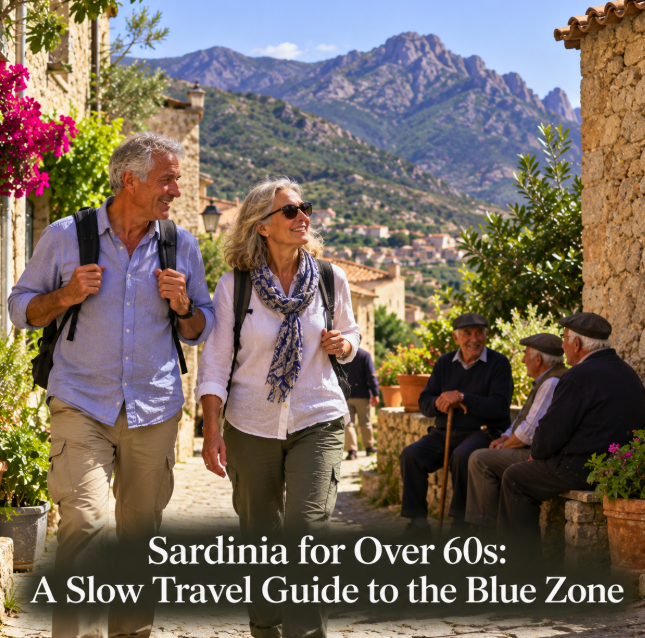
Sardinia works particularly well for travelers over 60 who prefer longer stays, unhurried meals and one meaningful outing rather than a checklist of attractions every day. For Americans interested in the island’s famous longevity story, a slow itinerary can also include villages in central-eastern Sardinia’s documented “Blue Zone” — but it is better approached as a cultural landscape than as a wellness attraction promising a secret formula for living to 100.
Scientific research identified a mountainous area of central-eastern Sardinia with unusually high levels of extreme longevity, historically especially among men. Later research has continued to study the interaction of physical activity, diet, social life, environment and genetics, but no single cause has been established. A 2025 scientific review found that Sardinia’s Ogliastra is among the better-characterized longevity regions, while also showing why simple “nine habits to live longer” explanations should be treated cautiously.
Where is Sardinia’s Blue Zone?
The original demographic research mapped a longevity concentration across the mountainous central-eastern part of the island. For travelers, Ogliastra and neighboring inland communities provide the clearest way to encounter this landscape through villages, traditional food, pastoral culture and everyday local life.
Villagrande Strisaili, at around 750 metres above sea level on the slopes of the Gennargentu, is presented by Sardinia’s official tourism portal as a village strongly associated with exceptional longevity. Its territory combines mountain scenery, archaeological sites and old oak woodland, while the Gulf of Arbatax lies to the east.
Perdasdefogu, another Ogliastra mountain town, is also identified by the regional tourism authority with the island’s longevity area. It is surrounded by limestone landscapes and agro-pastoral traditions. Seulo, in the Barbagia di Seulo, is likewise described by the regional tourism portal as part of Sardinia’s Blue Zone and sits amid gorges, forests and the Flumendosa river landscape.
These are living communities, not themed exhibits. The most rewarding visit is therefore modest: walk through the village, stop for coffee, eat local food, visit a museum or archaeological site when open and allow the landscape to explain why daily life here has historically been very different from life in a large city.
A seven-day slow itinerary
For a first visit, avoid trying to combine the entire island with the Blue Zone in one week. A comfortable plan is to spend three nights on the coast and three or four nights in or near Ogliastra, with a final night positioned for the departure airport if necessary.
Days one to three can be based around Arbatax, Tortolì or Santa Maria Navarrese. This provides restaurants, coastal scenery and a gentle introduction without requiring a mountain drive immediately after a long journey from the United States. A boat excursion can be included if boarding arrangements and sea conditions suit your mobility, but it is not essential.
Move inland on day four and visit Villagrande Strisaili at an easy pace. Rather than scheduling several villages, combine one town with lunch and a scenic drive. On day five, choose Perdasdefogu or another Ogliastra community and leave time for spontaneous stops. Day six can be devoted to local food, crafts, archaeology or a short nature walk appropriate to your fitness.
On day seven, begin moving toward Cagliari or Olbia depending on your flight. Sardinia’s interior roads are scenic but often winding, so transfer days should not be overloaded with sightseeing.
Why a rental car usually makes sense
Sardinia has trains and buses, and urban public transport can work well for city stays. The regional tourism authority nevertheless notes that a car offers the greatest freedom for exploring the island. That becomes especially relevant in the Blue Zone, where villages and rural attractions are dispersed and bus schedules may not suit a leisurely visitor itinerary.
For two travelers, a small automatic car is often the simplest option. Choose accommodation with straightforward parking and avoid the largest rental category unless you need the space. Mountain villages can have narrow streets and steep sections.
If neither traveler wants to drive, build the trip around Cagliari or another well-connected base and arrange private or small-group excursions into the interior rather than trying to reproduce a road trip by public bus.
Accessibility needs to be checked place by place
Being over 60 does not automatically imply limited mobility, and many travelers in their sixties and seventies will hike, swim and explore independently. But anyone who does have reduced mobility should verify facilities rather than assuming that a “senior-friendly” itinerary is step-free.
Sardinia’s official tourism portal notes that many public transport vehicles have boarding equipment for passengers with reduced mobility, but that assistance may still be necessary and travelers should confirm the exact vehicle with the transport company. It also says accessible beach walkways and dedicated facilities are available at some resorts, but recommends checking with the local tourism office or municipality for the exact beach.
Historic villages present another variable. Cobbles, slopes, stairs and uneven pavements are part of the built environment. Ask hotels specifically about elevators, steps between reception and rooms, shower access and the distance from parking rather than relying on a generic “accessible” label.
What the longevity research actually suggests
Sardinia’s longevity story is more interesting when it is not reduced to a miracle diet. Research has examined genetic background, environmental factors, nutrition, physical activity, psychological well-being and social structures. An ecological study of male longevity concluded that the geographic differences may reflect a combination of environmental, lifestyle and genetic factors rather than one isolated behavior.
More recent work has continued to examine physical activity and functional capacity among older residents of the Sardinian Blue Zone. Other studies have looked at cognitive reserve and psychological well-being. These findings are useful for understanding a population, but they do not prove that a visitor can copy a local meal or routine and obtain the same longevity outcome.
That distinction matters because commercial “Blue Zone tours” can sometimes turn demographic research into a wellness promise. A responsible experience should focus on history, foodways, community and landscape rather than implying medical benefits.
Eat slowly, but do not expect a longevity menu
Traditional inland food is part of the experience. Depending on the village and season, meals may include bread, pasta, legumes, vegetables, cheeses, olive oil and meat associated with pastoral cooking. Local wine may also be part of social meals.
Instead of searching for a restaurant advertising a “Blue Zone diet,” look for an agriturismo, family restaurant or guided food experience that explains where ingredients come from and how local dishes developed. The cultural context is more authentic than a menu assembled around longevity marketing.
Travelers with dietary restrictions should communicate them when booking. Traditional set meals can involve multiple courses and may not provide extensive à-la-carte substitutions without advance notice.
Best time for an unhurried trip
May, June, September and early October are attractive periods for slow travel because they generally avoid the greatest intensity of the August holiday season. The coast remains appealing, while inland sightseeing can be more comfortable than during the hottest summer afternoons.
Spring and autumn also suit travelers who want villages and landscapes rather than a beach-only holiday. Weather in mountain areas can differ noticeably from the coast, however, so pack a light layer and check the forecast before inland excursions.
August is possible, but accommodation demand, traffic around major coastal resorts and heat can make the island feel less slow. If August is your only option, spend more time inland and avoid changing hotels every night.
Build rest into the itinerary
Jet lag is a real part of a US-to-Sardinia trip. The first full day should not begin with a long mountain drive or strenuous hike. Stay two or three nights in each base, keep at least one afternoon unscheduled and make lunch part of the experience rather than something squeezed between attractions.
That rhythm fits Sardinia particularly well. A morning village visit, a long lunch, a short scenic stop and an evening walk can produce a richer day than covering three towns and arriving at each one tired.
The Blue Zone provides a natural theme for this kind of trip, but the lesson is not that Sardinia has discovered a guaranteed recipe for longevity. What visitors can genuinely experience is a part of the island where researchers documented exceptional longevity and where mountain geography, food traditions and community life remain closely connected. For travelers over 60, exploring it slowly is not a compromise — it is one of the most appropriate ways to see it.