Jellyfish can appear along Sardinia’s coast in September, but a sighting at a popular beach does not automatically mean the sea is dangerous or that there is an island-wide emergency. Reports from beaches such as Poetto near Cagliari or La Cinta at San Teodoro should be treated as local, changing conditions: jellyfish can be pushed toward shore by currents and winds, and their numbers can differ dramatically from one beach to another on the same day.
As of 16 September 2026, official Sardinian environmental sources reviewed for this article do not show a general jellyfish alert covering Poetto, La Cinta or Sardinia as a whole. ARPAS is publishing current marine and bathing-water information, but the public bathing-water monitoring system is primarily designed to assess water quality rather than provide a real-time jellyfish count. That distinction matters when social posts or beach reports describe an “invasion.”
Which jellyfish are found in Sardinia?
ARPAS has carried out dedicated monitoring of jellyfish in Sardinian waters. Regional results covering 2018–2023 recorded 361 observations belonging to ten species. Among the more frequently reported organisms were Velella velella, Cotylorhiza tuberculata and Pelagia noctiluca.
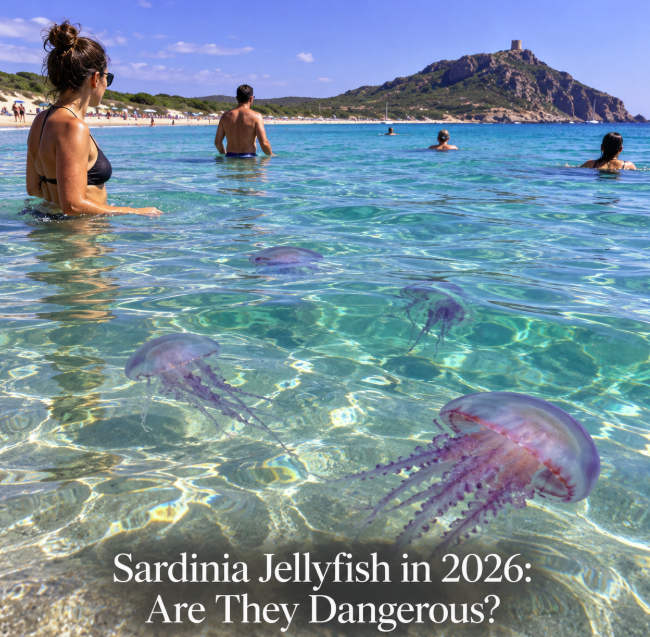
For swimmers, Pelagia noctiluca — commonly known as the mauve stinger or luminous jellyfish — deserves particular attention because it has a painful sting. Sardinia’s regional environmental information specifically describes the species as having stinging capability.
Not every large or unusual-looking jellyfish poses the same problem. ARPAS has also documented Rhizostoma pulmo, the large barrel jellyfish, as well as Phyllorhiza punctata, the white-spotted jellyfish. In previous monitoring in the Gulf of Olbia, ARPAS noted that Phyllorhiza punctata should not cause alarm among swimmers because it is not considered stinging to people, although it can have ecological effects because it feeds on plankton, fish eggs and larvae.
This is why identifying the species matters more than simply seeing the word “jellyfish” in a beach report.
Is September jellyfish season?
There is no single Sardinian jellyfish season that guarantees either their presence or absence. Jellyfish occurrence depends on species, water conditions, currents, winds, food availability and other environmental factors. They can be observed outside the busiest summer weeks, so September visitors should not assume that the end of August means the end of jellyfish encounters.
Conditions can also change quickly. A beach with several jellyfish in the shallows in the morning may look different later after the wind or current changes. Conversely, apparently clear water does not guarantee that an individual jellyfish will not drift into the swimming area.
On 16 September 2026, ARPAS’s marine bulletin was active with updated wind and sea information for Sardinian waters. Such conditions help explain why floating marine organisms may concentrate in particular coastal areas, but a weather forecast alone cannot reliably predict whether jellyfish will be present at Poetto, La Cinta or any specific swimming spot.
What should swimmers do when jellyfish are present?
If several jellyfish are visible in the water, the simplest precaution is not to swim among them. Keep children from touching specimens in shallow water or on the beach, and do not assume that a stranded jellyfish is harmless: tentacles can remain capable of stinging even when the animal appears inactive.
Pay attention to lifeguards, beach staff and any local warnings. At large beaches such as Poetto and La Cinta, conditions can vary along a long stretch of coastline, so information from the immediate bathing area is more useful than a social-media post made several kilometres away or several hours earlier.
If stung, leave the water calmly and avoid rubbing the affected skin. Seek assistance from lifeguards or local medical services when available, particularly for severe pain, extensive contact, breathing difficulty, dizziness, widespread reactions or other concerning symptoms. Serious symptoms require urgent medical attention.
Should September travelers worry?
No island-wide conclusion should be drawn from a cluster of sightings at one or two beaches. ARPAS monitoring confirms that Sardinia hosts multiple jellyfish species and that some, particularly Pelagia noctiluca, can sting. That makes awareness worthwhile, not panic.
For visitors heading to Poetto, La Cinta or elsewhere on the Sardinian coast, the most useful habit is to check the water when arriving, follow local instructions and ask lifeguards or beach staff if jellyfish have been seen that day. If one beach has a noticeable concentration, conditions at another nearby stretch of coast may be completely different.
Sardinia’s bathing season extends well into warm September weather, and jellyfish are part of the Mediterranean marine environment. Treat sightings as a local beach condition to assess in real time rather than evidence that swimming around the island has suddenly become unsafe.