Mosquitoes are a real part of warm-weather travel in Sardinia, but travelers should distinguish ordinary bite prevention from fear of a specific Zika outbreak. As of September 2026, there is no active CDC Zika Travel Health Notice for Sardinia or Italy. The European Centre for Disease Prevention and Control also states that Zika is not endemic in mainland Europe and that most European cases are associated with travel outside the mainland EU/EEA. Sardinian health authorities nevertheless recommend mosquito precautions because mosquitoes can transmit several infections, including West Nile virus, dengue, chikungunya and potentially Zika.
For most visitors, the practical message is straightforward: pack a good repellent and use normal bite-prevention measures, particularly in mosquito-prone environments. Travelers who are pregnant, planning pregnancy or have particular medical concerns should use current official health guidance rather than relying on social-media warnings.
Is there a Zika warning for Sardinia?
No current CDC Zika Travel Health Notice specifically targets Sardinia or Italy. In its August 2026 Zika update, the CDC listed an active Zika travel notice for Bali, Indonesia, not Italy.
ECDC describes Zika as a mosquito-borne infection widely distributed in tropical and subtropical regions and says it is not endemic in mainland Europe. That does not mean transmission in Europe is biologically impossible. Mosquito vectors capable of transmitting several arboviruses are present in Mediterranean Europe, and imported infections can create conditions for occasional local transmission.
The distinction matters. Saying that Sardinia has mosquitoes capable of participating in disease transmission is not the same as saying Sardinia currently has a Zika outbreak.
Why Sardinia is still talking about mosquito-borne diseases
In May 2026, the Autonomous Region of Sardinia launched a public mosquito-prevention campaign. The regional health authority specifically mentioned arboviruses including West Nile fever, chikungunya, dengue and Zika and encouraged residents to reduce mosquito exposure.
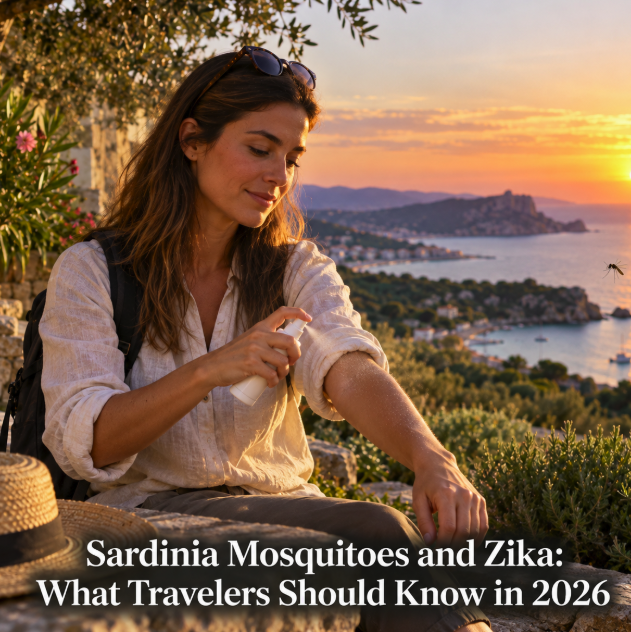
The recommendations include wearing long, light-colored clothing outdoors, particularly around dawn and during evening or nighttime hours; using insect repellent; choosing screened or air-conditioned accommodation when possible; and eliminating standing water around homes and terraces.
This is preventive public-health advice, not evidence that every disease named in the campaign is circulating widely among tourists.
What about dengue?
Dengue deserves more attention in modern European travel planning than it once did. The CDC currently classifies Italy as an area where dengue risk is sporadic or uncertain, rather than a country with frequent or continuous dengue transmission.
ECDC noted in July 2026 that dengue and chikungunya remain largely associated with international travel in Europe, while local transmission has been occurring more frequently in some European areas where competent mosquito vectors are established.
That changing European picture is one reason Sardinian authorities emphasize prevention even when a traveler is not visiting a tropical destination.
West Nile is a different mosquito problem
West Nile virus should not be confused with Zika. It is transmitted primarily by infected mosquitoes and is established as a seasonal public-health concern in parts of Europe.
There is no licensed human vaccine or preventive medicine for West Nile. The CDC recommends preventing mosquito bites with effective repellent, long loose-fitting clothing and screened or air-conditioned accommodation. Mosquitoes associated with West Nile are particularly active from dusk to dawn.
Most people infected with West Nile do not develop serious illness, but severe neurological disease can occur, particularly among older people and those with certain health vulnerabilities. Travelers do not need to panic, but they should take bite prevention seriously.
Are Sardinia's mosquitoes worse at certain times?
Mosquito activity generally increases in warm conditions and around suitable breeding habitat. Irrigated gardens, wetlands, standing water and sheltered outdoor spaces can feel very different from an exposed, windy beach.
There is also no single mosquito schedule. The mosquitoes involved in West Nile transmission are commonly more active around dusk and dawn, while Aedes mosquitoes associated with dengue, chikungunya and Zika can bite during daylight hours as well.
That means repellent should not be treated only as an after-dinner product. If mosquitoes are active where you are staying, protection can make sense during the day too.
What repellent should you bring?
Choose a proven insect repellent and follow its label directions. The CDC recommends EPA-registered repellents for travelers and also suggests loose-fitting long sleeves and trousers when mosquito exposure is likely.
Travelers who are particularly sensitive to bites may prefer accommodation with air conditioning or good window and door screens. A mosquito net can be useful when sleeping somewhere without screened rooms, particularly during outdoor or rural trips.
If you are combining Sardinia with camping, farm stays or long evenings outdoors, repellent deserves a permanent place in the daypack rather than being left at the hotel.
What if you are pregnant or planning pregnancy?
Zika receives special attention because infection during pregnancy can cause serious fetal complications. This is why travelers who are pregnant or planning pregnancy often encounter more cautious Zika advice than other tourists.
Current CDC guidance tells travelers first to determine the Zika risk classification of their destination and to discuss relevant risks with a healthcare provider when pregnancy is involved. Current ECDC guidance likewise emphasizes individualized medical advice for pregnant travelers and people planning pregnancy when considering areas with Zika transmission.
Because Sardinia is not under an active Zika Travel Health Notice, travelers should avoid interpreting general online Zika warnings for tropical destinations as if they automatically apply to Sardinia. Anyone pregnant or planning pregnancy who wants individualized reassurance should check the latest official destination guidance and speak with their clinician before travel.
How to reduce bites in Sardinia
- Use an effective insect repellent according to the product label.
- Wear loose long sleeves and trousers when mosquitoes are active.
- Use screens or air conditioning when available.
- Do not leave buckets, plant saucers or other containers holding standing water around a holiday rental.
- Keep repellent with you during rural dinners, agriturismo stays, camping and evenings near vegetation or wetlands.
- Remember that some mosquito species also bite during the day.
These measures are useful even if disease risk is low because ordinary mosquito bites can still be itchy, disruptive and unpleasant.
When should you seek medical advice?
A few mosquito bites during a Sardinian holiday are not, by themselves, a reason to assume infection. If you develop significant fever, rash, headache, unusual muscle or joint pain or other concerning symptoms during or after travel, seek medical advice and mention where you have been.
Symptoms overlap between many infections, and self-diagnosing Zika, dengue or West Nile from an online symptom list is unreliable. Medical evaluation is particularly important for severe symptoms, neurological symptoms, pregnancy or significant underlying health conditions.
The practical travel perspective
Travelers sometimes search for “Zika in Sardinia” after seeing a mosquito in their room or reading a broad warning about southern Europe. The current evidence does not support treating Sardinia as if it were under an active Zika travel alert.
At the same time, dismissing mosquitoes completely would be equally unhelpful. Sardinia's own health authority is actively promoting mosquito control in 2026 because mosquito-borne infections are a genuine public-health subject, and Europe is seeing a changing pattern of diseases such as dengue and chikungunya.
Pack repellent, use it sensibly, choose screened accommodation if you are especially concerned and pay attention to current official health notices. For the ordinary traveler, those precautions are far more useful than worrying that every Sardinian mosquito carries Zika.