If you are visiting Alghero, Stintino or northwest Sardinia in September, packing mosquito repellent is sensible. September is not automatically a mosquito-free month: warm weather can continue well beyond the peak summer season, and mosquito activity varies considerably according to temperature, recent rain, standing water, vegetation and the exact place where you are staying.
There is no reliable rule that says every traveler in Alghero or Stintino will encounter large numbers of mosquitoes. A breezy evening by an exposed beach can feel very different from a sheltered garden, campsite or rural accommodation only a short distance away. The useful advice is therefore not to expect a plague, but to bring repellent so that changing local conditions do not spoil an evening outdoors.
Sardinia officially recommends mosquito precautions
The Autonomous Region of Sardinia renewed its mosquito-prevention campaign in May 2026. Regional health authorities advise people to use insect repellent, wear long and light-colored clothing outdoors particularly around dawn and during evening or nighttime hours, stay where possible in accommodation with screens or air conditioning, and avoid standing water around homes and verandas.
The regional campaign is not simply about itchy bites. Sardinian health authorities point to mosquito-borne infections including West Nile disease and arboviruses such as dengue, chikungunya and Zika when explaining why prevention matters. This does not mean that an ordinary September holiday in Alghero or Stintino should be treated as a high-risk trip. It does mean that avoiding mosquito bites is a reasonable health precaution as well as a comfort measure.
The US Centers for Disease Control and Prevention gives similar advice for travelers to Italy. Its Italy travel guidance recommends avoiding bug bites, covering exposed skin and using an appropriate insect repellent. For mosquito protection, the CDC lists active ingredients including DEET, picaridin — commonly called icaridin in Europe — IR3535, oil of lemon eucalyptus or PMD, and 2-undecanone.
What repellent should US travelers bring?
American visitors do not need a Sardinia-specific product. A familiar, properly registered mosquito repellent is suitable. The CDC recommends EPA-registered repellents and notes that higher percentages of an active ingredient generally provide longer protection. For protection against both ticks and mosquitoes, its Italy guidance recommends a repellent containing at least 20% DEET for protection lasting up to several hours.
Picaridin is another useful option and is often labeled “icaridin” outside the United States. Travelers who prefer other formulations can check the active ingredient rather than choosing solely by brand name. Whatever product is used, follow its label instructions, especially when applying it to children.
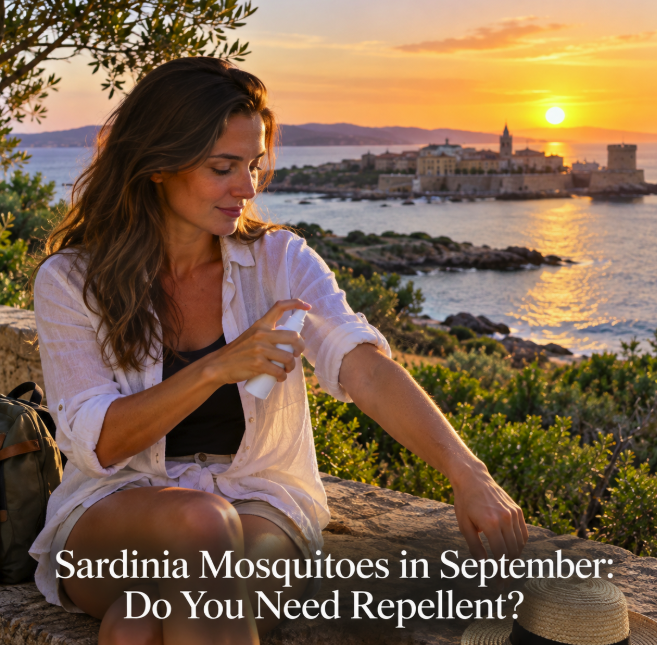
If sunscreen and repellent are both needed, the CDC advises applying sunscreen first and insect repellent afterward. Products containing oil of lemon eucalyptus or PMD should not be used on children under three, according to CDC guidance.
Alghero and Stintino: where mosquitoes may feel worse
Conditions can change within the same destination. Around Alghero, a room in the historic center, an exposed coastal terrace and a countryside agriturismo can have very different mosquito levels. Around Stintino, wind can help on open coastal stretches, while sheltered outdoor areas with vegetation or nearby standing water can be more favorable to mosquitoes.
This is why online reports from other travelers often contradict one another. Someone may spend a week near the sea and barely notice mosquitoes, while another visitor staying inland or beside a garden may need repellent every evening. Both experiences can be genuine.
For accommodation, window screens and air conditioning are useful when available. If mosquitoes are present indoors, keeping unscreened windows closed during periods of greater activity can help. Outside, loose long sleeves and trousers provide another layer of protection, particularly around dusk and after sunset.
So, should repellent go in the suitcase?
Yes. For a September trip to northwest Sardinia, a small bottle of effective repellent is an easy item to pack and may be particularly useful for dinners outdoors, countryside stays, camping, walks around vegetation and warm evenings when the air is still.
There is no need to organize a trip around mosquitoes or assume that Stintino and Alghero will be uncomfortable. September remains a popular period for enjoying Sardinia after the busiest weeks of summer. Mosquito activity is simply one of those highly local conditions that is easier to handle when you arrive prepared.
The simplest packing formula is effective repellent, light clothing that can cover arms and legs in the evening, and accommodation with screens or air conditioning when possible. If you arrive and mosquitoes are barely noticeable, the repellent stays in your bag. If conditions change after rain or on a still, warm evening, you will be glad you brought it.