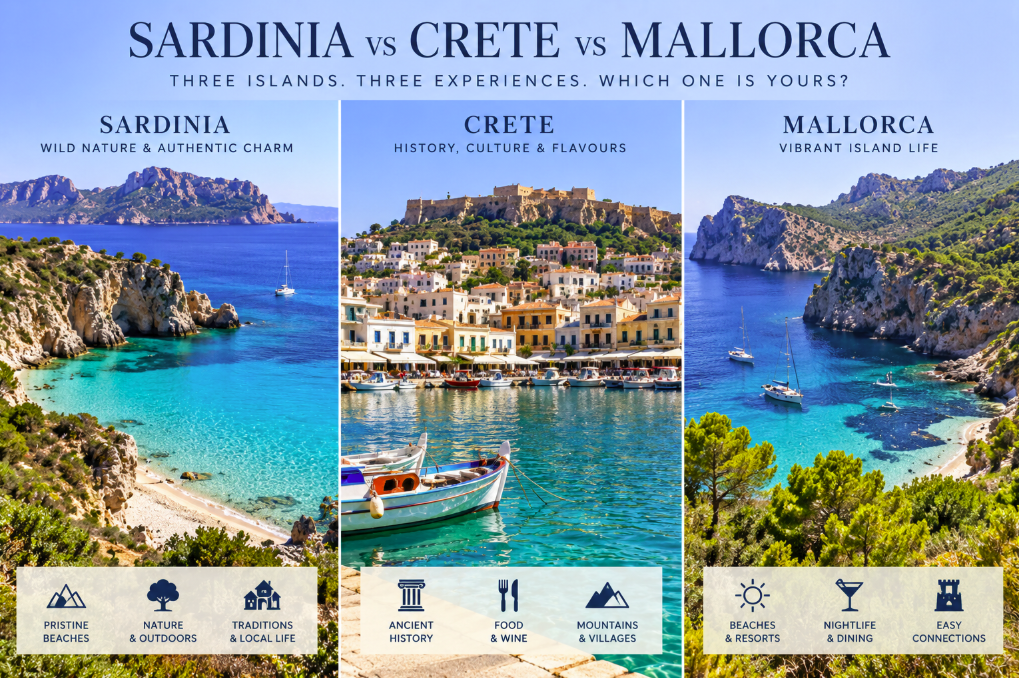
Sardinia, Crete and Mallorca can all deliver the Mediterranean holiday people imagine: clear water, mountain scenery, old towns, seafood and long summer evenings. But they are not interchangeable. Mallorca is the easiest choice for travelers who want a highly developed resort infrastructure and a lively capital; Crete is exceptional for combining beaches with major ancient history and a distinctive food culture; Sardinia makes its strongest case when the priority is wild coastline, protected landscapes and the feeling that there is always another less-developed corner of the island to explore.
If the search is specifically for an “unspoiled island paradise,” Sardinia has a persuasive advantage — but that description needs context. The island received more than five million tourist arrivals and nearly 22 million overnight stays in 2025, according to official regional figures. It is not undiscovered. Costa Smeralda, San Teodoro, Villasimius and other famous areas can be extremely busy in summer. Sardinia’s difference is that its large size and long, varied coastline still leave room for protected marine areas, remote beaches, mountain landscapes and inland communities far beyond the main resort zones.
For beaches and wild coastline: Sardinia
All three islands have beautiful beaches, so declaring a universal winner on water color alone is mostly subjective. Sardinia’s advantage is the variety and amount of coastline that still feels natural.
The island has extensive protected marine territory. La Maddalena Archipelago National Park alone covers more than 20,000 hectares of sea and land, around 180 kilometres of coastline and more than 60 islands and islets. The Tavolara–Punta Coda Cavallo marine protected area covers roughly 15,000 hectares of sea, while the Sinis Peninsula and Mal di Ventre protected area extends over about 26,000 hectares.
Protection can mean restrictions as well as beauty. Budelli’s famous Pink Beach, for example, can only be admired under strict conservation rules: landing, swimming and anchoring at the beach are prohibited. Bidderosa limits vehicle access during its controlled season. These rules are part of the reason some of Sardinia’s most delicate landscapes have not simply become ordinary resort beaches.
The west coast is especially useful for travelers who want a different Sardinia from the polished north-east. The Sinis Peninsula mixes quartz beaches, cliffs, wetlands and the archaeological site of Tharros. Farther south-west, the dunes and mining landscapes around Piscinas and Costa Verde feel dramatically removed from the stereotypical Mediterranean resort.
Crete competes strongly here with spectacular beaches and a much more mountainous interior, while Mallorca’s coves and Serra de Tramuntana are genuinely beautiful. But travelers who define “paradise” as long stretches of coast with fewer buildings immediately behind the beach are likely to find Sardinia particularly rewarding.
For archaeology and ancient history: Crete
Crete has the clearest advantage for a traveler whose beach holiday must also function as a major archaeological trip. The Minoan civilization gives the island an internationally important historical identity, with sites such as Knossos, Phaistos and Malia complementing later Venetian and Ottoman layers in cities including Chania and Rethymno.
Sardinia is far from historically empty. Its Nuragic civilization left thousands of archaeological traces, including the UNESCO-listed Su Nuraxi at Barumini, while Phoenician, Punic and Roman remains survive at places such as Nora and Tharros. In 2025 UNESCO also inscribed the funerary tradition known as the domus de janas on the World Heritage List as a serial property of prehistoric Sardinian sites.
The difference is one of familiarity. Many international travelers arrive in Crete already knowing the Minoan story. Sardinia’s prehistoric landscape is less familiar outside Italy, which can make it feel more like a discovery.
For easy resort logistics and nightlife: Mallorca
Mallorca is difficult to beat when convenience is the priority. Palma is a substantial, attractive city with a major airport, restaurants, nightlife, museums and an enormous tourism infrastructure. Resorts range from family-oriented beach towns to luxury properties, cycling hotels and nightlife centers.
The Balearic Islands as a whole received about 19.1 million tourists in 2025, according to the Balearic government, with tourism expenditure exceeding €23 billion. That scale helps explain why Mallorca can feel extremely easy for international visitors: there is a deep ecosystem of hotels, transfers, excursions, restaurants and services built around tourism.
The same strength can become a weakness for someone seeking solitude. The Balearic government itself is pursuing a tourism model based on containing visitor pressure, social and environmental sustainability and stronger off-season travel. Mallorca has wild places, but its most famous resort zones are much more visibly integrated into mass European tourism than Sardinia’s remote western and central areas.
For a first Mediterranean island trip without a car, Mallorca will often be the easiest of these three. For someone whose ideal evening means clubs, cocktail bars and a broad international restaurant scene, it is also the strongest choice.
For food: there is no honest loser
Crete has a particularly coherent culinary identity built around olive oil, vegetables, pulses, cheese, herbs, grilled meats and local wine. Food is one of the strongest reasons to choose the island, especially for travelers who want village tavernas and a cuisine closely associated with the Cretan landscape.
Sardinia’s food feels different from mainland Italian stereotypes. Expect pecorino cheeses, pane carasau, culurgiones, fregola, bottarga, roast meats and regional pasta traditions, with significant variation between coast and interior. The island also has distinctive wines including Vermentino di Gallura, Cannonau and Carignano del Sulcis.
Mallorca adds its own Balearic traditions, from ensaïmada to sobrasada, alongside one of the three islands’ most varied contemporary dining scenes. Palma in particular makes it easy to combine local cuisine with sophisticated international restaurants.
If food alone decides the trip, Crete may have the strongest immediate identity for many visitors. If the appeal is discovering a cuisine that many Americans know relatively little about, Sardinia is especially interesting.
For road trips: Sardinia and Crete reward time
Sardinia is larger than many first-time visitors expect. Trying to combine Alghero, Costa Smeralda, the Gulf of Orosei, Cagliari and the west coast in one short trip produces more driving than vacation. The better strategy is to choose one or two regions and explore slowly.
That geographic spread is also a strength. Leave a famous coastal town and the landscape can change quickly into cork-oak country, granite mountains, pastoral plateaus or villages where tourism is only one part of daily life. The central areas around Barbagia and the Gennargentu are a reminder that Sardinia is much more than a beach destination.
Crete has a similar road-trip personality. Its long shape, mountain roads and north-south contrasts make a car useful, and trying to see the entire island in a few days is equally unrealistic.
Mallorca is more compact and easier to sample on a shorter trip. That is an advantage for efficiency, though it offers less of the feeling of crossing a vast island landscape.
For avoiding crowds: choose the season before the island
No Mediterranean island can promise an empty famous beach in August. Sardinia’s official tourism data show just how quickly demand is growing: the island recorded more than 5.1 million arrivals and 21.8 million overnight stays in 2025, with overnight stays up 15.9% year on year. International visitors represented 56% of total overnight stays, and the United States was Sardinia’s leading non-European market.
Yet the same data show that travel is spreading beyond peak summer. April, May, September and October together now account for roughly a third of Sardinia’s overnight stays. For travelers seeking warm weather with less pressure on beaches and roads, late spring and September can be much more appealing than the peak weeks around August.
The same principle applies to Crete and Mallorca. Famous destinations become dramatically different outside the busiest school-holiday period. An “unspoiled” experience often depends as much on when and where you travel as on which island name appears on the boarding pass.
So which island should you choose?
Choose Mallorca if you want the easiest combination of flights, polished resorts, Palma city life, nightlife and short-trip convenience. Choose Crete if ancient history, mountain villages and a powerful local food culture are as important as beaches.
Choose Sardinia if your ideal trip revolves around transparent water, protected coastline, long scenic drives, archaeology that still feels under-the-radar internationally and the possibility of leaving a famous resort behind for a much quieter landscape.
Sardinia does not “win” every category, and pretending otherwise would make the comparison less useful. Mallorca is easier for some travelers and Crete has historical attractions Sardinia cannot replicate. But for the traveler using the phrase “unspoiled island paradise” as the main filter, Sardinia has an unusually strong combination: a major Mediterranean island with world-class beaches and a mature tourism industry that still contains large protected and sparsely developed landscapes.
The trick is not to spend the entire holiday chasing the same five Instagram beaches. Base yourself in one region, explore beyond the headline destinations and give the island enough time. That is where Sardinia’s advantage over a conventional resort holiday becomes clearest.