In the villages of central Sardinia, a group of men may stand close together and begin a sound that seems to rise from the landscape itself: deep, rough, resonant and richly layered. This is canto a tenore, one of the island’s most distinctive musical traditions, closely connected to shepherding and pastoral life. UNESCO recognises it as part of humanity’s intangible cultural heritage—but is it really a 3,000-year-old song?
What is Canto a Tenore?
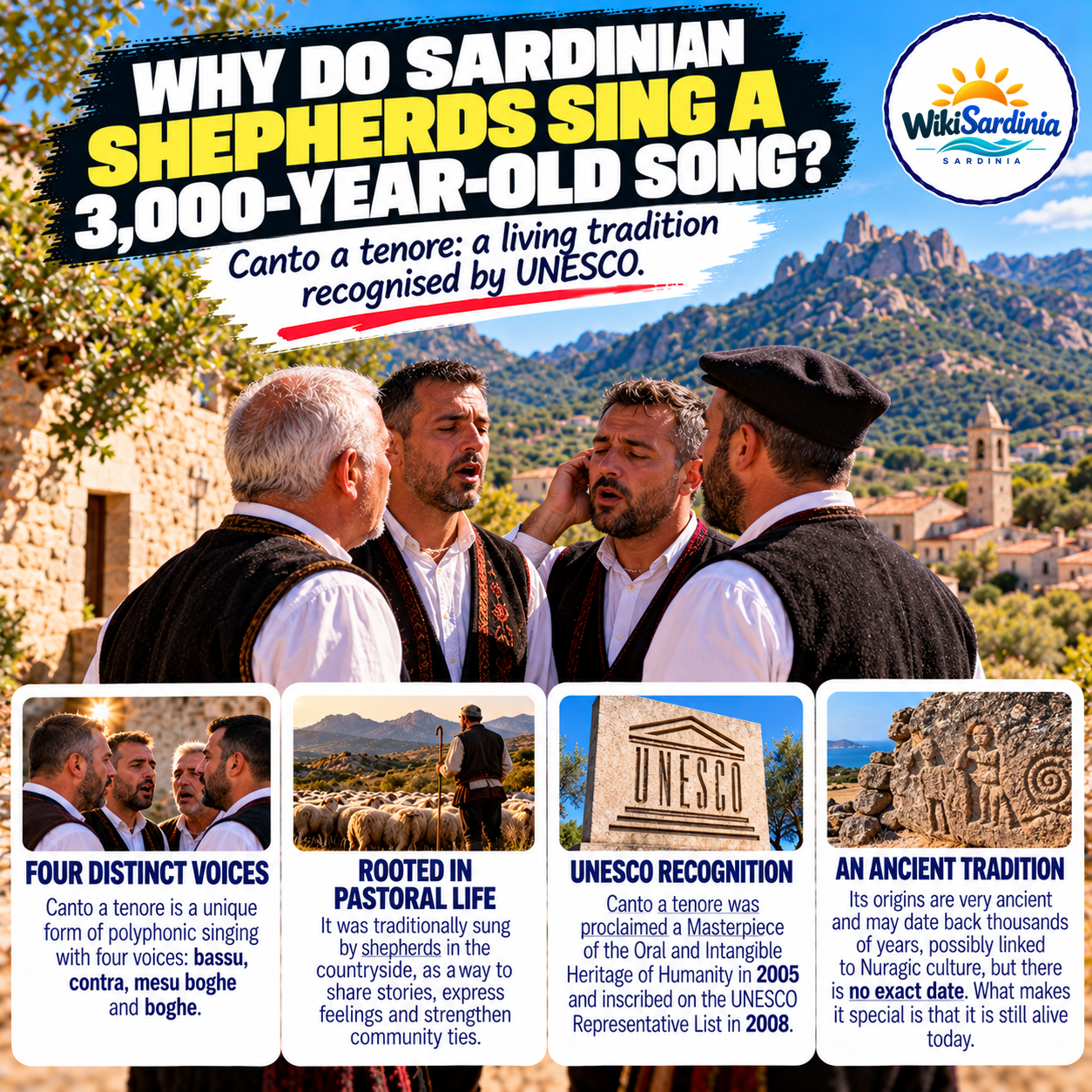
Canto a tenore is a form of polyphonic singing traditionally performed by four male voices standing in a close circle. The voices have Sardinian names: boghe or boche is the lead voice, while bassu, contra and mesu boche create the accompanying layers. The bassu and contra are especially striking for their deep, guttural timbre, which can sound almost like an animal call or a musical instrument.
The lead singer performs a poem or a line of prose while the other voices build a close, rhythmic chorus around it. Each group and locality can have its own style, repertoire and interpretation, making the tradition more varied than a single fixed song.
Why is it associated with shepherds?
The singing developed within Sardinia’s pastoral culture, especially in Barbagia and other parts of central Sardinia. Shepherding shaped work, social life and community identity, and canto a tenore became part of that world. It could be heard informally in local bars known as su zilleri, as well as at weddings, religious festivities, shearing gatherings and carnival celebrations.
It was not simply background music. Singing helped people come together, share poetry and express local identity. Today, performers come from different walks of life, but the tradition continues to carry the memory and social connections of the pastoral communities from which it grew.
Is the song really 3,000 years old?
The honest answer is that there is no confirmed date for the origin of canto a tenore. Its roots are ancient and its sound has inspired theories about links to the island’s deep past, including the Nuragic world. But UNESCO’s recognition does not certify that the singing began exactly 3,000 years ago, and the available evidence does not establish a precise age.
It is therefore better to describe canto a tenore as an ancient living tradition whose beginnings are uncertain, rather than state a specific age as a proven fact. Comparisons with opera can make a catchy headline, but they do not establish a reliable historical timeline.
Why did UNESCO recognise it?
Canto a tenore was originally proclaimed a Masterpiece of the Oral and Intangible Heritage of Humanity in 2005 and was inscribed on UNESCO’s Representative List of the Intangible Cultural Heritage of Humanity in 2008. The recognition reflects its cultural importance, distinctive vocal technique and deep relationship with community life.
UNESCO also notes that the tradition is vulnerable to social and economic changes, including the decline of pastoral culture and the effects of tourism. When performances are adapted mainly for visitors, the diversity of local repertoires and the intimate way the singing traditionally took place can be affected.
Where might you hear it in Sardinia?
Barbagia and central Sardinia are strongly associated with canto a tenore. It may be performed at cultural events, local festivals and organised concerts, while some groups continue to practise and share the tradition within their communities. If you attend a performance, listen for the contrast between the lead melody and the deep, resonant accompanying voices.
Approach it as a living practice rather than a staged curiosity: ask permission before recording close-up, respect the performers’ wishes and look for events organised by local groups or cultural associations.
What to listen for
- Four interlocking voices: the lead line combines with bassu, contra and mesu boche.
- Deep, guttural tones: the lower voices give the singing its distinctive earthy sound.
- Poetry and local variation: lyrics and melodies differ between communities and can address both traditional and contemporary themes.
- A social setting: the music is linked to gatherings, celebrations and community identity, not only to formal concerts.
An ancient sound that is still alive
Canto a tenore may not have a provable 3,000-year timeline, but its value does not depend on an exact date. It is a remarkable expression of Sardinia’s pastoral culture, sustained by singers and communities and recognised internationally by UNESCO. To hear it is to encounter not a relic frozen in the past, but a tradition that continues to evolve while keeping a powerful connection to the island’s history.
Read the official UNESCO entry on Canto a tenore and the Italian National Commission for UNESCO overview for the recognised description and history of its inscription.