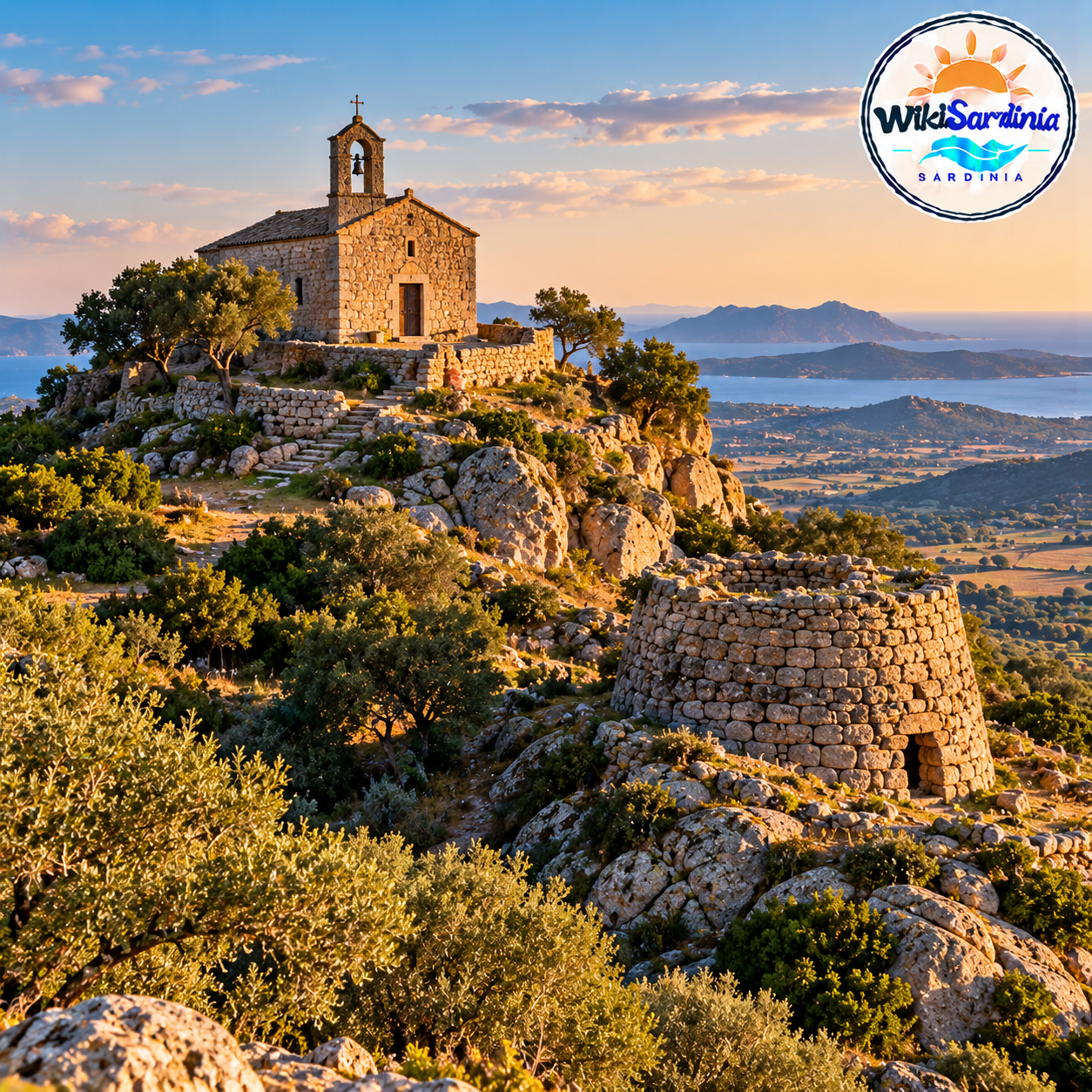
Across Sardinia, small stone churches and chapels often appear on ridges, hilltops and quiet slopes, overlooking villages, fields or the sea. Their locations can feel mysterious, especially when a chapel stands near a prehistoric stone structure. The explanation is not a single rule: hilltop churches reflect a mix of medieval settlement, local devotion, pilgrimage, landscape and, in some cases, the reuse of much older sacred places.
Were the churches built on ancient nuraghi?
Sometimes a church stands directly beside a nuraghe or within a landscape already used for ritual long before Christianity arrived. In other cases, Christian places of worship reused or replaced earlier sacred sites. But it would be misleading to say that Sardinia’s hilltop churches are all “Christianised nuraghi”: many have no demonstrated direct connection to a nuraghe, and their locations have different histories.
A clear example: Santa Sabina near Silanus
One of the island’s most striking examples is the church of Santa Sabina, near Silanus in the Marghine area. The Byzantine church stands only a short distance from a nuraghe, a sacred well and two Giants’ tombs. The area was occupied and used for sacred purposes during the Nuragic period, thousands of years before the medieval church took its present form.
The official SardegnaTurismo guide describes this close relationship between Nuragic monuments and the later church, noting that Christian sanctuaries were sometimes built over or beside earlier places of worship. Santa Sabina is a good example of the layering of sacred landscapes across different periods.
Why choose a hilltop?
Elevation can make a church visible from a wide area and give it a strong place in the landscape. A chapel on a ridge might serve nearby rural communities, stand along an old route, mark a settlement or become a destination for a local feast or pilgrimage. In some places, the hill itself may have had symbolic importance long before the church was built.
Topography also mattered in rural life. Churches and sanctuaries were often linked to paths, farms and small settlements rather than only to the centre of a modern town. Their position could reflect the way people moved through and used the countryside over centuries.
Did Christianity replace older beliefs?
The arrival and spread of Christianity did not happen in one moment across Sardinia. Over time, Christian communities developed churches and sanctuaries within landscapes that already contained Nuragic monuments, Roman remains, springs and other places with older cultural significance. Sometimes a later church was built close to an earlier sacred place; sometimes an older structure was reused; in other cases, the connection is uncertain.
Archaeologists distinguish documented evidence—such as buildings, inscriptions and finds—from interpretations about why a particular site was chosen. The fact that a church and a nuraghe stand near each other is meaningful, but by itself it does not prove that the church was deliberately built to convert or erase a specific prehistoric cult.
How to visit these places respectfully
- Check access before going: some rural churches open only for services, festivals or by local arrangement.
- Respect religious use: keep noise low and avoid entering during a service unless welcome.
- Protect archaeological remains: do not climb on ruins, move stones or remove objects.
- Follow marked paths: some sites are on private land or within protected archaeological areas.
- Look at the wider landscape: the relationship between the church, village, spring, tombs and nuraghe often tells more than the building alone.
A landscape shaped by many centuries
Sardinia’s hilltop churches are not all remnants of a single conversion strategy, but they do reveal how communities repeatedly gave meaning to the same landscape. A medieval chapel may overlook an old route, serve a rural settlement or stand beside a much older sacred place. Santa Sabina shows how extraordinary these layers can be: a church, nuraghe, sacred well and Giants’ tombs sharing one small area.
For further context, see the official SardegnaTurismo guide to Nuraghe Santa Sabina and UNESCO’s overview of the Nuragic monuments of Sardinia.