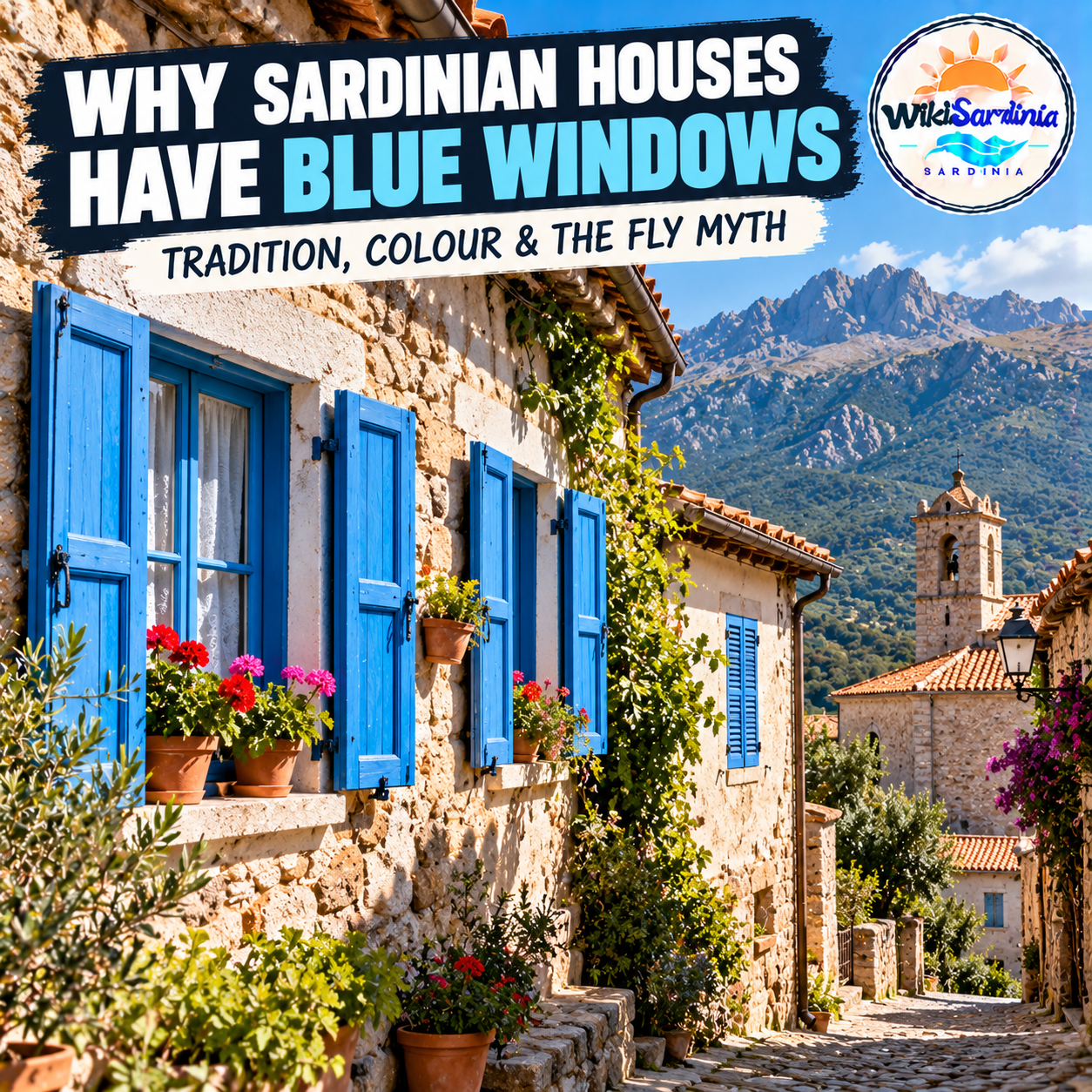
Blue shutters and window frames give some Sardinian villages a distinctive look, but they are not found on every house across the island. One of the best-known examples is Desulo, a mountain village on the slopes of the Gennargentu, where traditional houses built with local shale are often finished with blue doors and windows. The colour is part of the village’s visual identity and local tradition.
Why are the windows blue?
There is no single explanation that applies to every Sardinian home. In places such as Desulo, blue is one of the colours associated with local tradition and the character of the village. Across the wider Mediterranean, blue has also been used on doors, shutters and window surrounds for practical, decorative and historical reasons. The pigment available to a household, the cost of paint and the wish to distinguish one home from another could all influence the choice.
The official SardegnaTurismo guide to Desulo specifically notes the village’s blue doors and windows and describes a local tradition of colours linked to the surrounding Barbagia areas.
Does blue paint really keep flies away?
You may hear that Sardinian families painted their windows blue to repel flies and mosquitoes. It is a familiar folk explanation in parts of the Mediterranean, but it should not be presented as a proven universal reason for the colour. Scientific evidence does not establish that ordinary blue paint, by itself, reliably keeps flies away.
Some historical pigments contained compounds with properties different from those of modern paints, so the ingredients used in a particular place and period may matter. That is not the same as saying that the colour blue itself is an effective insect repellent today.
Why does the tradition continue?
Once a colour becomes part of a village’s character, it can survive long after its original practical purpose—if there was one—has faded. Blue shutters create a strong contrast with pale stone walls, reflect local aesthetic preferences and help preserve a recognisable streetscape. Residents may also repaint windows in familiar colours because that is what they grew up seeing around them.
Where can you see blue windows in Sardinia?
Desulo, in central Sardinia, is a good place to notice this tradition. Walk respectfully through the village’s public streets and look at the contrast between the local stone, blue-painted woodwork and the mountain setting. Other Sardinian towns have their own colour palettes, but styles vary from village to village and even from house to house.
What to look for when you visit
- Notice the materials: compare painted wooden shutters with the local stone or plaster around them.
- Look for local patterns: colour traditions often make more sense when viewed across a whole street rather than a single window.
- Respect private homes: photograph buildings from public spaces and avoid looking into residents’ interiors.
- Ask locally: residents may have family stories about when a particular colour was chosen, even when there is no single island-wide explanation.
A little colour, a lot of local identity
Blue windows are a charming feature of Desulo and other Mediterranean villages, but the idea that all Sardinian homes use blue to stop flies is too simple. In Sardinia, the colour can reflect a local aesthetic tradition, the materials available and the way a community chooses to preserve its built heritage. The most reliable answer is not one legend for the whole island, but a collection of local stories and architectural choices.