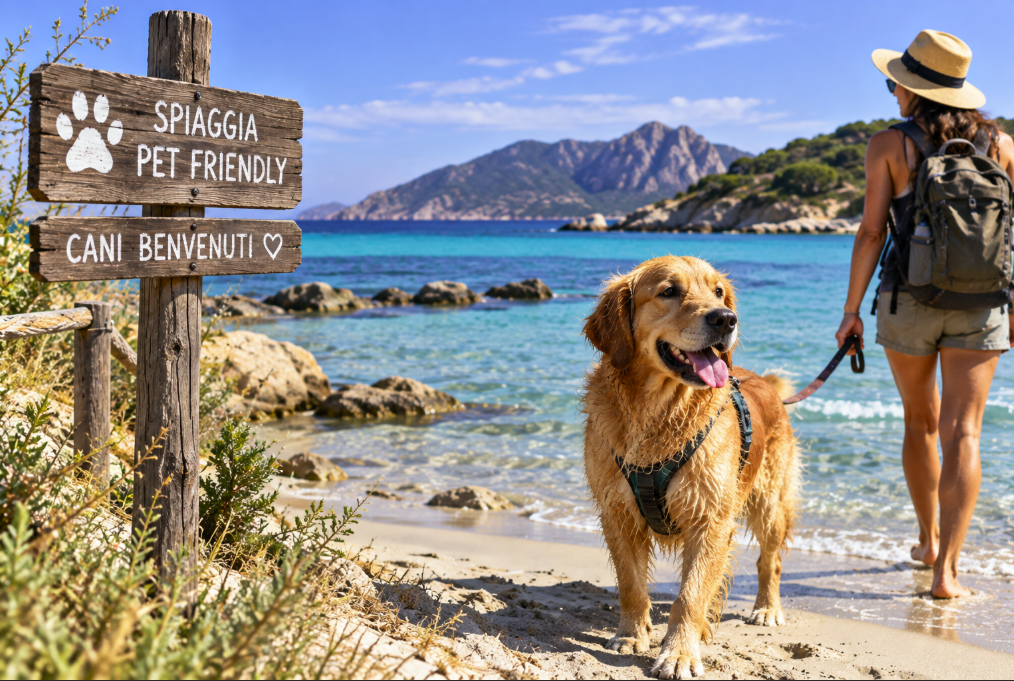
Sardinia can work well for a family holiday with a dog, but “pet-friendly island” does not mean dogs are automatically allowed on every famous beach. During the bathing season, access is governed by coastal rules and local designated areas, so travelers should plan around verified dog beaches rather than arriving at La Pelosa, La Cinta or another popular shoreline and assuming a leash is enough. In 2026, confirmed options include dedicated areas in Alghero, Cagliari, Porto Ferro and Fiume Santo.
For U.S. families, there is another layer of planning before the beach question even begins: a dog entering the European Union from the United States must satisfy current EU animal-health requirements. That makes Sardinia with a pet entirely possible, but it is a trip to organize well before departure rather than at airport check-in.
Where can dogs go to the beach in Sardinia?
Dedicated dog beaches are the simplest option because their rules are published and the swimming area may be specifically arranged for animals. Alghero has a municipal Dog Beach on Viale I Maggio. The municipality allows dogs of any size and breed when accompanied by their owner or temporary handler, provided the animal is identifiable by microchip, properly registered and up to date with vaccinations and parasite treatments.
Dogs at Alghero's designated area must remain supervised and controlled. Swimming is permitted in the water directly in front of the dog beach, and owners are responsible for cleaning up after their animals. The municipality also warns that the area does not provide shade, drinking water or a lifeguard service, so visitors need to bring water and create appropriate shade themselves.
In Cagliari, the official dog beach at Poetto is another particularly practical choice. It is near the seventh bus stop, opposite the Ospedale Marino area. Cagliari Turismo says the designated zone is fenced and includes access to the sea within a buoyed area. A drinking-water fountain is available on the promenade. Dogs must be microchipped and accompanied by health documentation showing that they are in good health, and owners must carry equipment for cleaning up waste.
The Municipality of Cagliari confirmed the dog area again for summer 2026. Its July update described a fenced space with several pedestrian entrances and waste bins, designed so owners and dogs can spend time together beside the Poetto waterfront.
Porto Ferro and Fiume Santo: two 2026 options near Sassari
Northwestern Sardinia has two officially confirmed seasonal dog areas for 2026. The Municipality of Sassari reopened designated sections at Porto Ferro and Fiume Santo in June.
At Fiume Santo, the dog area extends for about 250 linear metres and approximately 1,500 square metres. Porto Ferro has a smaller designated section of about 60 metres, covering roughly 360 square metres. Both areas are scheduled to remain in operation until October 31, 2026.
The municipality requires dogs to be healthy, microchipped and registered. Owners must clean up after them, and additional control requirements apply to dogs considered problematic. These official areas are useful for travelers staying around Sassari, Alghero or the northwestern coast because they remove much of the uncertainty about whether a particular stretch of sand accepts dogs during the summer season.
Do not assume every Sardinian beach accepts dogs all day
Sardinia issued a regional maritime ordinance for the 2026 season, while municipalities and other competent authorities can regulate specific coastal areas. The practical result for visitors is that rules can vary by beach, season and designated zone.
Older regional bathing rules have allowed dogs on ordinary beaches during limited early-morning and evening periods while restricting animals during the main bathing day, with exceptions for assistance and rescue dogs and for authorized dog beaches. Travelers should not rely on an old timetable for a 2026 holiday, however. Check the current municipal or beach-specific rule for the exact beach you plan to visit.
This is especially important at protected, reservation-controlled or heavily visited beaches. A hotel describing itself as pet-friendly does not mean the beach in front of it is legally open to dogs.
How to choose a genuinely pet-friendly hotel
“Pets allowed” is only the first question. Before booking accommodation in Sardinia, ask whether dogs are accepted in your specific room category, whether there is a size or weight limit, how many pets are permitted and whether a nightly or cleaning fee applies.
Also check the rules for breakfast rooms, restaurants, pools, gardens and private beach concessions. Some properties accept dogs in bedrooms but restrict them from most shared areas. Others provide outdoor space, bowls or pet amenities but still cannot override municipal rules governing the public shoreline.
For a family traveling by car, ground-floor rooms or apartments with an outdoor area can be more practical than a formal resort. They make early walks easier and reduce the number of times a dog must move through crowded hotel corridors or elevators.
Location matters too. A property within walking distance of a verified dog beach may be more useful than a luxurious “pet-friendly” hotel requiring a 40-minute drive every time the dog needs outdoor exercise.
Bringing a dog from the United States to Italy
Current European Commission rules require pets entering the EU from a non-EU country to meet identification and animal-health conditions. Dogs must be microchipped and have a valid rabies vaccination. For a primary rabies vaccination, the validity period begins at least 21 days after completion of the vaccination protocol.
Travelers arriving from outside the EU generally need an EU animal health certificate issued or endorsed according to the applicable rules shortly before entry, together with the required non-commercial movement declaration. The Commission's current 2026 rules specify a certificate validity window of 10 days from issue until the documentary and identity checks at the EU entry point, with special provisions for sea travel.
The exact rabies antibody testing requirement depends on the country of origin and the EU's current listed-country rules. U.S. travelers should therefore use the European Commission's current pet-entry guidance and confirm documentation with their veterinarian and the relevant U.S. authorities well before departure rather than relying on an old blog checklist.
An EU pet passport is primarily a document for eligible pets and owners within the European system; a U.S. traveler should not assume that an American veterinary record functions as an EU pet passport.
Heat is often the bigger day-to-day problem
A Sardinian summer can be difficult for dogs even when beach access is legal. Hot sand, strong sun and parked cars create risks that do not appear on a hotel pet policy. Early morning and later afternoon are generally more comfortable for walks, while midday should be planned around shade and water.
Bring a portable bowl and more drinking water than you expect to need. Do not assume a dog beach has showers, shade or a fountain: Alghero's municipal dog-beach rules specifically tell owners to provide their own shade and water.
Before a long beach day, check whether your dog can safely tolerate heat, salt water and hot ground. A dog that is comfortable on a cool U.S. beach may respond very differently to Sardinian conditions in July or August.
A practical pet-friendly Sardinia itinerary
Alghero is one of the easiest bases because the city has a confirmed municipal dog beach and is close to the 2026 dog area at Porto Ferro. It also provides restaurants, shops and evening walks without requiring every outing to begin with a long drive.
Cagliari works well for similar reasons. The Poetto dog beach gives families a verified coastal option while the city offers services and accommodation choices beyond resort properties. A trip combining Alghero and Cagliari can therefore provide two urban bases where pet logistics are relatively straightforward.
Travelers exploring more remote parts of the island should call accommodation providers and municipalities before committing to the route. Rules and seasonal facilities can change, and the nearest authorized dog beach may be farther away than the map suggests.
Sardinia with a dog is less about finding an island where every door is open and more about choosing the right doors in advance. Verify the beach, confirm the hotel's exact pet policy, prepare the EU entry paperwork and plan around summer heat. With those pieces handled, bringing a dog can fit naturally into a Sardinian road trip rather than becoming a daily negotiation over where the animal is allowed.