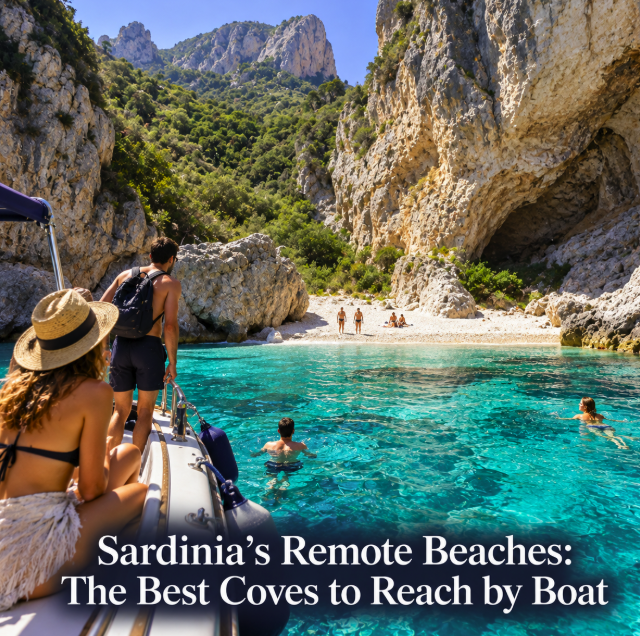
Sardinia has spectacular coves that feel accessible only from the sea, particularly beneath the limestone cliffs of the Gulf of Orosei. But the popular phrase “boat-only beaches” needs a correction: several famous beaches reached by excursion boats can also be approached on foot, sometimes via demanding routes suitable for experienced hikers. For ordinary beachgoers, however, a boat from Santa Maria Navarrese, Cala Gonone or another nearby port is often by far the simplest way to reach them.
The richest concentration is along the Baunei coast, where cliffs, forests and deep valleys make road access impossible at many coves. Here are the places worth putting on a boat itinerary — with an honest explanation of whether the sea is truly the only option.
Cala Mariolu: the classic boat-day beach
Cala Mariolu, traditionally known in Baunei as Ispuligedenie, is one of the signature coves of the Gulf of Orosei. White pebbles and extraordinarily clear water sit beneath the Supramonte cliffs, and excursion boats regularly include it when access conditions allow.
It is not literally reachable only by sea. Baunei’s official tourism service documents a trekking route from the Golgo plateau to Ispuligedenie. That route is a serious excursion rather than a casual path from a parking lot, which explains why most visitors experience Mariolu by boat.
For travelers who simply want a swim and several hours on the coast, the sea approach is the practical choice. Always verify the day’s landing rules when booking because access can be temporarily restricted.
Cala Biriala: remote even by Sardinian standards
Cala Biriala is a small cove framed by limestone, Mediterranean woodland and a distinctive rock arch. Boats traveling the Baunei coast frequently stop here, and the water around the cove is part of the attraction.
Again, “boat-only” is not technically accurate. The official Baunei hiking description gives a land route of about 2.5 kilometres each way, but grades it for experienced hikers. It includes exposed sections, a steel cable, a metal ladder, scrambling and a poorly marked section through woodland. The tourism service recommends using a guide.
That makes Biriala a perfect example of what travelers usually mean by a boat-access beach: there is no ordinary drive-up access, and the alternative is a genuine mountain excursion.
Cala dei Gabbiani: an easy addition to a boat itinerary
North of Cala Mariolu, Cala dei Gabbiani is another beautiful strip along the Baunei coast. The official local tourism service describes a beach roughly 250 metres long, named for the gulls that gather there toward sunset.
Small-boat excursions from Santa Maria Navarrese currently include Cala dei Gabbiani among their possible landing stops, often paired with Biriala or Sisine. Exact itineraries vary with operator, season, crowding and sea conditions, so choose a trip based on the coastline rather than demanding a guaranteed sequence of beaches.
For a visitor without advanced trekking plans, this is effectively a sea-access destination.
Portu Cuau and the tiny coves between the famous names
One advantage of a small RIB excursion is seeing places that large-beach lists barely mention. Portu Cuau is part of the wild Baunei coastline, where tiny inlets appear beneath high cliffs between better-known destinations.
Not every small cove is suitable for a beach landing, and a skipper may choose a swimming stop from the boat instead. That flexibility is valuable: some of the most memorable water on the Gulf of Orosei is found in places where the attraction is the sea itself rather than an organized beach.
When comparing excursions, ask how many passengers the boat carries and whether the itinerary includes swimming stops away from the busiest beaches.
Cala Sisine: remote, but definitely not boat-only
Cala Sisine belongs on a boat itinerary because its broad pebble beach and dramatic valley make an impressive arrival from the sea. But it should not appear on any honest list of beaches that can only be reached by boat.
Baunei’s official tourism service gives a land approach from the Golgo plateau. A roughly 13-kilometre unpaved road follows the valley toward Planu ’e Murta, from where the final walk to the beach takes around half an hour. The closest parking area is suitable for off-road or 4×4 vehicles; with an ordinary car, the walk is substantially longer.
For most vacationers, the boat is still easier. For hikers and drivers equipped for the route, the land option is real.
Cala Luna: famous, beautiful and reachable on foot
Cala Luna is often included in online “boat-only Sardinia” lists, but that description is misleading. It can be reached by boat and by hiking routes, including approaches from the Cala Gonone side and the inland trail network.
Its caves, long beach and dramatic cliffs make it one of the most recognizable places in the Gulf of Orosei. It is also one of the busier destinations in high season. If your goal is a sense of isolation, a small-boat trip that combines Cala Luna with less crowded swimming stops may be more satisfying than spending the entire day there.
What about Cala Goloritzé?
Cala Goloritzé is the important exception to the idea that a boat can solve every access problem. The protected beach is famous for its limestone pinnacle and tightly managed access. Visitors can hike to the beach through the official trail system, while boats must respect the rules governing the protected waters and cannot simply treat the beach like a normal landing stop.
Do not book a generic “hidden beaches by boat” excursion assuming it will put you ashore at Goloritzé. Ask exactly what the operator means when it lists the cove: many boat trips admire or swim near protected areas while following the required distance and navigation rules.
Where to leave from
Santa Maria Navarrese is an excellent departure point for the southern Baunei coast and gives quick access to the cliffs around Capo Monte Santu before continuing north toward the famous coves. Local operators offer both larger excursion vessels and small RIB trips.
Cala Gonone is the other major gateway to the Gulf of Orosei, especially convenient for Cala Luna and the northern-to-central part of the gulf. From either port, excursion format matters as much as departure point.
A large motor vessel is generally more stable and offers more onboard space. A small RIB carries fewer passengers and can create a more intimate day, but it is more exposed to sun, spray and movement. Private charters provide flexibility at a significantly higher price.
Do not expect a fixed itinerary in all conditions
The Gulf of Orosei is a natural coastline, not a theme-park route. Wind, waves, beach capacity, municipal rules and temporary restrictions can change where a boat lands. Current Baunei excursion information itself shows that access to individual stops can be suspended, with operators adjusting their routes accordingly.
This is why the best question when booking is not “Do you guarantee five specific beaches?” but “Which stops are planned, and what happens if conditions change?” A responsible skipper should adapt the day to the sea rather than force a published itinerary.
The best list for non-hikers
If by “reachable only by boat” you really mean remote beaches with no simple road access, focus on Cala Mariolu, Cala Biriala and Cala dei Gabbiani, then add the smaller coves and swimming spots along the Baunei cliffs. Cala Sisine and Cala Luna are also excellent by boat, but both have genuine land approaches.
That distinction makes the experience more interesting, not less. Sardinia’s east coast is exceptional because sea and mountains meet so abruptly that a beach can be an easy stop from a boat and, at the same time, the destination of a demanding Supramonte trek.
For most travelers carrying a beach bag rather than climbing equipment, the answer is simple: take the boat, leave the car behind and let the cliffs explain why these coves still feel hidden.