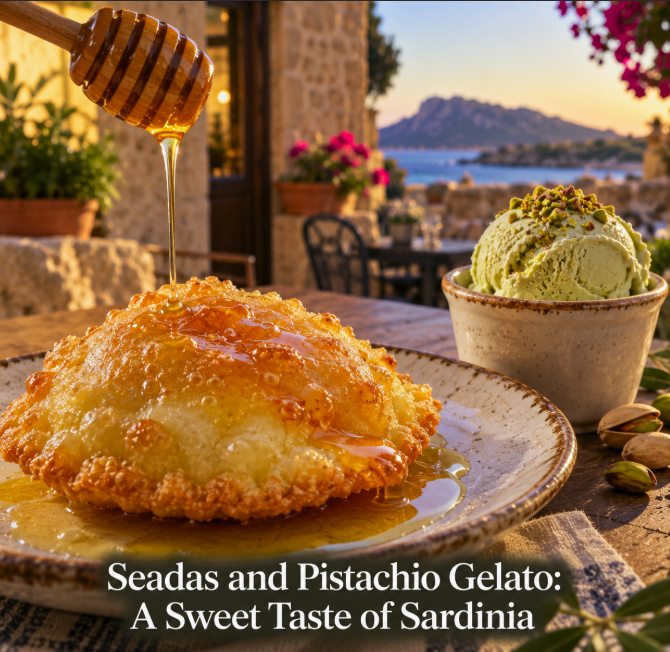
Ask an American traveler to picture an Italian dessert and gelato is likely to come first, with pistachio among the flavors they recognize immediately. In Sardinia, however, there is another sweet worth ordering before leaving the island: the seada, a hot fried pastry filled with cheese and traditionally finished with honey. The contrast of crisp dough, warm savory cheese and aromatic sweetness makes it unlike the typical pastry-counter dessert.
If you are searching for a pastry shop rather than waiting until the end of a restaurant meal, Alghero currently has a particularly direct option: Seadas To Go Alghero by Bon Bons Dolci Sardi on Via Luigi Einaudi, a pastry shop dedicated enough to the specialty to put seadas in its name. Current local business information lists split morning and late-afternoon opening hours on most operating days, so check the day’s schedule before walking over.
What exactly is a seada?
Sardinia’s official tourism portal describes the seada — also called sebada, sevada and by other local variants — as two discs of pastry enclosing a tangy, melting cheese filling flavored with lemon or orange peel. It is fried and served hot, traditionally with honey. Strawberry-tree honey, known for its distinctive bitter edge, is especially associated with the dessert.
The name changes around Sardinia. The regional tourism authority notes that you may hear sevada in Nuoro, seada in Cagliari and variants such as sebada, seatta or sabada elsewhere. The filling and honey can vary too, which means trying the dessert in two different parts of the island does not necessarily produce exactly the same result.
Traditional descriptions connect seadas with Sardinia’s agro-pastoral culture, particularly the Barbagia area. What is now normally ordered as dessert has its roots in a cuisine where cheese, semolina, citrus and honey were everyday ingredients rather than luxury decoration.
Honey or sugar?
Honey is the version most visitors should try first. Official regional descriptions specifically mention honey and give strawberry-tree honey as a preferred traditional choice. Its slightly bitter character is a useful counterpoint to the rich fried pastry and cheese.
Sugar is also used in some preparations and is not an invention for tourists. But if a pastry shop offers a choice between ordinary sugar and local honey, the honey version better demonstrates the sweet-savory contrast that makes the dish memorable.
Ask whether the seada is fried to order. It is at its best when the exterior is crisp and the cheese inside is still hot and elastic. A cold seada sitting in a display case is not the experience the dish is designed to deliver.
Where to look for seadas in Alghero
Seadas To Go Alghero by Bon Bons Dolci Sardi, at Via Luigi Einaudi 21, is currently categorized as a pastry shop and specializes in the dessert. That makes it a useful address for travelers specifically searching for seadas rather than hoping a general café happens to have them.
Seadas are also common on traditional Sardinian restaurant menus in Alghero and elsewhere on the island. In a restaurant, they are usually prepared as the final course and served hot. Availability can change, so if the dessert is the main reason for choosing a restaurant, ask when reserving.
For a wider food itinerary, Orosei is another place where the regional tourism authority explicitly highlights seadas with golden strawberry-tree honey among local flavors. Inland areas around Nuoro and Barbagia are particularly relevant to the dessert’s cultural history.
And what about pistachio gelato?
Pistachio is not uniquely Sardinian in the way seadas are. It belongs to the broader Italian gelato tradition, and visitors will find it across the island. The better question is therefore not whether pistachio is “Sardinia’s best flavor,” but whether a particular gelateria makes a good pistachio.
A well-made pistachio gelato should taste primarily of nuts rather than vanilla or almond essence. Color is not a reliable quality test, but an unnaturally fluorescent green should not be treated as proof of authenticity. Ask whether the shop makes its gelato in-house and, if the information is available, what pistachio paste or nuts it uses.
Current local listings show artisan gelaterias across Sardinia, including Gelateria artigianale 9 3/4 on Via Carlo Alberto in Alghero, Gelatificio di Federico on Corso Vittorio Emanuele II in Cagliari, BM&V Gelateria Artigianale in central Olbia and Timasù Gelateria Artigianale in Baunei. Their current opening hours extend into the evening, although flavors rotate and pistachio availability should be checked on the day.
Two desserts, two different Sardinian experiences
Gelato is ideal while walking through an old town or along a waterfront. Seadas deserve a few minutes at a table while they are still hot. Trying both is more interesting than treating them as competitors.
In Alghero, for example, you can have a seada after lunch or visit the dedicated pastry shop, then save gelato for an evening walk through the historic center. In Cagliari, Olbia or a smaller mountain town, the same rule applies: use gelato as the flexible everyday sweet and look for seadas where they are cooked fresh.
If you have only one chance to taste a dessert that tells you something specifically about Sardinia, order the seada. Its combination of cheese, citrus-scented pastry and honey belongs to the island’s pastoral food culture in a way that pistachio gelato does not. Then have the pistachio gelato anyway — there is no reason a food trip needs only one dessert.