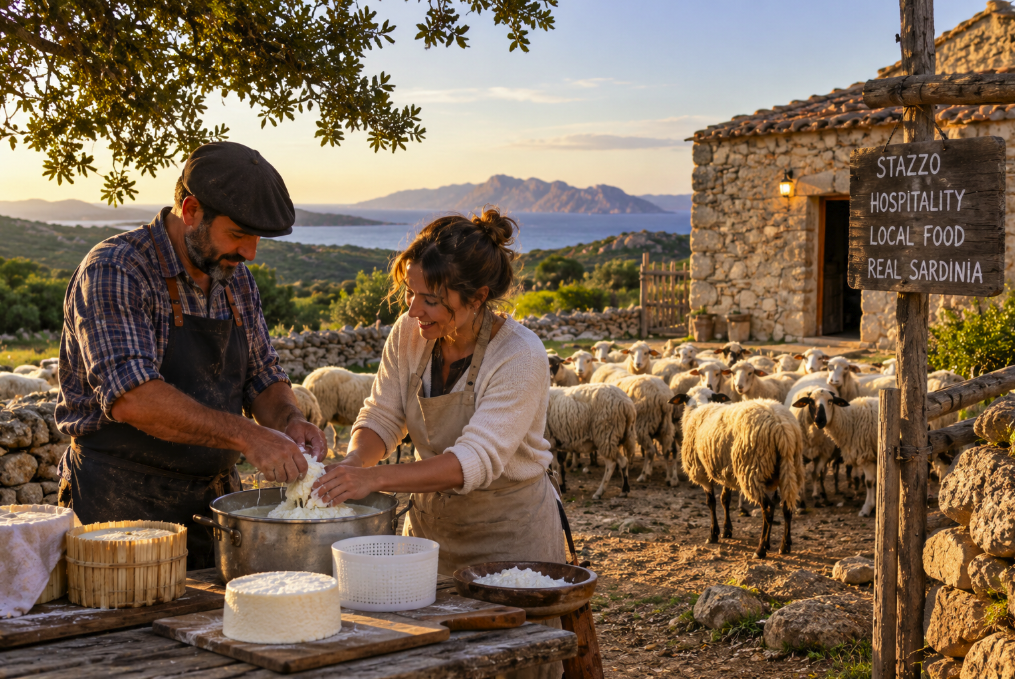
For travellers who want to go beyond Sardinia’s beaches, rural experiences are offering a very different way to understand the island: spending time with shepherds, learning how sheep’s milk becomes cheese, eating farm products and, in Gallura, staying in the traditional country houses known as stazzi. These activities are increasingly packaged as bookable experiences, but the most interesting ones remain closely tied to working farms, seasonality and the people who still practise Sardinia’s pastoral traditions.
Making pecorino with a Sardinian shepherd
Cheese-making is one of the clearest ways for visitors to get close to Sardinia’s pastoral culture because it turns a familiar product into a process that can be seen and understood. In Olbia, Mannos currently offers a small-group “shepherd for a day” experience in which participants visit the farm and take an active role in making Sardinian pecorino. The producer explains how fresh sheep’s milk is curdled and shaped, followed by a tasting of local products.
The experience is seasonal rather than a generic year-round attraction. Mannos indicates availability approximately from December to August, with hand milking possible only during part of winter, roughly December to February. The activity lasts around two and a half hours and is designed for groups of four to ten people. This seasonal detail matters: genuine agricultural experiences have to follow the animals and the production calendar, not simply the visitor calendar.
Another version can be found in Samugheo, in central Sardinia. Here Mannos promotes a shepherd’s breakfast hosted by Gerolamo, whose family pastoral tradition stretches back more than a century. The setting is a pinnatzu, a traditional shepherd’s shelter, and the experience revolves around su cagiau, a fresh fermented sheep’s-milk cheese also known in parts of Sardinia as casu axedu or fruhe. Visitors taste the cheese and then see how it is prepared.
In Bitti, a longer shepherd experience offered through Sardinia To Experience combines farm activities with a traditional lunch. The programme is based at Agriturismo Calavrina and includes hands-on pastoral activities and local food, turning the visit into a half- or full-day immersion rather than a short tasting.
Ogliastra offers yet another format. Ogliastra Experiences describes a trekking day with a shepherd that can include caring for the flock, milking, making cheese and casu axedu, a countryside walk and seasonal food. The important distinction is that these experiences are not all interchangeable: location, farm routines, season and the host determine what visitors can actually do.
Sleeping in a stazzo: Gallura beyond the resorts
The word stazzo belongs particularly to Gallura in northern Sardinia. Traditionally, a stazzo was a rural dwelling and farmstead connected with an agricultural and pastoral way of life. Today, some historic buildings have been restored as small-scale accommodation, allowing travellers to stay in the countryside without pretending that every restored house is still a working shepherd’s home.
Stazzu Pittorra, in the countryside of Santa Teresa Gallura near San Pasquale and Porto Liscia, is one example. Its owners describe it as a historic stazzo restored conservatively, surrounded by Mediterranean vegetation, with a vineyard, olive grove, donkeys, chickens and bees. The property accommodates a small number of guests and looks towards the La Maddalena archipelago.
Near Aggius, Agriturismo Stazzu Coiga occupies an old Gallurese stazzo dating to 1860 and recognised as a historic-cultural building. The property was restored while retaining characteristics of the original rural house. La Cerra, also in Alta Gallura, offers rooms gathered in a stazzo as part of a family-run farm with agriturismo, agricamping and countryside cooking.
These stays can be appealing precisely because they are quieter and less standardized than a conventional resort. But travellers should check what is actually offered before booking. A property called a stazzo may provide accommodation without shepherd activities, while a cheese-making experience may take place on a farm that does not offer overnight stays.
How to choose an authentic rural experience
The word “authentic” is used very freely in tourism, so a few practical checks are worthwhile. Look for experiences led directly by producers or working farmers, clear information about the location and duration, realistic seasonal availability and an explanation of what participants will actually do. If milking or cheese-making is advertised every day of the year regardless of the agricultural cycle, it is reasonable to ask how the activity is organized.
Visitors should also remember that a farm is a workplace. Closed shoes and practical clothing are often more appropriate than beachwear, and anyone with food allergies or dietary requirements should contact the host in advance. Activities involving animals can change according to weather, season and the needs of the flock.
For travellers staying around Olbia and the Costa Smeralda, Gallura is particularly convenient for combining a rural stay with the coast. Samugheo and Bitti lead deeper into central Sardinia, while Ogliastra combines pastoral culture with a more mountainous landscape. Around Alghero, agriturismi such as Sa Mandra also offer rural accommodation and food-focused activities, including a Sardinian pecorino tour and tasting.
The attraction is not simply the chance to photograph sheep or taste cheese. At its best, a shepherd experience explains why pecorino, seasonal rhythms, grazing land and rural architecture remain part of Sardinia’s living culture. Spending a morning making cheese or a night in a restored stazzo can reveal an island that is easy to miss when a holiday is planned entirely around the shoreline.