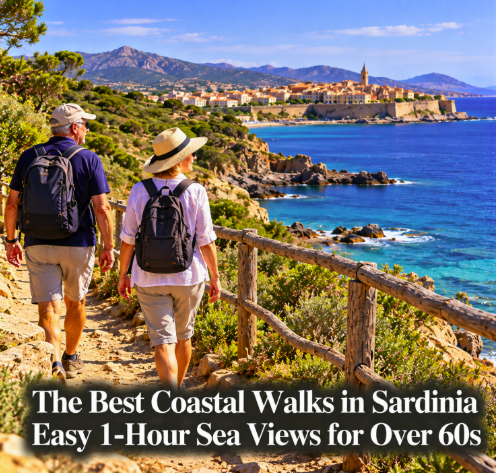
You do not need a demanding trek to enjoy Sardinia on foot. Some of the island’s most rewarding sea views are available on promenades, waterfront paths and short coastal trails that can be enjoyed for roughly an hour without committing to steep mountain terrain. For travelers over 60—or simply anyone who prefers a relaxed walk—the important questions are surface, gradient, shade, wind and how easily the route can be shortened, not age itself.
Alghero’s waterfront and bastions are among the simplest choices because the walk combines open sea views with cafés and an easy return into town. Cagliari’s Poetto promenade is flatter still. Travelers who want a more natural setting can look toward Porto Conte, Bosa Marina or the coastal paths of La Maddalena, while keeping in mind that even a short nature trail can be rougher than an urban promenade.
Alghero waterfront and the old-town bastions
For a first coastal walk in Sardinia, Alghero is hard to beat. The seafront allows walkers to combine views across the bay with the historic walls of the old town, and there is no need to follow a fixed hiking itinerary.
A relaxed option is to begin around the harbor, continue along the bastions and turn back whenever you have reached your preferred time or distance. The old-town section provides frequent places to stop, while the waterfront keeps the sea in view for much of the walk.
This is a particularly practical choice for travelers who are unsure how far they want to walk. You are never committed to a remote trail, and cafés, restaurants and taxis are much easier to reach than on a rural coastal route.
The main limitation is that historic paving can be uneven in places. Comfortable shoes are more useful than beach sandals, especially for anyone concerned about balance.
Poetto in Cagliari: the easiest flat option
Poetto is Cagliari’s long urban beach and one of the most straightforward places in Sardinia for a flat seaside walk. The promenade extends for several kilometres, so a one-hour outing can be as short or long as you like.
There is no reason to walk the entire beach. Choose a section, walk for 25 to 30 minutes and return along the same route. Marina Piccola at the western end provides views toward the Sella del Diavolo headland, while the long sweep of Poetto opens eastward along the Gulf of Cagliari.
Because this is an urban beachfront rather than a hiking trail, access to bars, transport and services is generally easier. That makes it a sensible option for travelers who want sea air and movement without rough terrain.
Summer sun is the main concern. In July and August, early morning or late afternoon is more comfortable than midday, particularly for anyone who is sensitive to heat.
Maria Pia and the Alghero beach corridor
Travelers staying in Alghero can also create an easy hour-long walk along the beach corridor toward Maria Pia. The landscape gradually shifts from urban waterfront to sandy beach and pine-backed sections.
This works well when the objective is simply to walk beside the sea rather than visit monuments. The route can be shortened at any point, and sections near town remain close to services.
Walking directly on soft sand is considerably more tiring than walking on a firm promenade. Anyone with knee, hip or balance concerns should favor paved or compact surfaces rather than spending the full hour on loose sand.
Porto Conte: nature without committing to a major hike
Porto Conte Regional Natural Park near Alghero offers a much wilder coastal setting, with limestone cliffs, Mediterranean vegetation and views toward Capo Caccia. The park has a network of walking routes, but not every trail should be described as easy.
For a relaxed outing, choose a short signed section close to an established access point rather than attempting one of the longer routes toward Punta Giglio or Monte Timidone. Ask park staff or the local visitor information point which route currently offers the best combination of sea views and gentle terrain.
This is where footwear becomes more important. Even a relatively level Mediterranean nature path can include stones, exposed roots and irregular ground.
Wind should also influence the decision. Porto Conte and Capo Caccia can be exposed during strong mistral conditions, making an otherwise simple walk much less comfortable.
Bosa Marina and the Temo riverfront
Bosa provides a useful alternative for travelers who want water views without a classic hiking trail. The old town lies along the Temo River, while Bosa Marina brings the walk out toward the coast.
A short waterfront stroll can be combined with time in the town itself, which makes Bosa especially suitable on a day when the weather is pleasant but not warm enough for the beach.
Rather than chasing a precise one-hour loop, use the riverfront or marina as an out-and-back walk. This gives you complete control over distance and avoids the pressure of finishing a longer trail once you are tired.
La Maddalena: short coastal walks with island scenery
La Maddalena island offers beautiful coastal scenery and numerous roads and paths near the sea. The challenge is choosing carefully: some natural routes are rocky and more demanding than photographs suggest.
For an easy hour, favor waterfront sections around the town and established coastal access points rather than setting off toward remote coves without checking the terrain. A short scenic drive followed by a 20- or 30-minute walk each way can be more enjoyable than attempting a long circuit.
The La Maddalena Archipelago is a protected national park, so walkers should remain on appropriate paths, respect signs and avoid entering sensitive dune or vegetation areas.
Is one hour really “easy”?
Duration alone does not determine difficulty. An hour on a flat promenade can be gentler than 30 minutes on steep, loose rock.
Before choosing a route, look at elevation change, surface and exposure. If a description includes scrambling, steep descents, narrow cliff paths or substantial elevation gain, it is not the same kind of outing as the walks described here.
Travelers with reduced mobility, balance difficulties or joint problems should also distinguish between “easy hiking” and an accessible route. A trail may be rated easy for hikers while still containing steps, gravel or uneven rock that makes it unsuitable for wheelchairs or walking aids.
Walking in Sardinian heat
For older travelers, heat can turn a gentle coastal stroll into a demanding activity. In summer, start early or wait until late afternoon. Carry water even on a one-hour walk, particularly on natural routes where there may be no services.
A hat, sunglasses and sunscreen remain useful outside midsummer because coastal exposure can be strong. Spring and autumn are often more comfortable for walking, although wind and rain become more variable.
If the forecast includes extreme heat, a shaded town walk may be a better decision than an exposed coastal trail.
Footwear matters more than hiking credentials
You do not need heavy mountain boots for an urban promenade, but supportive walking shoes can make a substantial difference. For nature paths, use shoes with enough grip for loose stones and dry Mediterranean soil.
Trekking poles can help some walkers on uneven terrain, although they are unnecessary for flat routes such as Poetto. The important thing is to choose equipment for the surface rather than for the prestige of carrying hiking gear.
Five practical choices
For maximum simplicity, choose Poetto in Cagliari. For a combination of sea and history, walk Alghero’s waterfront and bastions. For beach scenery close to a town, try the Alghero–Maria Pia corridor. For a natural setting, choose a short appropriate section within Porto Conte after checking current trail conditions. For a slower town-and-water experience, use Bosa’s riverfront and marina.
La Maddalena is an excellent addition for travelers already visiting the archipelago, but it does not make sense to organize an entire ferry journey simply for a one-hour walk unless the island is already part of the itinerary.
Turn around before you need to
The easiest way to make a coastal walk enjoyable is not to treat it as a challenge. If you want to be out for one hour, turn around after roughly 25 minutes rather than waiting until you feel tired. That leaves time for photographs, a bench stop or an unexpected section of uneven ground.
This approach is particularly useful in Sardinia because coastal scenery encourages people to keep walking “just a little farther.” The view around the next bend may be beautiful, but the return distance does not disappear.
For travelers over 60, there is no single best walk based on age. A fit 70-year-old may comfortably cover terrain that challenges a younger visitor, while someone recovering from an injury may need a flat promenade. Choose according to mobility and conditions, not the number on a passport.
Sardinia rewards that flexibility. An hour beside the sea can mean historic walls in Alghero, flamingo-country horizons near Cagliari, wild limestone around Porto Conte or a quiet waterfront in Bosa—and none of them require turning the day into an expedition.