In the heart of western Sardinia, Oristano tells a story of migration, medieval independence, powerful rulers and traditions that still fill its streets with colour. Although the surrounding territory preserves traces of civilizations stretching back thousands of years, the present city rose to prominence in the Middle Ages as the capital of the Giudicato of Arborea, one of Sardinia's independent judicial kingdoms.
Ancient roots: before Oristano
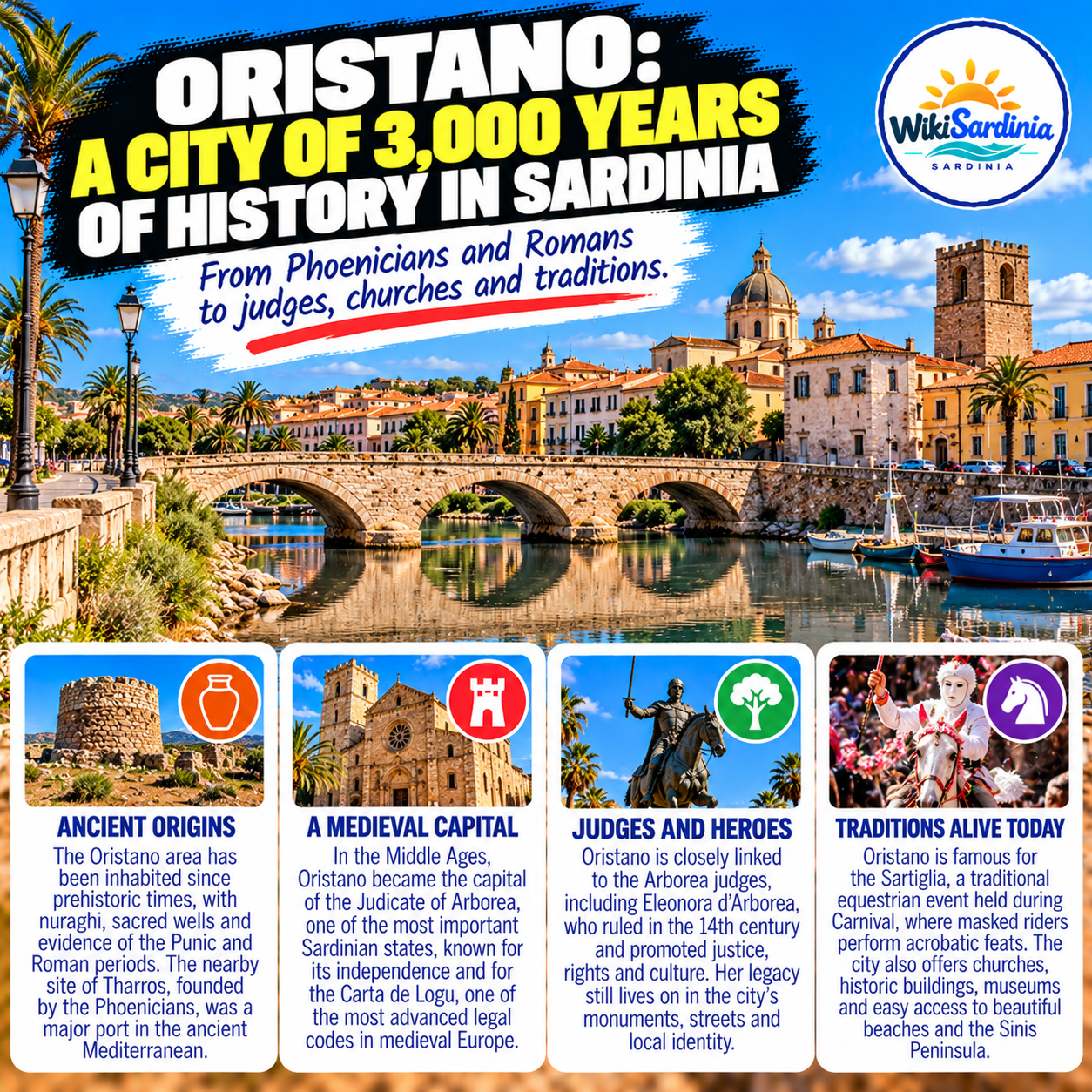
The Oristano plain was inhabited long before the medieval town existed. Prehistoric communities left nuraghi and other archaeological remains across the surrounding landscape. On the nearby Sinis Peninsula, Phoenician settlers established Tharros, which later flourished under Carthaginian and Roman rule. Its ruins, overlooking the sea near San Giovanni di Sinis, preserve streets, columns, baths and traces of its maritime importance.
It is important not to confuse the history of the territory with the founding of Oristano itself: the modern city is not simply a 3,000-year-old Phoenician town. Its decisive urban development belongs to a later period.
1070: the rise of Aristianis
According to the traditional historical chronology, around 1070 the seat of the Giudicato of Arborea moved from the coastal area of Tharros to Aristianis, the medieval name of Oristano. The move is commonly associated with Judge Orzocco I de Lacon-Zori and the growing vulnerability of coastal settlements to attacks from the sea. The inland location offered a more defensible and practical administrative centre. Over time, the town developed fortifications, churches, workshops and markets.
The capital of an independent Sardinian kingdom
During the Middle Ages, Sardinia was divided into four giudicati: Arborea, Cagliari, Torres and Gallura. These were political states with their own rulers, institutions and legal traditions. Oristano became the political heart of Arborea, which eventually emerged as the last major Sardinian giudicato resisting the expansion of the Crown of Aragon.
The city's medieval importance is visible in surviving landmarks, especially the Tower of Mariano II, also called the Tower of San Cristoforo, built in 1290 as part of the city's defensive system.
Mariano IV and the struggle for Sardinia
In the fourteenth century, Judge Mariano IV of Arborea pursued an ambitious policy of territorial expansion and resistance to Aragonese control. Under his rule, Arborea became a formidable power, extending its influence across much of the island. Oristano was not merely a provincial town: it was the capital of a state actively shaping Sardinia's political future.
Eleonora d'Arborea and the Carta de Logu
One of Oristano's most celebrated historical figures is Eleonora d'Arborea, who governed as judge-regent during the late fourteenth century. She is closely associated with the Carta de Logu, the influential legal code of Arborea. The code regulated civil and criminal matters, agriculture, property and social relations. It built upon earlier legal work and remained influential under subsequent rulers for centuries. Eleonora's reputation as a political leader and lawgiver makes her one of Sardinia's most enduring historical symbols.
The statue of Eleonora in Piazza Eleonora d'Arborea is a natural starting point for visitors interested in this history. As with many historic monuments, the statue reflects later interpretations of her image rather than a contemporary portrait.
1410–1478: the end of Arborea's independence
After the defeat of Arborean forces at Sanluri in 1409, the giudicato's political position deteriorated. In 1410, William III of Narbonne relinquished his claims and Oristano came under Aragonese authority, becoming the centre of a marquisate. Later resistance continued, but the defeat of Leonardo Alagon at Macomer in 1478 marked the end of the final major attempt to restore Arborean autonomy.
Spanish, Savoyard and modern Oristano
Under Aragonese and later Spanish rule, Oristano continued as an agricultural and commercial centre serving the surrounding countryside. After the island passed to the House of Savoy in 1720, administrative and economic life changed gradually. In the nineteenth and twentieth centuries, modern transport and public institutions helped reshape the city. Oristano became the capital of its own province in 1974, strengthening its administrative role in western Sardinia.
The Sartiglia: a medieval tradition still alive
Oristano's most spectacular living tradition is the Sartiglia, the equestrian event held during Carnival. Masked riders gallop along a course and attempt to pierce a suspended star with a sword. The event also features daring horseback acrobatics and elaborate ceremonial customs. Its history developed over centuries, and its exact origins are debated; it should not be treated as an unchanged ritual dating to a single medieval year. Today it is one of Sardinia's most recognizable celebrations.
What to see in historic Oristano
Begin in Piazza Eleonora d'Arborea and walk toward the Tower of Mariano II. Visit the Cathedral of Santa Maria Assunta, whose current appearance reflects multiple building phases, and explore the narrow streets of the historic centre. The Antiquarium Arborense museum introduces visitors to the archaeology and history of the city and its territory.
Outside the city, the Sinis Peninsula offers a remarkable combination of ancient Tharros, coastal landscapes and beaches. The nearby town of Cabras is also home to the archaeological museum displaying important finds from the area, including the celebrated Giants of Mont'e Prama.
Why Oristano matters
Oristano is not simply a convenient stop on the way to Sardinia's beaches. It was the capital of a medieval Sardinian state, the city associated with Eleonora d'Arborea and the Carta de Logu, and the home of a living equestrian tradition. To understand Sardinia beyond its coastline, Oristano is one of the best places to begin.