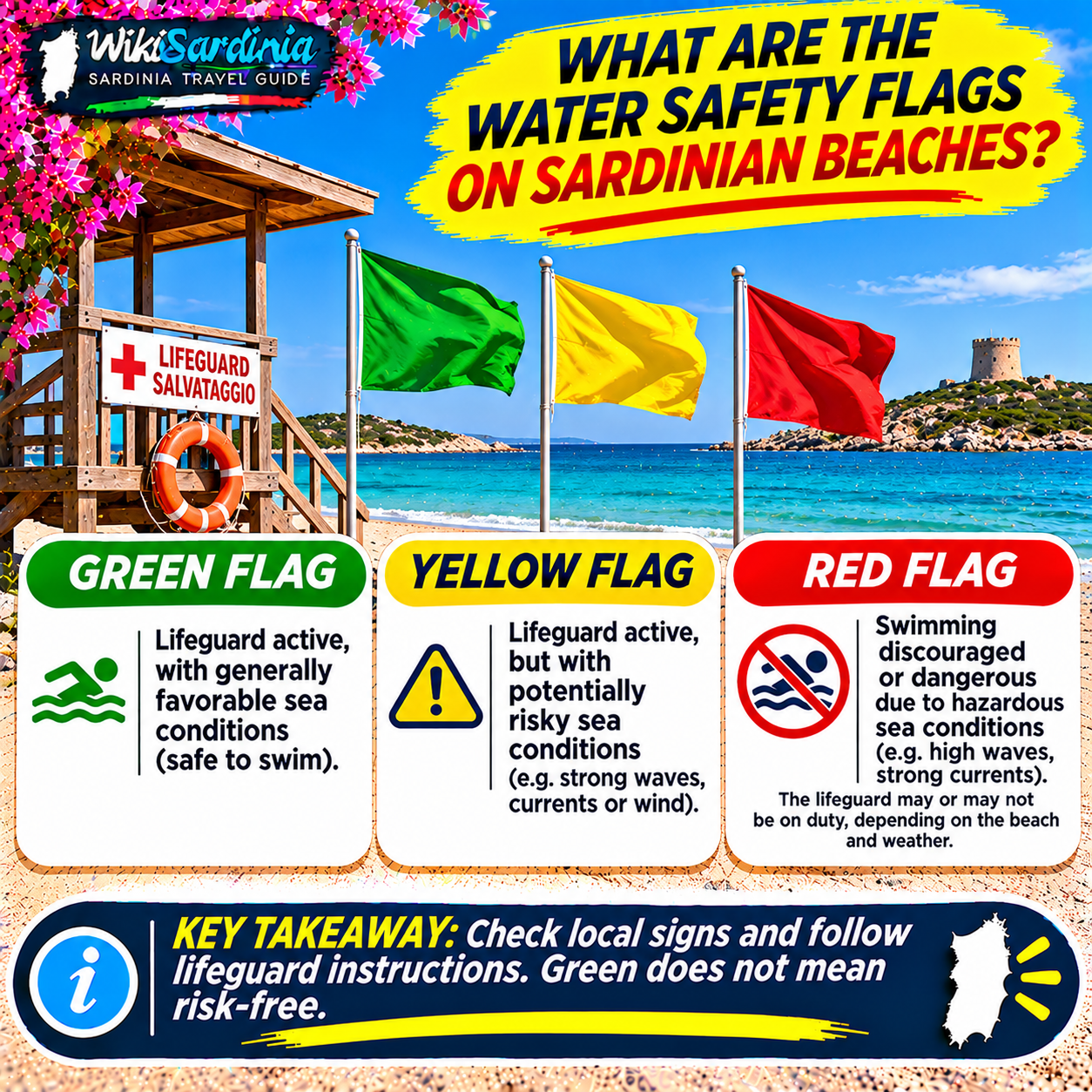
On an organized beach in Sardinia, you may see a green, yellow or red flag flying near the lifeguard station. Green means lifeguard service is active and conditions are favorable; yellow means lifeguards are active but sea conditions may be risky; red means swimming is discouraged or dangerous, whether or not lifeguards are on duty. These meanings reflect the more standardized Italian beach-safety approach introduced in 2025. Always check the actual local notice board and current maritime ordinance: the flags are safety warnings, not a replacement for legal restrictions or your own judgment.
What does a green beach flag mean?
A green flag (bandiera verde) indicates an active rescue service and generally favorable weather and sea conditions. It does not mean the sea is guaranteed safe for every swimmer. Keep children within close supervision, stay within the designated bathing area and watch for changes in waves, wind and currents. Even experienced swimmers should avoid overestimating their ability.
What does a yellow beach flag mean?
A yellow flag (bandiera gialla) signals that lifeguard assistance is active but weather or sea conditions could present risks. These might include wind, waves or currents. Consider staying out of the water if you are not a confident swimmer, and ask the lifeguard what the warning means at that beach. Do not interpret yellow as permission to swim far from shore. Older local regulations sometimes used yellow to signal strong wind and the need to close beach umbrellas, so check the posted explanation.
What does a red beach flag mean?
A red flag (bandiera rossa) signals that bathing is discouraged, unsafe or dangerous. It may also appear where a rescue service is unavailable, depending on the applicable local rules and notices. The Sardinian regional tourism authority explicitly advises visitors not to enter the water when a red flag is displayed. The flag itself is a safety signal; a separate legal prohibition on swimming may also be imposed by an authority. Do not assume every red flag has the identical legal effect in every location, but treat it as a strong reason to stay out of the sea.
Does a red flag mean the lifeguard has gone home?
Not necessarily. Under the standardized system, red can be displayed even when lifeguards remain on duty because the sea is dangerous. In other situations, a red flag and signage may warn that no rescue service is available. Read the nearby notice board or ask the staff. Never enter dangerous water just because you can see a lifeguard tower.
Can I swim if there are no flags?
No flag does not mean safe water. Some beaches are not supervised, especially outside the main summer season. The official SardegnaTurismo safety guidance warns that not every beach has a rescue service and advises assessing the sea carefully when no flag is displayed. Look for warnings about currents, rocks, sudden depth changes and access restrictions. If conditions are unclear, choose a supervised beach instead.
Are the flag colors the same on every Sardinian beach?
Italian maritime authorities moved toward standardized green, yellow and red signaling in 2025. However, the detailed legal rules are set through applicable maritime safety ordinances and local notices. Earlier Sardinian provisions also used white for an active lifeguard station and yellow for strong wind or umbrella precautions. Read the sign at the actual beach rather than assuming that a flag seen in another country has exactly the same meaning. The relevant official background is the Italian Coast Guard's 2025 beach-safety directive.
What should families with children do?
Choose a supervised beach when possible and ask where the designated swimming area begins and ends. Keep young children within arm's reach near the water, even under a green flag. Do not rely on inflatable toys as life-saving equipment. When the flag turns yellow, reassess whether conditions suit the child's ability. When it turns red, keep children out of the water and explain why.
What are rip currents and how can I recognize danger?
Rip currents are narrow, fast-moving flows that can carry swimmers away from shore, sometimes when the beach appears relatively calm. Breaking waves, shifting sandbars and channels can create hazardous conditions. If caught in a strong current, try to remain calm, float to conserve energy, signal for help and avoid exhausting yourself by fighting directly against the flow. If able, move parallel to shore to escape the current before returning toward land. Follow lifeguard instructions, and do not attempt a dangerous untrained rescue of another swimmer.
Does the Maestrale affect swimming safety?
Yes. The Maestrale, a northwesterly wind, can generate rough seas on exposed coasts, although its effect varies greatly with the beach's orientation and local geography. A sheltered-looking bay is not automatically safe. Check local weather and marine forecasts, observe the water and listen to lifeguards. Conditions can change during the day.
What if the flag changes while I am swimming?
Pay attention to whistles, announcements and directions from the lifeguard. Return to shore promptly if instructed, especially if a red flag is raised. Never argue with a rescue worker or enter a closed area to retrieve equipment. If someone is in difficulty, alert the lifeguard immediately instead of putting yourself at risk.
What if there is a swimming ban for pollution?
A municipal or health-authority bathing prohibition may be imposed for water-quality or other safety reasons, independently of the flag color. Look for official divieto di balneazione signs and notices and obey them. A green flag elsewhere on the beach does not override a legal ban covering a specific stretch of water.
Who should I call in a sea emergency?
Alert the lifeguard immediately if one is present. For a serious emergency in Italy, call 112 and give the beach name, municipality, nearest access point and what has happened. The Italian Coast Guard also operates the maritime emergency number 1530. Do not enter dangerous water to attempt a rescue unless you are trained and can do so safely.
Useful Italian phrases
“Cosa significa questa bandiera?” means “What does this flag mean?” “È sicuro fare il bagno?” means “Is it safe to swim?” “C'è il bagnino?” means “Is there a lifeguard?” “Ci sono correnti forti?” means “Are there strong currents?” “È vietata la balneazione?” means “Is swimming prohibited?”
Practical beach safety checklist
- Read the flag explanation and any local notices at the beach entrance.
- Prefer supervised beaches when traveling with children or inexperienced swimmers.
- Ask the lifeguard about current conditions before entering the water.
- Treat yellow as a caution signal and red as a reason to stay out.
- Never assume a missing flag means the water is safe.
- Obey official bathing bans and stay clear of boat channels.
- In an emergency, alert the lifeguard and call 112.
The WikiSardinia takeaway
Green: lifeguard active, favorable conditions. Yellow: lifeguard active, potentially risky conditions. Red: swimming discouraged or dangerous, with or without a lifeguard. These signals help you decide what to do, but conditions, local regulations and individual swimming ability still matter. The official SardegnaTurismo beach safety guide offers additional advice for visitors.